AI will replace most white-collar jobs within a decade

Updated 2026-07-30 5 supporting · 6 opposing arguments
Aldo's Synthesis high
Based on the strength of the Arguments below
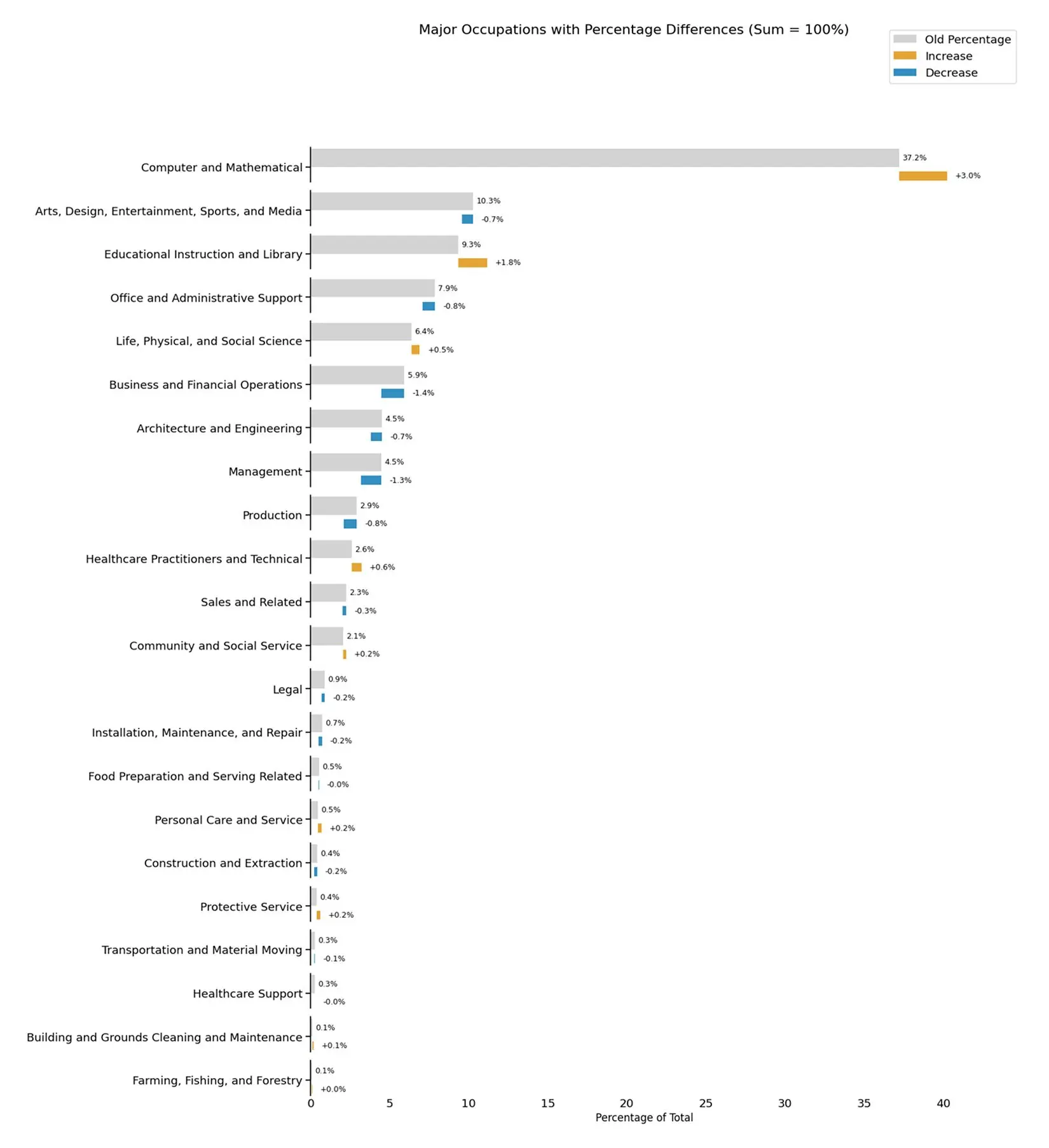
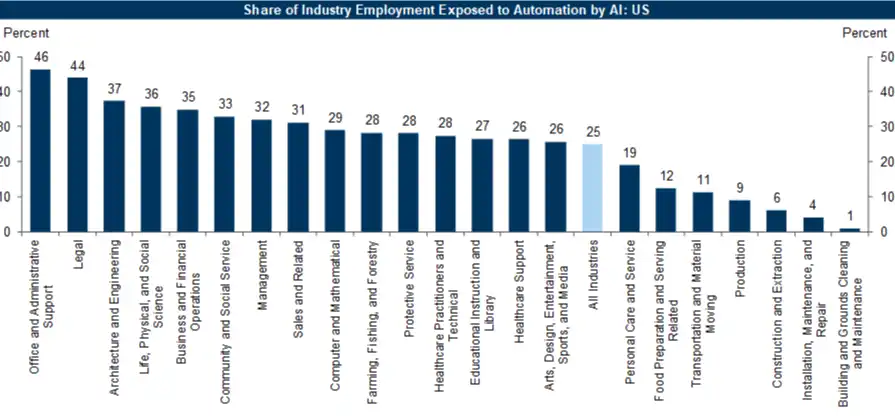
The claim asks whether AI will, by approximately 2036, eliminate or fully substitute for more than half of white-collar jobs—not merely alter many tasks, increase productivity, or reduce employment in selected occupations. The distinction matters because evidence of technical exposure or labor-saving assistance is not itself evidence of whole-job replacement, while early displacement in narrow markets may still reveal a pathway toward broader change. Assessment therefore requires separate consideration of technical capability, economic incentives, organizational adoption, demand responses, and the breadth and duration of observed employment effects. The strongest support for the claim is that generative AI already reaches a broad range of cognitive tasks and is particularly applicable to clerical, information, communication, and other digitized knowledge work (see Figure 3). Task-based studies consistently place clerical work at especially high exposure, identify increasing exposure in digitized professional work, and estimate that large shares of workers have at least some tasks that language models could affect (see Figure 2). This evidence establishes a technical domain large enough for substantial disruption, although the underlying studies generally classify tasks or applicability rather than autonomous performance of entire occupations. A second affirmative pathway is that experimentally observed productivity gains could reduce staffing requirements when organizations hold output roughly fixed. A customer-support rollout increased average productivity by about 14%, three software-development field experiments found approximately 26% more completed tasks, and consultants using GPT-4 worked faster and performed better on tasks within the system's capabilities. Those studies kept workers in the production process, but they demonstrate labor-saving magnitudes that could translate into fewer positions if demand and new responsibilities do not absorb the saved time. Actual displacement is already observable in unusually digitized markets, strengthening the inference that exposure can sometimes become employment loss. Online labor-platform studies report reduced demand, employment, or earnings in highly exposed categories, including writing and translation, after generative-AI tools became available. Together with high clerical exposure and employer plans to reduce some workforces where AI automates tasks, these findings support substantial losses in selected white-collar segments, though not yet losses across a majority of white-collar jobs. Rapid diffusion makes a ten-year adjustment period more plausible than current deployment levels alone might imply. A nationally representative U.S. survey found unusually fast generative-AI adoption by late 2024, while product-use data show that real activity is already concentrated in subsets of occupational tasks (see Figure 1). Adoption is still intermittent and narrower than comprehensive automation, but fast diffusion leaves time for repeated capability improvements and organizational learning before 2036. The central objection is that the evidence most often cited for large-scale disruption measures exposed tasks or useful assistance, not the elimination of complete jobs. The ILO, Microsoft, and task-rating research explicitly distinguish applicability or time savings from automation, noting that occupations bundle affected activities with duties that remain outside the measurements. The ILO accordingly identifies job transformation as the likelier aggregate outcome, and Microsoft cautions that usage logs omit interpersonal and physical duties, quality control, cost, regulation, organizational redesign, and employer choices. The strongest causal workplace studies currently demonstrate augmentation and labor-saving potential rather than autonomous end-to-end substitution. Across customer support, consulting, and software development, AI improved worker output while people remained responsible for using, checking, and integrating its contributions. The online-platform evidence prevents treating augmentation as universal, but it does not show that the experimental occupations—or most white-collar occupations—can function without workers. Observed labor-market effects and one prominent macroeconomic model are also far below the scale required for majority replacement. An OECD review found no clear aggregate employment decline attributable to AI, and matched Danish records covering 25,000 workers in 11 exposed occupations detected no effect on earnings or recorded hours during the measured period despite adoption and time savings. Acemoglu's model likewise estimates that only a relatively small portion of tasks will be cost-effective to automate over a decade and projects modest central productivity effects. These findings have short-horizon, external-validity, and model-assumption limitations, but supporting the claim would require subsequent effects to accelerate dramatically beyond them. Economy-wide substitution must also cross an organizational implementation gap that frontier demonstrations do not measure. U.S. government survey data show rising but still limited and uneven business use, while the Danish study found small measured labor-market effects even where chatbots had diffused. Employer respondents anticipate both workforce reductions and extensive upskilling, indicating adaptation rather than a uniform move to workerless processes. Finally, labor saved at the task level need not produce an equal reduction in jobs because lower costs can expand output and complementary work. Economic research on automation identifies substitution, complementarity, demand expansion, and creation of new tasks as simultaneous mechanisms. Consistent with those mechanisms, freelance data show rising demand for some AI-complementary services, and employer projections across structural trends through 2030 anticipate more jobs created than displaced overall. The evidence supports an uneven outcome: substantial contraction is plausible in selected occupations even if most white-collar jobs survive in redesigned form. Clerical work, routine content production, translation, and other screen-based services face stronger exposure or observed displacement than professional and managerial occupations considered as complete bundles of duties. Thus, a forecast of sharp losses in particular categories is materially better supported than the broader threshold of eliminating more than half of all white-collar jobs. Replacement prospects also depend on whether capability improves across an occupation's weakest links, not merely on average performance gains. In the consultant experiment, AI improved performance on suitable tasks but made users less likely to reach the correct answer on a task beyond the model's frontier. Software experiments establish meaningful gains but not elimination, and uneven business adoption further separates isolated technical success from reliable occupation-wide substitution. Even when AI raises productivity, the employment result remains conditional on firms' and markets' responses. The bundle contains evidence of productivity improvements, short-term displacement in an exposed online market, and employer expectations of both job creation and destruction across broader structural trends. It therefore cannot determine whether saved labor will predominantly reduce headcount, expand output, or shift workers toward complementary tasks over the decade. The forecast is highly sensitive to both definitions and future assumptions. The available literature combines task-exposure models, early adoption data, short-run experiments, historical mechanisms, and employer expectations rather than decade-long causal evidence. Different conclusions can follow depending on capability progress, cost, autonomy, regulation, adoption, demand, and whether “replace” means loss of tasks, reduced headcount, or disappearance of an occupation. The decisive gap is the absence of evidence that directly tracks economy-wide, whole-job substitution over anything close to the claim's ten-year horizon. Exposure estimates do not resolve whether all essential duties can be automated, experiments do not resolve equilibrium employment responses, and early market studies do not establish generalizability across professional, managerial, administrative, and clerical work. The evidence also does not settle how reliability, costs, regulation, organizational redesign, and demand will evolve jointly through 2036. A further audit concern is unresolved conflict-of-interest classification for some vendor, employer, and industry-linked sources. That concern does not erase convergent findings from peer-reviewed, governmental, and institutional sources, but it warrants restraint where product-use data or employer expectations carry substantial inferential weight. On the current evidence, the claim that AI will replace most white-collar jobs by approximately 2036 is not supported: broad task exposure, meaningful productivity gains, and selective displacement make major disruption plausible, but whole-job elimination at the asserted scale remains substantially less evidenced than augmentation, job redesign, and concentrated occupational losses. Confidence in this evidence-balance judgment is high, while confidence in any precise 2036 employment forecast is necessarily lower. The dominant uncertainty is whether rapid improvements in reliable autonomy and cost-effective deployment can overcome organizational constraints quickly enough to convert task-level productivity into economy-wide headcount substitution; unresolved conflict-of-interest classifications are a secondary evidentiary concern.

Supporting Arguments

P1A majority of advanced-economy work is already exposed
The IMF estimates that about 60% of jobs in advanced economies are exposed to AI, while task studies find especially high applicability in professional, information, and clerical work. Because white-collar employment is concentrated in these economies and activities, the technical scope needed for large disruption plausibly exists, although exposure is not synonymous with replacement.
66/100 · Data Analysis
P2Large productivity gains could sharply reduce staffing needs
Controlled and field studies report substantial output gains in customer support, consulting, and software development. If organizations can produce the same output with fewer labor hours and demand does not grow proportionately, these gains create a direct economic pathway from AI assistance to smaller white-collar workforces.
80/100 · Logical Inference
P3Displacement is already visible in highly digitized markets
Freelance-market studies find falling employment, earnings, or demand in exposed services such as writing and translation after generative AI became widely available. These markets are unusually easy to automate and may foreshadow effects elsewhere, though their workers and contracting structures are not representative of all white-collar employment.
84/100 · Direct Evidence
P4Clerical occupations face particularly high automation risk
ILO analyses consistently identify clerical work as the occupational group most exposed to generative AI, and employer surveys forecast declines in administrative roles. Since clerical employment contains standardized, screen-based information tasks, this segment could experience substantial job losses even if professional and managerial roles are mainly augmented.
74/100 · Data Analysis
P5Rapid diffusion compresses the adjustment timeline
Generative AI reached widespread personal and workplace use much faster than earlier digital technologies, and employers report plans to automate tasks and reduce some workforces. Fast adoption makes material disruption within ten years plausible even though current use remains intermittent and uneven.
82/100 · Data Analysis

Opposing Arguments

C1Exposure studies do not predict whole-job elimination
Most headline estimates count tasks whose time or content AI could affect, not occupations that can operate without people. Both the ILO and Microsoft analyses emphasize that jobs combine automatable activities with interpersonal, judgment, verification, accountability, and other tasks, so broad exposure cannot substantiate replacement of most white-collar jobs.
80/100 · Direct Evidence
C2The strongest workplace studies show augmentation, not replacement
Randomized and quasi-experimental studies find that AI raises worker output, often most for less-experienced employees, while people remain in the workflow. These results demonstrate economically significant assistance but supply no direct evidence that most occupations can be performed autonomously end to end.
85/100 · Direct Evidence
C3Observed aggregate employment effects remain small
The OECD found no clear sign that AI had reduced aggregate labor demand, and a detailed Danish study detected no meaningful effects on earnings or recorded hours in exposed occupations during its observation window. Short follow-up means future displacement remains possible, but current evidence is far from the scale required by the claim.
78/100 · Direct Evidence
C4Cost-effective automation may cover too few tasks within ten years
Acemoglu's macroeconomic analysis estimates that a limited share of tasks is likely to be economically worthwhile to automate over a decade, producing modest central productivity effects. The claim therefore requires capabilities, reliability, or costs to improve much faster than this model assumes.
80/100 · Data Analysis
C5Organizational adoption lags technical capability
Official business surveys show that economy-wide AI deployment remains much lower than public awareness or consumer experimentation. Integrating AI into governed workflows requires complementary data, software, training, process redesign, monitoring, and legal accountability, making majority job replacement within one decade harder than laboratory capability estimates suggest.
68/100 · Logical Inference
C6Automation can create demand and new complementary work
Economic history shows that automation eliminates tasks while lowering costs, expanding output, complementing other tasks, and creating new work. Consistent with that mechanism, freelance evidence identifies growth in AI-complementary services and employers collectively forecast more jobs created than displaced across structural trends through 2030.
57/100 · Logical Inference

All contributions are reviewed for clarity, balance, and evidence. The strongest insights are elevated into the argument graph — with credit to you.

Help improve this analysis on ProConWiki →
𝕏 Share Facebook LinkedIn