Facial recognition should be banned in public spaces
Aldo's Synthesis high
Based on the strength of the Arguments below
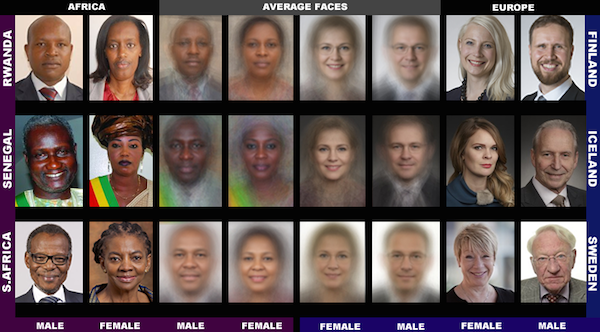
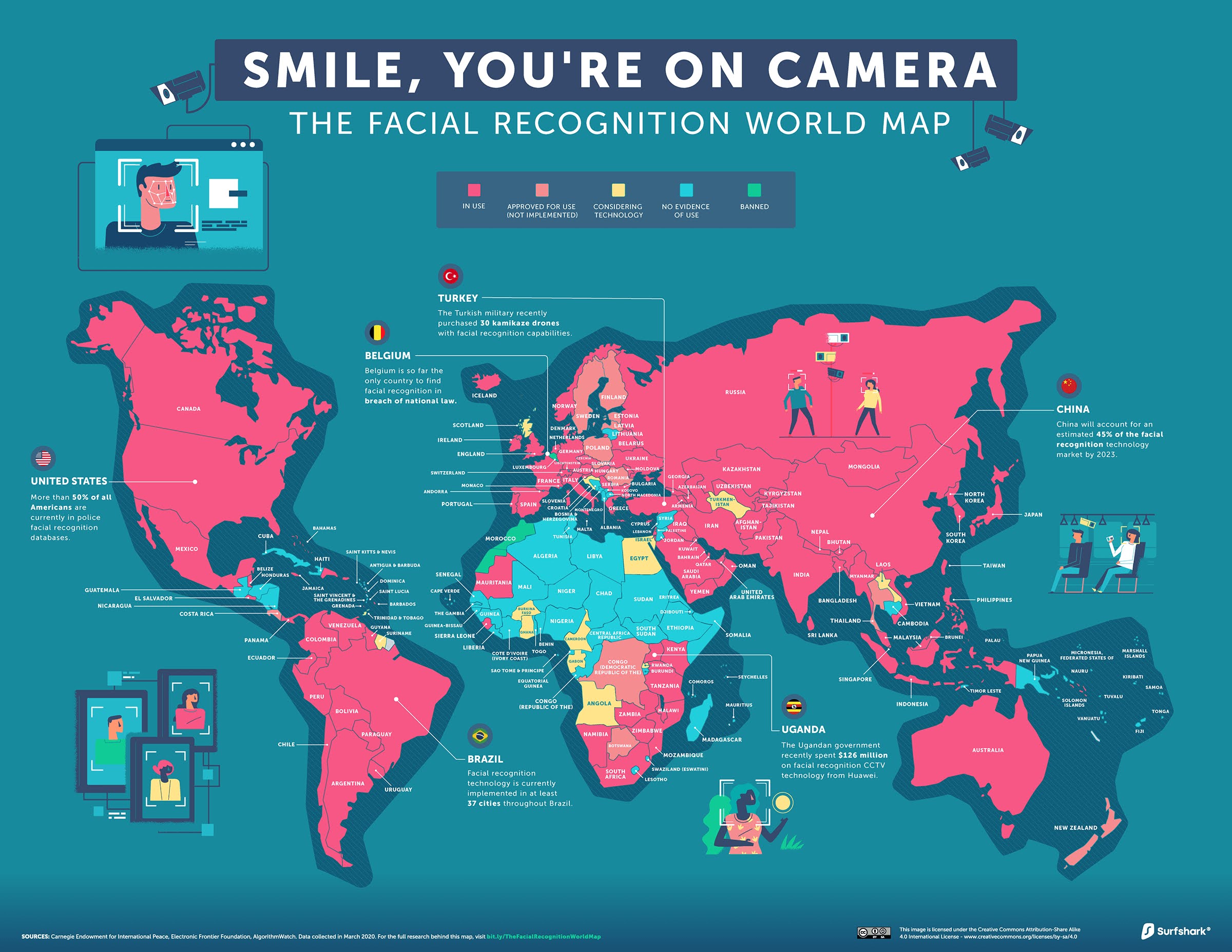
The claim asks whether governments and private entities should be prohibited from identifying or tracking people with facial recognition in publicly accessible spaces, apart from narrowly defined emergencies. The central policy choice is not simply between privacy and safety, but between a categorical rule that prevents inherently scalable surveillance and a regulated-use model that preserves selected applications while attempting to control their risks. Assessment therefore turns on the gravity and reversibility of documented harms, the practical value of permitted deployments, the credibility of safeguards, and the comparative—not merely absolute—case for prohibition. The strongest case for a ban is that public-space facial recognition can transform ordinary, difficult-to-monitor observation into scalable identification while oversight has repeatedly failed to impose clear limits. A Georgetown investigation estimated that police face-search systems made roughly half of American adults searchable and documented weak transparency, auditing, and legal controls, although its national estimate combined agency records and estimates rather than uniform reporting. GAO found incomplete awareness, role-specific training, and privacy or civil-liberties policies among federal law-enforcement users, while the Bridges court held that police discretion over deployment locations and watchlists was insufficiently constrained and that the equality assessment was inadequate. Together, these findings support the ban argument that function creep is not merely speculative: broad technical access combined with open-ended institutional discretion can erode practical anonymity before effective controls are established. A second pro-ban consideration is that match errors and unequal performance can become serious and unevenly distributed harms when recognition output enters police decision-making. NIST evaluations show that error rates depend on algorithm, image quality, demographic group, and operational task, with substantial demographic differences in many systems even though technical improvement can reduce them (see Figure 1). Peer-reviewed reviews likewise identify bias and discrimination as material concerns, including differences associated with intersecting characteristics, although the supplied reviews are syntheses rather than controlled measurements of each deployed system (see Figure 2). A peer-reviewed observational study associates police facial-recognition use with racial disparities in arrests, and the Williams case illustrates how an erroneous candidate match can contribute to wrongful arrest when investigators fail to corroborate it adequately; the former cannot establish causation, and the latter is one litigated incident. The ban case is especially strong where identification burdens political expression rather than responding to an immediate serious threat. In Glukhin, the European Court of Human Rights held that using facial recognition to identify and prosecute a peaceful protester violated privacy and freedom-of-expression protections. That judgment supplies concrete legal support for treating identification of peaceful demonstrators as disproportionate, though its political-expression context does not decide every public-safety use. The precautionary argument gains force because biometric exposure and data linkage can create durable risks that ordinary credential remedies do not readily reverse. Peer-reviewed reviews identify insecure biometric storage, repurposing, dataset linkage, consent deficiencies, and function creep as recurring concerns, while emphasizing that their severity depends on database design, access controls, setting, and accountability. The strongest challenge to a categorical ban is that targeted live deployments have produced actionable matches and arrests, so prohibition would eliminate demonstrated operational utility rather than only hypothetical capability. The Metropolitan Police reports alerts, engagements, and arrests involving people sought for alleged offenses or court matters, showing that the technology can assist interventions. Those agency-reported outputs do not establish the accuracy of every intervention, conviction, deterrence, or overall crime reduction, but they make the opportunity cost of banning narrowly scoped searches a legitimate consideration. A technology-wide ban also risks treating highly variable systems and configurations as though they had one fixed accuracy profile. NIST finds performance differences by algorithm, image quality, demographic group, and task, while independent NPL testing found that threshold selection changes the tradeoff between correct matches and false alerts and reported no statistically significant demographic imbalance for the particular police configuration tested. The NPL result cannot be generalized beyond the tested system and settings, but it demonstrates that poor performance in some products does not prove unacceptable performance in every configuration. Regulated use may also interrupt the pathway from a false candidate to coercive action by treating a match only as an investigative lead. GAO calls for documented policies, testing, role-specific training, human review, and monitoring, and the Williams settlement imposed corroboration requirements and restrictions on arrests based solely on a match. These measures are plausible alternatives to prohibition, although the record of incomplete policies and uneven implementation leaves their real-world reliability open to question. Limited outcome research further cautions that a ban might forgo crime-control benefits. A peer-reviewed city-level study reports an association between police adoption and changes in violent crime, but nonrandom adoption and possible differences in policing, investment, crime trends, and reporting make the result suggestive rather than causal. Nor does the available public-attitudes evidence establish uniform support for categorical prohibition. A nationally representative UK survey found support for some police uses, particularly serious-crime investigations, alongside opposition to intrusive or weakly safeguarded applications and demands for transparency, proportionality, and oversight. The evidence most clearly supports differentiating uses by purpose, scale, duration, location, watchlist, and consequences rather than treating every public-space application as equally harmful or beneficial. Continuous crowd or protest identification implicates broad searchability, weak governance, variable operational performance, and protected expression, whereas short and geographically bounded searches for a specified serious threat present a narrower intrusion and a more concrete safety rationale. The Glukhin judgment, GAO findings, and UK survey therefore converge on necessity, proportionality, transparency, and bounded discretion, although they do not identify one universally optimal legal rule. A strict regulatory alternative is credible only if safeguards are enforceable throughout the deployment chain rather than stated as general principles. The supplied evidence supports controls over watchlist criteria, deployment locations, retention, thresholds, testing, human verification, corroboration, transparency, monitoring, and independent auditing because failures in these areas can amplify civil-rights and accuracy risks. Courts and auditors have identified governance failures capable of remediation without holding that every narrowly tailored deployment is impermissible, but repeated implementation gaps strengthen the case for presumptive prohibition wherever effective enforcement cannot be demonstrated. Neither operational successes nor documented harms alone establish the superior net social outcome of a ban or regulated use. Alerts and arrests show actionable output but not counterfactual effects on crime, displacement, wrongful intervention, deterrence, conviction, or chilling of lawful conduct. Conversely, evidence of bias, privacy risk, and unlawful deployments demonstrates the need for strong limits but does not by itself show that no narrower legal regime could control those harms. The principal gap is comparative: the bundle does not directly measure whether a comprehensive public-space ban produces better net outcomes than enforceable, purpose-specific regulation. Independent counterfactual studies of crime reduction, displacement, wrongful stops or arrests, chilling effects, and long-term function creep are limited, so operational counts and individual incidents cannot settle the policy comparison. Evidence on private-entity tracking is also thinner than evidence on policing, even though the claim would prohibit both. The bundle likewise does not provide a direct comparative evaluation of existing jurisdictional bans and restrictions, so the broader regulatory landscape shown in Figure 3 supplies context rather than outcome evidence. A secondary uncertainty concerns institutional independence and conflicts of interest. Some utility evidence comes from agencies evaluating their own deployments, while one prominent wrongful-arrest account is presented by counsel for the affected person; these sources remain relevant but warrant caution when estimating frequency and net effect. On the supplied evidence, the balance is against routine or broad public-space facial recognition but does not establish that a near-categorical ban is superior to tightly bounded regulation for every serious-threat use case. Confidence in this balanced judgment is high because the record includes strong technical, peer-reviewed, governmental, operational, and judicial material on both benefits and harms. The dominant uncertainty is comparative effectiveness, compounded by unresolved source-interest concerns: the evidence shows that unbounded deployment is hazardous and that targeted deployment can be useful, but not whether enforceable safeguards will outperform prohibition over time.
Supporting Arguments
P1Public identification erodes practical anonymity
Persistent facial identification can convert ordinary movement through streets, transport systems, and demonstrations into searchable records without meaningful consent. Large-scale police access and weak governance documented in the United States support the concern that narrower policies may expand through function creep.
67/100 · Direct Evidence
P2Errors can lead to unequal and serious harms
NIST found substantial demographic differences in many algorithms, while policing research associates facial-recognition use with racial disparities. A false candidate can become consequential when investigators treat it as identification, as illustrated by the Williams wrongful-arrest case.
86/100 · Direct Evidence
P3Surveillance can burden protest and political expression
Identifying people at demonstrations can expose participants to state scrutiny and deter lawful expression even when no arrest occurs. In Glukhin, the European Court of Human Rights found facial identification of a peaceful protester disproportionate and violative of protected rights.
54/100 · Direct Evidence
P4Existing oversight has often been inadequate
GAO found incomplete policies, training, and civil-liberties controls among federal law-enforcement users. The Bridges judgment likewise found that police discretion over locations and watchlists was insufficiently bounded, supporting the view that deployment has outpaced enforceable safeguards.
78/100 · Direct Evidence
P5Biometric exposure is difficult to reverse
Unlike a password, a face is continuously exposed and cannot readily be replaced after database misuse or breach. Reviews identify insecure storage, repurposing, and linkage across datasets as enduring risks, strengthening the precautionary case against routine public-space collection.
75/100 · Logical Inference
Opposing Arguments
C1Targeted deployments can locate wanted people
Metropolitan Police reports show that live deployments have generated actionable alerts and arrests, demonstrating practical utility rather than merely hypothetical benefits. A comprehensive ban would remove this tool even for narrowly scoped watchlists concerning serious risks, although independent evidence of overall crime reduction remains limited.
73/100 · Direct Evidence
C2Accuracy depends on system quality and operating threshold
NIST and NPL testing show that facial-recognition systems do not have one universal error rate: performance differs by algorithm, image conditions, demographic group, and decision threshold. A technology-wide ban may therefore ignore configurations with low false-alert rates and smaller measured demographic differences.
66/100 · Direct Evidence
C3Human review and corroboration can limit match-related harm
A facial-recognition output can be governed as an investigative lead rather than probable cause or proof of identity. GAO recommendations and the Williams settlement point toward training, documented review, independent corroboration, and audit trails as alternatives to prohibition.
72/100 · Logical Inference
C4Some evidence suggests possible crime-control benefits
A city-level study reports an association between police adoption of facial recognition and violent-crime outcomes. The observational design cannot rule out confounding, but it cautions that a ban may carry public-safety opportunity costs that have not been fully measured.
0/100 · Data Analysis
C5Public acceptance is conditional rather than uniformly opposed
UK survey evidence found support for some police applications, particularly those connected to serious crime, while respondents rejected less justified uses. This weakens the claim that a categorical ban clearly reflects public preferences and instead supports purpose-specific rules.
52/100 · Data Analysis
All contributions are reviewed for clarity, balance, and evidence. The strongest insights are elevated into the argument graph — with credit to you.
Help improve this analysis on ProConWiki →