Social media algorithms are harmful to adolescent mental health

Updated 2026-07-28 4 supporting · 4 opposing arguments
Aldo's Synthesis high
Based on the strength of the Arguments below
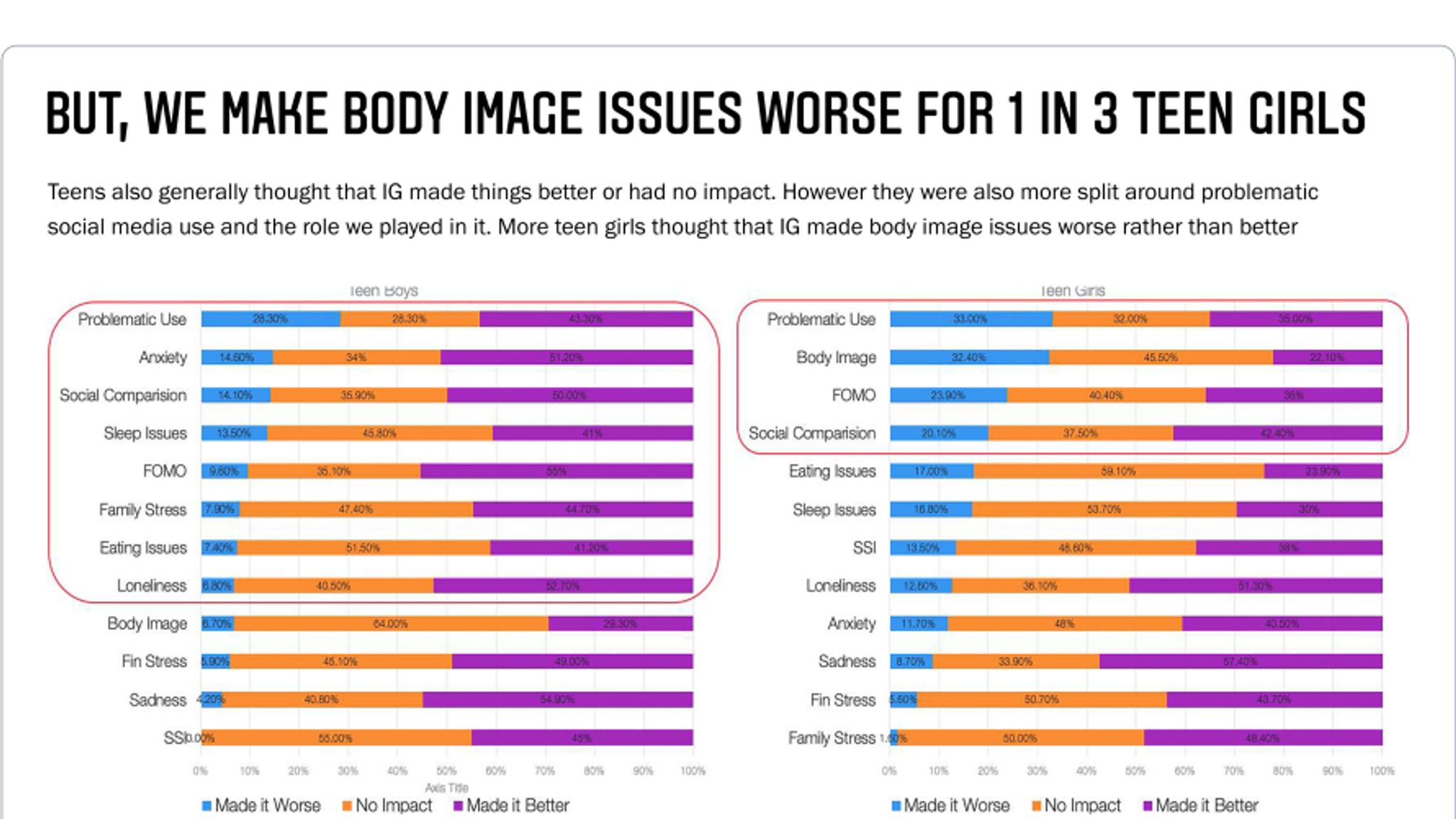
The claim asks whether personalized ranking and recommendation systems harm adolescent mental health by intensifying compulsive engagement, risky content, social comparison, cyberbullying, and sleep disruption. The central analytical problem is attribution: evidence that a harmful experience occurs on social media does not by itself establish how much personalization caused, amplified, or prolonged that experience. What is at stake is not merely whether social media can correlate with distress, but whether specific designs create enough incremental risk to justify targeted safeguards rather than undifferentiated restrictions on adolescents’ online activity. The strongest support for the claim is a convergent pathway case: problematic engagement, sleep disruption, harassment, and psychologically risky comparison are associated with poorer adolescent outcomes, and engagement-oriented features are plausible contributors to those exposures. A systematic review and meta-analysis found statistically significant but small associations between adolescent social-media use and internalizing symptoms, with problematic use more strongly related than time spent. In a large UK cohort of 14-year-olds, heavier use was associated with higher depressive-symptom scores, particularly among girls, while sleep disruption, online harassment, low self-esteem, and poor body image statistically accounted for portions of the relationship. Together, these findings make compulsive engagement and sleep displacement more credible targets of concern than raw screen time alone, while the widely discussed temporal rise in adolescent distress remains contextual rather than algorithm-specific evidence (see Figure 1). A second pathway concerns repeated exposure to content and interactions already associated with psychological risk. Systematic-review and meta-analytic evidence associates appearance-focused use, idealized images, and social comparison with body dissatisfaction, body-image concerns, disordered eating, and eating-disorder symptoms among young people. A meta-analysis likewise found a significant positive association between cyberbullying victimization and adolescent depression. These studies support the risk mechanisms but generally do not experimentally compare recommendation systems, so internal platform findings often invoked in this debate cannot substitute for an identified incremental algorithm effect in the supplied evidence (see Figure 2). The pathway argument gains coherence because separate reviews identify both cyberbullying and social comparison as recurring correlates of serious adolescent difficulties. The cyberbullying review found consistent associations with depression, anxiety, self-harm, suicidal behavior, and other mental-health problems, although it could not establish how much algorithms increase exposure. The social-comparison meta-analysis similarly supports a mechanism through which repeated appearance-focused recommendations could be harmful, while leaving both causality and the ranking system’s incremental contribution unresolved. Professional and public-health synthesis supports precautionary design measures even without proof that every personalized feed causes harm. The American Psychological Association recommends age-appropriate design, monitoring, digital literacy, and limits on features encouraging excessive use or harmful comparison, while expressly recognizing that effects depend on users, circumstances, content, and features. A review of reviews also reports recurring links with depression, anxiety, distress, poor sleep, body-image problems, and disordered eating, alongside possible benefits and substantial causal uncertainty; this mixed synthesis is the appropriate context for government advisory summaries (see Figure 3). The principal challenge is that most adolescent evidence measures social-media use, problematic use, sleep, or content experiences rather than randomly assigning young people to different ranking systems. The meta-analyses rely substantially on observational and self-reported measures and do not isolate recommendation algorithms, while the cohort evidence identifies statistical mediation without proving that platform systems caused either the exposures or symptoms. The APA’s feature-specific recommendations reflect this distinction by avoiding the premise that all use or all personalization has one uniform effect. The observed average relationships are generally too limited and methodologically ambiguous to establish a broad causal proposition about algorithms. Problematic use is associated with depression, anxiety, sleep difficulty, and reduced well-being, but general use has smaller or less consistent relationships, and self-report plus observational designs limit causal interpretation. Cohort and body-image reviews identify vulnerable groups and concerning associations, but neither residual confounding nor the possibility that distressed adolescents select different online experiences can be excluded, and the algorithm-specific effect cannot be precisely estimated. Longitudinal adolescent evidence further supports a bidirectional and socially contingent account rather than a simple one-way exposure model. Research on early adolescence examined reciprocal influence between social-media use and internalizing symptoms and identified co-rumination as a relevant social mechanism. An adult Facebook randomized experiment provides only indirect caution: replacing algorithmic ranking with a chronological feed substantially altered exposure and platform behavior but had little detectable effect on measured political attitudes, an outcome and population different from adolescent mental health. Personalized discovery may also facilitate protective experiences, making blanket removal potentially costly for some adolescents. A systematic review of LGBTQ youth found mixed outcomes: online environments can expose users to harassment and harmful comparison, but can also provide social support, identity affirmation, health information, and community. The broader review literature likewise reports both recurring risks and possible benefits from connection and support, with heterogeneous methods preventing a single net-effect estimate. The evidence is best understood as heterogeneous across content, engagement pattern, vulnerability, and platform context rather than as one average effect shared by every adolescent and algorithm. Problematic use, sleep loss, harassment, and appearance-related comparison emerge as concerning conditions, while broad exposure measures are weaker explanations. The review evidence and UK cohort also indicate variation by circumstances and gender, with especially strong cohort associations among girls, but observational methods do not determine whether those differences originate in algorithms, content choices, social environments, or prior vulnerability. Nor should a change in exposure automatically be treated as an equal-sized change in psychological outcome, as the adult feed experiment illustrates outside the adolescent mental-health setting. Problematic engagement is therefore a more defensible risk marker than time alone, but it does not identify one sufficient remedy. The meta-analysis found stronger relationships for problematic use than for time spent, while also reporting small effects and substantial variation. Accordingly, policies limited to screen-time caps or chronological feeds may fail to address harmful content, harassment, sleep, or preexisting vulnerability; the APA instead recommends a combination of design, monitoring, and literacy measures tailored to features and circumstances. The most supportable formulation is that some algorithmic designs can heighten particular risks for some adolescents, not that personalization is invariably harmful. Associations with problematic use, sleep, and depressive symptoms coexist with observational limitations and longitudinal evidence of reciprocal influence. That combination can justify precautionary safeguards while withholding the stronger universal causal judgment. The decisive gap is direct adolescent evidence comparing algorithmic and nonalgorithmic feeds while measuring clinically meaningful mental-health outcomes. Without that comparison, the evidence cannot cleanly separate ranking effects from content availability, social interaction, notification design, total use, user selection, or prior distress. This limits estimates of effect size, direction, and the adolescents most likely to benefit or be harmed by particular recommendation objectives. Additional gaps concern long-term outcomes, platform-to-platform differences, and the comparative effects of specific remedies. The bundle does not permit a confident ranking of chronological feeds, screen-time limits, feature restrictions, age-appropriate recommender objectives, monitoring, or digital literacy as interventions. Conflict-of-interest classifications also remain unresolved, creating uncertainty about how much weight to place on research conducted by or dependent on platform access. The curated figures supply important context but do not close the attribution gap. Population trends, internal platform slides, and advisory graphics can motivate inquiry and policy attention, but the frozen evidence bundle does not validate their underlying data as direct causal estimates of personalized-ranking effects. On balance, the evidence supports with high confidence a narrower conclusion: some personalized social-media designs plausibly heighten mental-health risks for some adolescents, but it does not establish that social-media algorithms as a class universally cause harm. The balance is driven by replicated associations involving problematic use, sleep, comparison, and harassment, tempered by small average relationships, heterogeneous benefits and harms, and predominantly observational research that rarely isolates algorithms. The dominant uncertainty driver is attribution: whether and by how much a particular recommender system changes clinically meaningful outcomes beyond the effects of content, interpersonal experience, user vulnerability, and social-media use itself. Unresolved conflict-of-interest classifications are a secondary limitation on confidence in the weighting of individual studies.

Supporting Arguments

P1Recommendation systems can repeatedly surface psychologically risky content
Appearance-focused social comparison is associated with body-image concerns and eating-disorder symptoms, while cyberbullying is associated with depression and self-harm-related outcomes. Algorithms optimized for engagement could increase repeated exposure to such material, although direct experimental evidence quantifying that incremental effect in adolescents remains limited.
97/100 · Logical Inference
P2Problematic use and sleep disruption are linked to poorer mental health
Meta-analytic evidence finds stronger mental-health associations for problematic social-media use than for simple time spent, alongside links to sleep problems. Engagement-maximizing feeds, autoplay, and notifications may contribute to compulsive use and sleep displacement, making design a plausible part of the causal pathway.
98/100 · Logical Inference
P3Large cohort evidence identifies plausible pathways of harm
The UK Millennium Cohort Study found heavier use associated with depressive symptoms, especially among girls, with sleep, harassment, self-esteem, and body image accounting for part of the association. These pathways align with concerns that personalized feeds can amplify comparison and prolonged engagement, though the study did not directly manipulate algorithms.
68/100 · Data Analysis
P4Youth-health authorities advise precautionary platform design
The U.S. Surgeon General and APA conclude that risks are credible enough to justify age-appropriate design, stronger safeguards, and limits on features that promote excessive use or harmful comparison. Their recommendations reflect converging evidence and developmental vulnerability, not proof that every algorithm or adolescent is harmed.
84/100 · Expert Opinion

Opposing Arguments

C1Most evidence does not isolate algorithms from social-media use
Reviews overwhelmingly study screen time, frequency, problematic use, or content experiences rather than randomized exposure to different recommendation systems. The claim therefore attributes harm to algorithms more specifically than the current adolescent evidence usually permits.
100/100 · Direct Evidence
C2Average associations are small and causality remains uncertain
The meta-analysis of internalizing symptoms reports small overall associations, with problematic use more strongly related than time spent. Self-report, residual confounding, selection effects, and reverse causation—such as distressed adolescents seeking more online engagement—mean observational correlations cannot by themselves establish algorithmic harm.
84/100 · Data Analysis
C3Changing a feed can alter exposure without changing outcomes
A large randomized adult Facebook study found that replacing algorithmic ranking with a chronological feed changed exposure and platform behavior but had little detectable effect on measured political attitudes. It is not evidence about adolescent mental health, but it cautions against assuming that every large algorithm-driven exposure difference produces a large psychological effect.
72/100 · Direct Evidence
C4Social-media discovery can provide connection and support
For LGBTQ adolescents, social media can enable identity affirmation, peer support, information access, and community that may be difficult to obtain offline. Recommendation and discovery systems may facilitate these benefits, so eliminating personalization could also remove protective experiences.
73/100 · Direct Evidence

All contributions are reviewed for clarity, balance, and evidence. The strongest insights are elevated into the argument graph — with credit to you.

Help improve this analysis on ProConWiki →
𝕏 Share Facebook LinkedIn