Voters’ views on major foreign-policy and social issues tend to be sharply polarized along party lines
Bottom line (updated 2026-11-13): The claim is mostly true as a broad trend: party gaps are large on many major issues. Still, the gap changes by issue, and some agreement remains, so the divide is not total.
What's this about?
People disagree about whether voters from each party hold very different views on world events and social issues.
The claim says party ties now shape many big views.
What supporters say
- Party ties now play a bigger role in views about wars, allies, and America’s role overseas.
- Big gaps appear on many social issues, such as guns, race, abortion, and border rules.
- Over time, people from each party have lined up more often on the same side of issues.
What critics say
- People from both parties still agree on some big issues.
- Voters may think the party gap is wider than it really is.
How to read this
The number of points on each side does not show who is right; strong proof matters more than a longer list.
The bottom line
The claim is mostly true as a broad trend: party gaps are large on many major issues.
Still, the gap changes by issue, and some agreement remains, so the divide is not total.
The claim that voters’ views on major foreign-policy and social issues are sharply divided by party is broadly supported—but only as a general trend. The evidence shows major gaps on several high-profile issues, while also revealing important areas of agreement and uncertainty about how wide the divide really is.
The case for
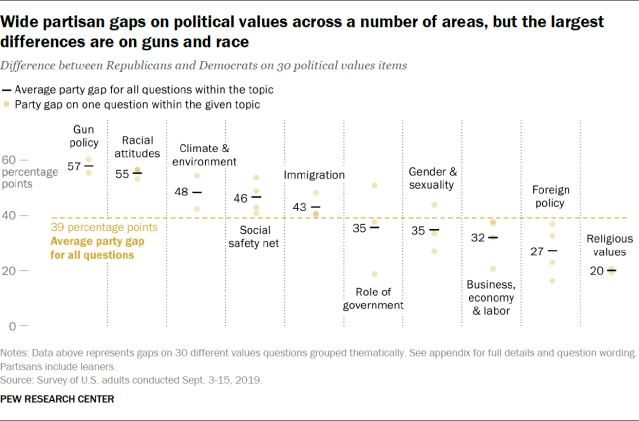
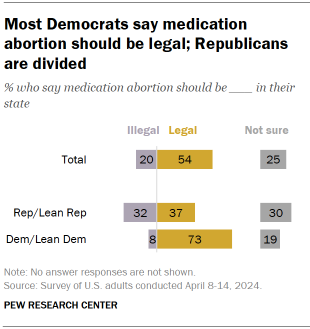
The strongest evidence comes from the repeated appearance of large partisan gaps across several major social-policy issues. In one Pew analysis of 30 political-values questions, Republicans and Democrats differed by an average of 39 percentage points, with especially wide divisions over guns and race (see Figure 1). Other surveys find substantial differences over abortion, including access to medication abortion, as well as illegal immigration and conditions at the southern border 1.
Party divisions also shape which problems voters consider most urgent. Republicans and Democrats place different levels of importance on gun violence, climate change and racism. These patterns suggest that the disagreement is not limited to one isolated controversy, but appears across several high-salience areas.
Foreign policy shows a similar, increasingly visible pattern. The Chicago Council’s analysis of opinion over several decades finds that party divisions have become more important in shaping Americans’ foreign-policy views. Research published in peer-reviewed journals also indicates that issues once associated with broad bipartisan agreement have developed clearer partisan fault lines 2.
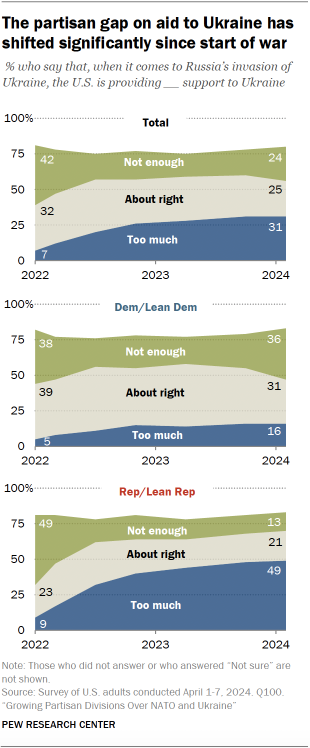
Recent Pew surveys, for example, show widening differences over NATO, the war in Ukraine, America’s responsibility for European security and how much support the United States should provide Ukraine (see Figure 3). This gives the claim support beyond domestic social policy, although the divisions vary depending on the issue and the period.
Long-term research points in the same direction. Studies using American National Election Studies data from 1972 to 2004 found that people’s policy views became more closely tied to their party identity. Pew also documented widening partisan differences in political values during the Bush and Obama years 3.
The case against
The evidence does not show that voters are sharply divided on every major issue. Large majorities of Republicans and Democrats agree on protecting Social Security. Survey findings also show concern across party lines about health-care costs and the influence of money in politics, even when voters disagree about other national problems 4.
There is also a difference between how polarized Americans think the parties are and how far apart their actual policy views may be. A Carnegie research review says Americans often exaggerate the ideological distance between Republicans and Democrats. One peer-reviewed study found only a weak relationship between strong partisan dislike and the degree to which voters’ policy views are sorted by party 5.
That means intense hostility toward the other party can exist alongside smaller substantive disagreements than the phrase “sharply polarized” suggests. The evidence also distinguishes between several kinds of polarization: emotional dislike, divisions among political leaders and actual differences in voters’ policy positions. Evidence of one type does not automatically prove the others.
Foreign-policy polarization, in particular, appears sensitive to the issue and the time period. Growing disagreements over Ukraine and NATO have not erased bipartisan agreement on every foreign-policy question. Historical research also cautions against describing the early Cold War as either entirely united or entirely divided.
The bottom line
The evidence moderately supports the claim, but only when it is understood as a broad contemporary tendency rather than a universal rule. The strongest support concerns pronounced party differences over abortion, guns, race, immigration, climate change and Ukraine.
The evidence is less strong for saying that all major issues, or all voters, are sharply polarized. It also does not establish one clear definition of “sharp,” or fully separate changes in voters’ views from changes in party coalitions, messages from political leaders and the issues receiving the most attention. The overall pattern is real and repeated across surveys and research, but its scope and durability—especially in foreign policy—remain uncertain.
Figures & data
All contributions are reviewed for clarity, balance, and evidence. The strongest insights are elevated into the argument graph — with credit to you.
Help improve this analysis →