Americans’ views of foreign countries are increasingly polarized along partisan lines
Bottom line (updated 2026-11-09): The claim is mostly true, but the change is uneven. Party splits are clearest for Israel, Ukraine, and Mexico, while many Americans still agree about other countries.
What's this about?
People disagree about whether Americans now view foreign countries more through party lines. The answer seems to be yes, but not for every country.
What supporters say
- Party gaps are especially large when Americans judge Israel, Ukraine, and Mexico.
- Ukraine and NATO have become more tied to party views than before.
- Different views about war, jobs, armies, and allies can help drive party splits.
- Democrats and Republicans now name different countries as the biggest threat.
What critics say
- Several U.S. allies still have wide support from both major parties.
- Americans still agree about some important countries, even when they disagree elsewhere.
How to read this
The number of points on each side does not show who is right; the strength of each point matters more.
The bottom line
The claim is mostly true, but the change is uneven. Party splits are clearest for Israel, Ukraine, and Mexico, while many Americans still agree about other countries.
Americans’ views of foreign countries are becoming more divided along party lines, but the shift is uneven. The clearest divisions involve countries tied to major conflicts or domestic political disputes, while broad agreement remains on several other nations.
The case for
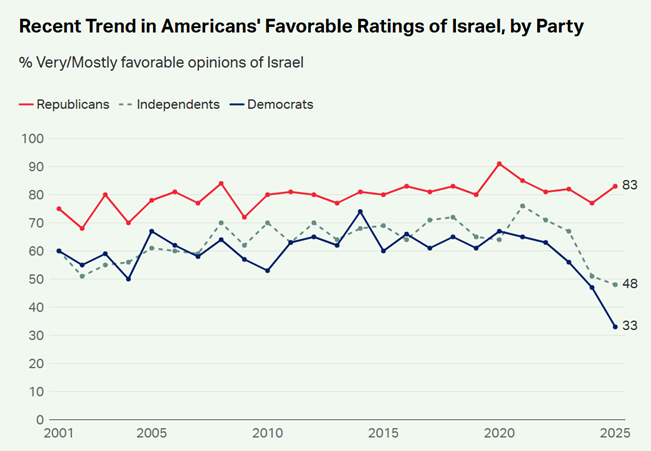
The strongest evidence comes from current polling showing large partisan gaps over Israel, Ukraine and Mexico. Gallup found roughly a 50-point difference between Republicans and Democrats in views of Israel, while the gaps for Ukraine and Mexico exceeded 30 points. These are among the clearest signs that Americans’ evaluations of particular countries can now differ sharply by party 1 (see Figure 1).
Israel provides an especially clear example. Republicans were more sympathetic to Israelis, while Democrats were more sympathetic to Palestinians. That divide reflects not only different views of the conflict, but also sharply different attitudes toward the countries and groups involved 1 (see Figure 2).
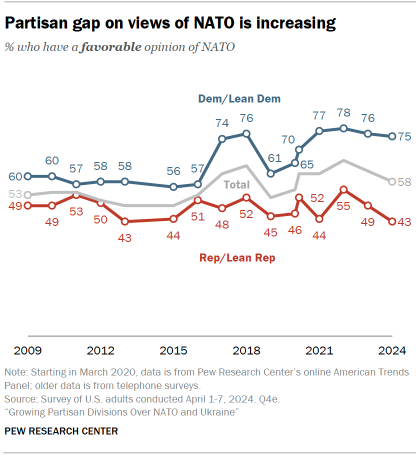
Ukraine and NATO have also become more partisan issues. Pew has recorded growing Republican-Democratic differences over NATO, support for Ukraine and views of Ukraine’s leadership 2 (see Figure 3). Some of these questions concern American policy or foreign leaders rather than country favorability itself, but they still show how international affairs have become tied to political identity.
The parties also increasingly identify different foreign threats. Republicans most often named China as the greatest threat, while Democrats increasingly pointed to Russia. Different threat priorities can lead Democrats and Republicans to interpret the same governments and international events in different ways 3.
Those differences have a broader political foundation. Surveys show disagreements over the importance of military strength, protecting American jobs, maintaining alliances and other foreign-policy goals. These priorities offer a plausible explanation for why partisan divisions appear across several international issues rather than representing isolated polling results 4.
The case against
Large partisan gaps in a few prominent cases do not prove that Americans’ views of foreign countries are broadly or steadily polarizing. On some major powers, Republicans and Democrats still agree. About eight in 10 Americans viewed China unfavorably, and majorities in both parties viewed Russia negatively or as an enemy 5.
Several important U.S. allies also retain broad bipartisan support. Gallup found generally favorable views of Canada, Britain, France and Japan. Pew’s comparisons of the Group of Seven countries likewise showed that Americans’ opinions vary from country to country, but did not suggest that every country has become a partisan issue 6.
There is also a measurement problem. Views of a country are not identical to views of its government, its people, U.S. military assistance or an alliance such as NATO. Polling questions have changed over time, as have international events and the party controlling the White House. A sharp gap today might reflect a lasting change in partisan identity—or a temporary response to a particular conflict or political controversy.
The available research does not provide one long, consistent series using the same countries, questions and party definitions over many years. That makes it difficult to determine how much partisan division has increased, and how much reflects changing events, elite political messages or differences in the people surveyed.
The bottom line
The evidence leans toward the claim, but only conditionally and with low confidence about its broadest form. Americans’ views of several highly visible countries and conflicts—especially Israel, Ukraine and Mexico—are clearly divided by party, and disagreements over threats and foreign-policy goals help explain why.
But the evidence is much stronger for large partisan gaps in selected, politically charged cases than for a general, steadily increasing polarization of views about foreign countries as a whole. Broad agreement remains on China’s unfavorable image, Russia’s negative standing and the positive views of several U.S. allies. The central uncertainty is whether today’s most striking divisions will persist once changing events, question wording and the difference between country attitudes and foreign-policy opinions are taken into account.
Figures & data

All contributions are reviewed for clarity, balance, and evidence. The strongest insights are elevated into the argument graph — with credit to you.
Help improve this analysis →