Americans broadly support LGBTQ nondiscrimination protections but are divided over transgender sports and bathroom policies
Bottom line (updated 2026-11-17): The evidence shows broad support for LGBTQ fair-treatment laws, but less agreement about transgender sports and bathroom rules. Both sides have points, but the main pattern still leans toward the claim; exact changes over time remain unclear.
What's this about?
People disagree about whether most Americans support LGBTQ fair-treatment laws but split over transgender sports and bathroom rules.
The polls show more agreement on basic rights than on these specific rules.
What supporters say
- Laws that protect LGBTQ people from unfair treatment have wide support across the country.
- Americans agree less when polls ask about rules for transgender people in sports and bathrooms.
- Views differ greatly by party, faith, age, and where people live.
What critics say
- New polls show that support for some limits may have grown, especially for sports.
- Many people support some restrictions, so “divided” may make the split sound too small.
- Poll results can change because groups ask questions in different ways and use different methods.
How to read this
The number of points on each side does not show who is right; strong proof matters more than a long list.
The bottom line
The evidence shows broad support for LGBTQ fair-treatment laws, but less agreement about transgender sports and bathroom rules.
Both sides have points, but the main pattern still leans toward the claim; exact changes over time remain unclear.
Americans appear to support LGBTQ nondiscrimination protections more broadly than they agree on specific rules affecting transgender people. But the picture is complicated: recent polling suggests growing support for some restrictions, especially in sports, while survey wording and institutional differences make the trend difficult to measure precisely.
The case for
The clearest evidence for the claim is the gap between general protections and specific transgender policies. PRRI found that 72% of Americans support laws protecting LGBTQ people from discrimination. That included 67% of Republicans, 85% of independents and 92% of Democrats, suggesting that support is not limited to one political party, even though the strength of that support varies sharply. 1
By contrast, Americans show less agreement when asked about particular rules. PRRI found that only 40% opposed laws requiring transgender people to use bathrooms corresponding to the sex assigned to them at birth. Gallup, meanwhile, found that 69% favored assigning transgender athletes to sports teams based on birth gender. These results do not show a single national view, but they do show that support for equal treatment in general can coexist with more restrictive views about sports and bathroom policies. 2
The claim also uses “broadly” and “generally” as descriptions of national opinion, not as claims that every group agrees. Polling from the Williams Institute and PRRI’s American Values Atlas shows substantial differences by party, religion, age, geography and other demographic factors. The overall pattern is therefore a two-level one: a national majority may favor nondiscrimination protections while groups within the country remain sharply divided over transgender-specific policies. PRRI’s comparison of these issues is summarized in Figure 1 (see Figure 1). 3
The case against
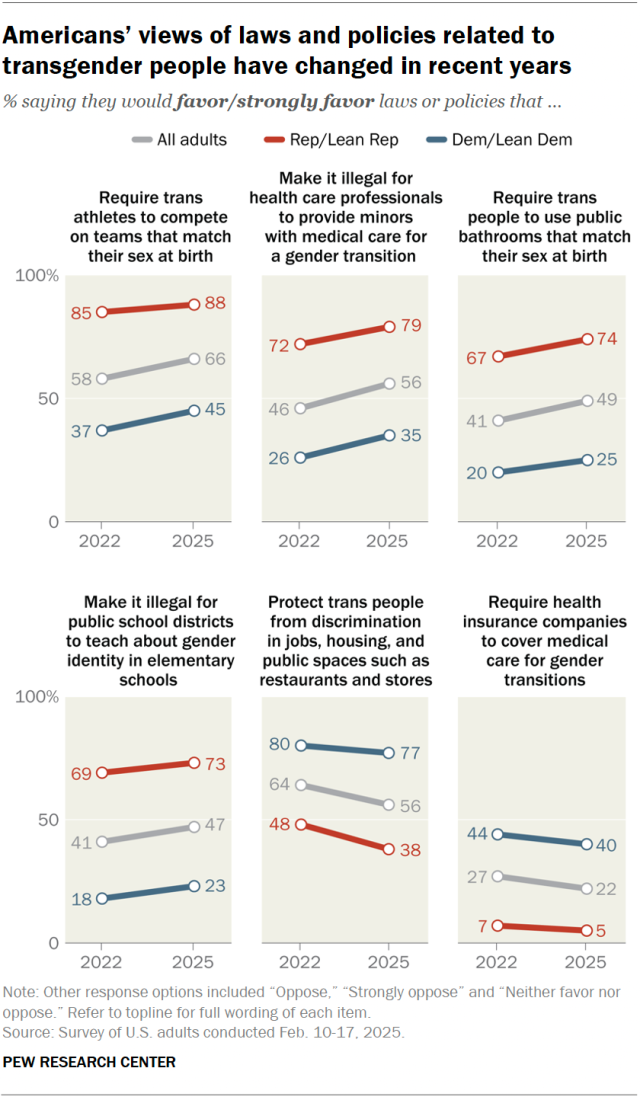
The main challenge is that the claim may understate how restrictive current opinion has become on some issues. Pew’s 2025 survey of 5,097 U.S. adults found increased support for several restrictions on transgender people and lower support for some protections compared with 2022. That does not erase majority support for every nondiscrimination measure, but it means the claim should not be treated as a timeless description of American opinion or as evidence that views are moving steadily toward greater inclusion (see Figure 2). 4
Sports opinion may also be better described as a restrictive majority than as simple division. Gallup found in 2023 that 69% favored assigning transgender athletes to teams matching their birth gender, up from 62% in 2021. On that question, the public is not evenly split, even if broader debates about transgender rights remain contested (see Figure 3). 5
There are also limits to comparing the available surveys. PRRI and the Williams Institute provide large, relevant studies, but their institutional focus means their findings should be considered alongside polling from Pew and Gallup rather than treated as conclusive on their own. Results can change depending on whether a question emphasizes bathrooms, privacy, safety, gender identity or assigned sex. There is no single long-running survey that asks all three issues—general nondiscrimination, sports and bathroom access—with identical wording.
Research about the effects of inclusive bathroom laws should not be mistaken for research about public opinion. One peer-reviewed review found no evidence that such laws increase restroom safety violations. The Williams Institute likewise reports no rise in restroom-related criminal incidents, while documenting denial of access and harassment experienced by transgender people. Those findings address the consequences of policy, not whether Americans support it. 6
The bottom line
The evidence supports the claim as a qualified description, but only with low confidence. The strongest part is the contrast between clear majority support for general LGBTQ nondiscrimination protections and less consistent—often more restrictive—views on specific transgender policies.
The opposing evidence is important, not because it overturns that contrast, but because it shows that “divided” may be too mild for some questions, particularly sports. Recent shifts also weaken any suggestion that the pattern is stable over time. Survey wording, timing and institutional differences leave open how much of the apparent change reflects real movement in public attitudes.
Figures & data
All contributions are reviewed for clarity, balance, and evidence. The strongest insights are elevated into the argument graph — with credit to you.
Help improve this analysis →