Brazilian presidential elections are increasingly shaped by polarization between competing ideological coalitions
Bottom line (updated 2026-11-15): The evidence clearly shows that rival belief groups shaped Brazil’s 2018 and 2022 presidential races. Still, we are not sure these groups form lasting, clear, or fully shared belief groups.
What's this about?
People disagree about whether Brazil’s presidential races now show a deep split between rival belief groups.
The 2018 and 2022 races strongly support this idea, but we are not sure these groups will last.
What supporters say
- Strong dislike between Lula’s and Bolsonaro’s supporters turned elections into fights between rival groups.
- Parties moved farther apart, while fewer voters stayed near the middle.
- The 2018 race created sharper links between people’s lives, views, and voting choices.
- In 2022, voters split over fair elections, court power, the law, and rights for smaller groups.
What critics say
- Much of the split may come from strong dislike, not from clear ideas about how society should work.
- Brazil has many parties, so the idea of two neat belief groups may not fit well.
How to read this
The number of points on each side does not show who is right; the stronger proof matters more.
The bottom line
The evidence clearly shows that rival belief groups shaped Brazil’s 2018 and 2022 presidential races.
Still, we are not sure these groups form lasting, clear, or fully shared belief groups.
The claim is that Brazil’s recent presidential elections have been shaped increasingly by rival ideological camps, rather than by ordinary party competition or short-term judgments about government performance. The evidence strongly supports that view for the 2018 and 2022 elections, but leaves open whether these camps are durable, coherent ideological coalitions.
The case for
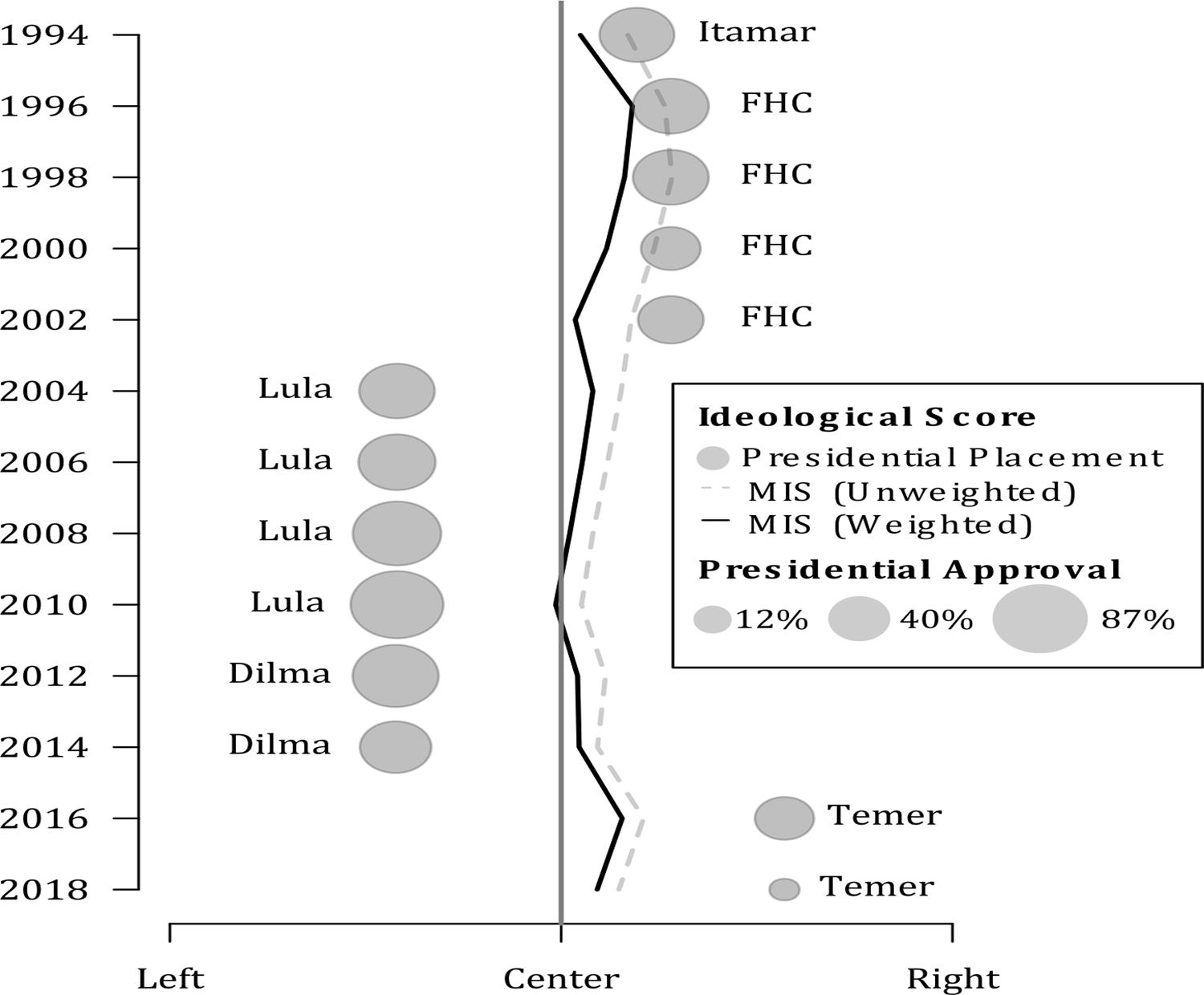
The strongest evidence comes from the combination of changes in the party system, voting patterns and public attitudes. Recent estimates show sharper polarization among parties, a wider gap between the president and Congress, and a weaker political center. That has made presidential contests easier to understand as competition between opposing camps rather than as a contest among broadly similar parties (see Figure 1). 2
The 2018 election was a clear turning point. Researchers found unusually strong demographic divisions in voting, with some of those differences linked to voters’ positions on political and social issues. Support for Jair Bolsonaro and Bolsonarismo was also associated with divisive cultural and political attitudes, not only dissatisfaction with the economy. Compared with the longer-term voting pattern, this suggested a notable intensification of social and ideological alignment (see Figure 2; see Figure 3). 1
The 2022 election strengthened that interpretation. Supporters of Luiz Inácio Lula da Silva and Bolsonaro differed over democratic procedures, the separation of powers, the rule of law and minority rights. A survey of 1,291 people also found that right-wing authoritarian attitudes and support for social hierarchy helped predict support for Bolsonaro. These findings suggest that the contest involved value-based commitments, not simply judgments about economic performance or the candidates themselves. 3
Hostility between the camps also shaped the election. A preregistered, multiwave survey found strong and fairly equal levels of dislike between Lula and Bolsonaro supporters. Online networks showed sharply separated campaign communities. Correcting some false beliefs about the opposing camp reduced hostility, indicating that perceptions of group conflict were part of the electoral environment, rather than merely a result of having chosen a candidate. 4
The case against
The main objection is that much of the polarization may be emotional rather than ideological. Research on attitudes between 2014 and 2018 found that negative political identities helped explain hostility beyond conventional partisanship and ideology. People could strongly dislike the opposing leader or group without holding a clear or consistent ideological position of their own. Hostile camps, therefore, do not necessarily share a positive program or a lasting political identity. 5
Brazil’s fragmented party system provides a second limitation. The number of parties grew substantially after the 1988 Constitution, and presidents—including left-wing presidents—have often built governing arrangements across ideological lines. Studies emphasizing pragmatism in presidential coalition-building warn that campaign alliances should not automatically be treated as stable left-right blocs. Legislative parties and presidential supporters do not always line up neatly, and alliances can change over time. 6
This means the evidence is strongest for a time-limited trend beginning around 2018, not for every Brazilian election since the return to democracy. The Lula-Bolsonaro rivalry may have produced an unusually sharp division that will not necessarily survive different candidates or less exceptional contests. Online-network research also shows polarization in campaign communication, but does not prove that the entire electorate was divided in the same way.
The bottom line
The evidence strongly favors the claim, with high confidence when it is understood as a recent development in presidential competition. The 2018 and 2022 elections were increasingly organized around Lula- and Bolsonaro-aligned camps with meaningful ideological, demographic, value-based and emotional differences.
But the evidence is stronger for increased polarization than for the existence of fully coherent, durable ideological coalitions. The central uncertainty is how much of the alignment reflects lasting ideology, how much reflects dislike of the opposing side, and how much depends on the exceptional Lula-Bolsonaro confrontation.
Figures & data

All contributions are reviewed for clarity, balance, and evidence. The strongest insights are elevated into the argument graph — with credit to you.
Help improve this analysis →