Moral identities drive more of America’s gun and abortion divide than policy-outcome disagreements
Bottom line (updated 2026-10-24): The claim fits abortion better than guns, because moral identity clearly shapes abortion views. Still, the evidence does not prove that identity matters more than policy results in both fights.
What's this about?
People disagree about whether moral identity drives America’s gun and abortion fights.
The question asks if beliefs about right and wrong matter more than expected results.
What supporters say
- Feelings about right and wrong help shape people’s views on abortion.
- Abortion views now connect much more closely with party identity than before.
- Religious and cultural identities also shape some people’s gun views.
- Strong group ties can make people less willing to talk with opponents.
What critics say
- People also respond to real life events and the rules around abortion.
- Gun fights include real disagreements about safety, harm, and results.
- Many people support certain gun or abortion rules despite party divides.
How to read this
The number of points on each side does not show which side is right; strong proof matters more.
The bottom line
The claim fits abortion better than guns, because moral identity clearly shapes abortion views.
Still, the evidence does not prove that identity matters more than policy results in both fights.
The claim says America’s divisions over guns and abortion are driven more by moral and political identities than by disagreements over what different policies actually achieve. The evidence supports that view more clearly for abortion than for guns, but it does not establish the claim’s broader ranking with confidence.
The case for
Abortion attitudes have become closely tied to political identity. Overall public opinion has not changed dramatically, but the connection between abortion views and party affiliation has grown stronger. Religious, gender, racial and occupational differences have also persisted, a pattern more consistent with the sorting of competing moral communities than with people independently judging policy results. 1 (see Figure 1)
Research also links abortion opinions to moral emotions and broader worldviews. Feelings such as disgust, religious commitments, right-wing authoritarianism and competing ideas about rights and responsibility all help shape views. Studies of political language find that pro-life and pro-choice groups use distinct moral vocabularies, while research on advocacy groups describes rival beliefs about morality, religion, gender and the proper role of government. 2
Identity appears to matter in the gun debate as well, though the evidence is less direct. Studies connect gun-policy attitudes with religious affiliation, religious outlook and gun-related cultural beliefs. One mixed-methods study found that beliefs about guns may predict policy support better than party affiliation and demographic characteristics alone. Guns may serve as symbols of autonomy, protection or belonging to a community. 3 But it remains unclear whether those beliefs are truly separate from judgments about danger, safety and personal experience.
There is also evidence that identity shapes how Americans respond to opponents. In one experiment involving 2,507 people, participants encountered citizens with opposing views on abortion, guns and immigration. The study’s focus on whether people could humanize opponents and remain willing to engage suggests that social identity and emotional reactions are part of the conflict. It does not, however, show that they matter more than beliefs about policy results. 4
The case against
The strongest challenge is that Americans often disagree about what gun policies actually do, not simply about values. A RAND review separates moral principles from evidence about policy effects and concludes that gun debates are substantially rooted in disagreements over consequences. Research finds stronger evidence for some measures, such as child-access-prevention laws reducing firearm suicides and accidental injuries, while evidence for other policies remains mixed or limited. That uncertainty leaves room for sincere disagreement among people who share a concern about safety. 5
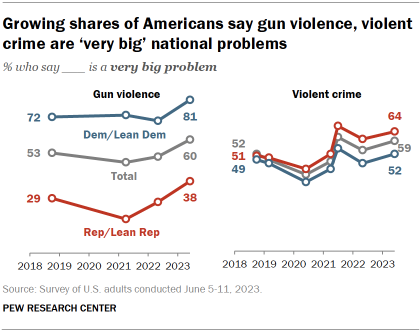
Public support for specific gun policies also crosses party lines. Pew has found broad concern about gun violence and majority support for several restrictions, including bans on assault-style weapons and high-capacity magazines. This suggests that Americans are not divided into two completely opposing moral camps. Identity may influence how strongly people hold these views or interpret the evidence, but policy judgments clearly matter too. 7 (see Figure 2)
Abortion views can also change with circumstances. Research across 51 countries finds that opinions vary with national policy environments and individual characteristics. Other studies report that personal experience can make abortion attitudes more flexible. KFF polling has found that majorities of women, including in states with abortion bans, support legal abortion in many or most circumstances and favor several policies protecting access. Those views indicate concrete judgments about health and access, not only expressions of group identity. 6
The bottom line
The evidence supports a qualified version of the claim, but not its strongest wording. Moral identities clearly help organize both conflicts, especially abortion, where partisan, religious and moral sorting is strongly documented. For guns, the evidence more clearly shows disagreement about risks and policy effects, and some supposedly “identity-based” gun beliefs may also reflect personal experience or perceived consequences.
Overall, the evidence favors the view that both identity and policy-outcome beliefs matter, with identity playing the clearer role in abortion. But no cited study directly compares their causal importance across both issues. The research therefore does not establish that moral identities drive more of the combined gun-and-abortion divide. Confidence in that broader claim is moderate at most: the supporting evidence is substantial, but the key comparison remains unresolved.
Figures & data


All contributions are reviewed for clarity, balance, and evidence. The strongest insights are elevated into the argument graph — with credit to you.
Help improve this analysis →