University tenure should be abolished
What's this about?
People disagree about whether colleges should end tenure, which gives some professors long-term job safety.
Supporters want renewable (can be renewed) contracts instead.
What supporters say
- Contracts could let colleges check teaching, research, and other work more often.
- Colleges could act more easily when a professor keeps doing poor work.
- Contracts could help colleges change classes when money or student needs change.
- Rules about jobs can affect what research professors choose and how they respond to school goals.
What critics say
- Studies do not show that ending tenure works better than fixing it.
- Some studies look at tenure changes, not at replacing tenure with contracts.
- Many colleges use part-time teachers, but those jobs may not offer safe, fair contracts.
- Colleges can use strong reviews after tenure to deal with long-term poor work.
The bottom line
The best evidence supports improving tenure, not ending it fully.
Colleges need fair ways to check poor work, but we are not sure contracts would do better.
University tenure should be abolished and replaced with renewable contracts, according to supporters who say the change would make institutions more flexible and faculty more accountable. But the available evidence points more strongly toward reforming tenure rather than eliminating it altogether.
The case for
Supporters of abolition argue that renewable contracts could give universities a more regular way to assess faculty work and respond to changing needs. Instead of making one high-stakes tenure decision early in a professor’s career, institutions could conduct recurring reviews of teaching, research and service. That could make it easier to address long-running poor performance, adjust staffing and reshape academic programs when budgets or student demand change. Research on post-tenure review supports the idea that universities need credible ways to deal with sustained inadequate performance 1.
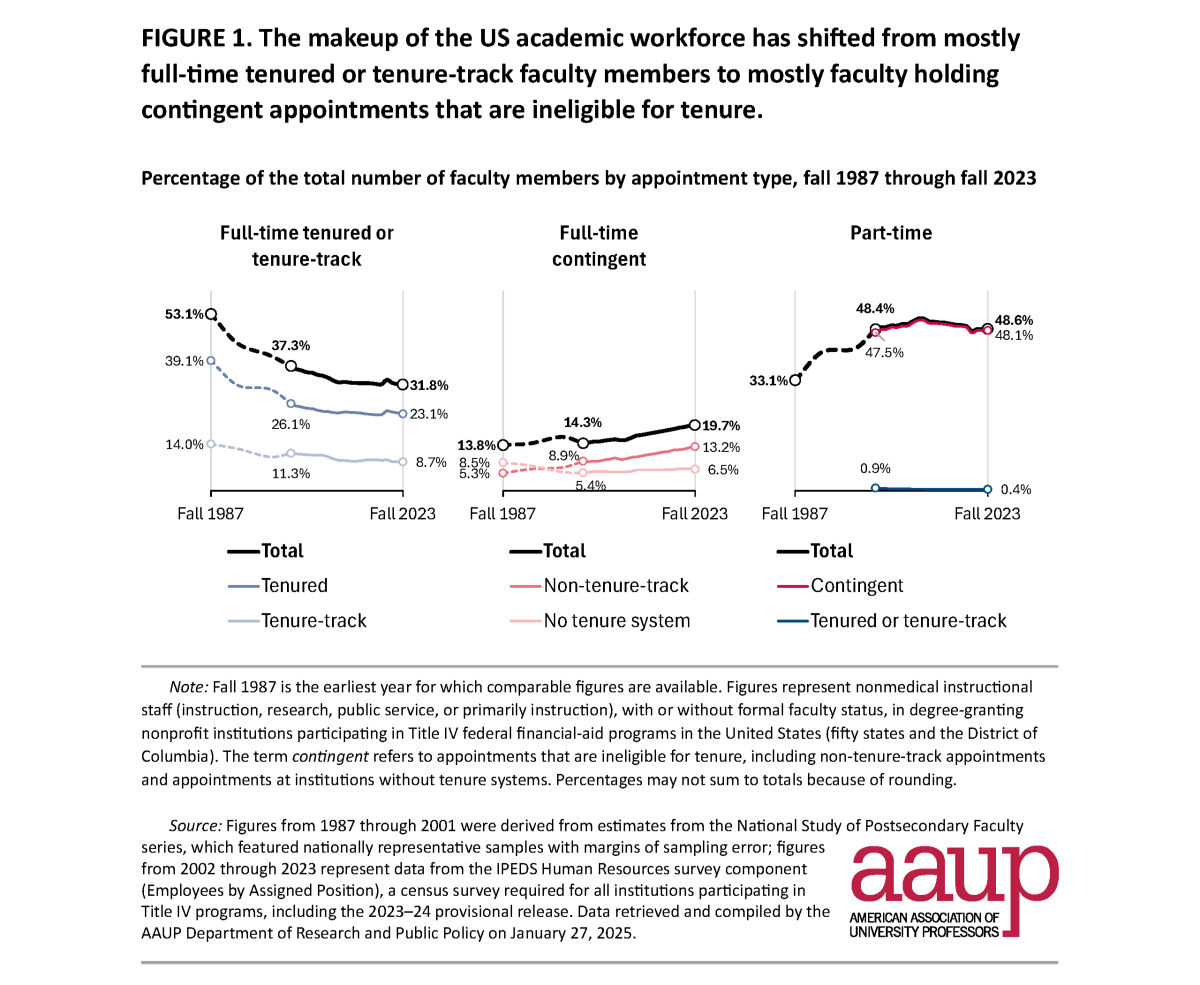
Traditional tenure is also not the only employment model in higher education. Many colleges already rely heavily on part-time and non-tenure-track instructors, and tenure arrangements differ widely across sectors. That shows universities can operate under other staffing systems, even if those systems are not necessarily the same as secure renewable contracts (see Figure 1).
There is also reason to believe that job security and evaluation rules affect academic behavior. Studies of tenure-track systems and reforms in China suggest that incentives can shape research choices and responsiveness 3. For advocates, that makes contract redesign a plausible way to encourage innovation or make faculty more answerable to institutional priorities.
But these studies do not show that abolishing tenure works better than improving the existing system. They examine incentives within tenure-track arrangements, or reforms that added stronger performance incentives alongside them—not a wholesale move from tenure to renewable contracts.
The case against
The strongest argument against abolition is that tenure is meant to protect scholars who pursue controversial research, teach unpopular ideas or speak out against powerful interests. Tenure is not simply a reward for seniority: backed by due-process rules, it is designed to prevent arbitrary dismissal. AAUP standards treat those protections as central to academic freedom, and its investigations have documented cases in which faculty faced political or institutional pressure 4.
Critics say renewable employment could make that pressure more powerful. A study of fixed-term faculty members in British universities found that dependence on contract renewal can limit academic freedom, as instructors become more sensitive to management priorities and institutional expectations 5. Related research also suggests that perceived risk and workplace conditions can affect what scholars choose to investigate.
There is little evidence that replacing tenure with contingent or renewable employment would reliably improve teaching or lower costs. Research on adjunct and contingent faculty shows mixed results for student outcomes. It also finds that experience, working conditions, course type, field of study and whether instructors are integrated into their institutions all matter 6. Those findings cannot be treated as a direct test of a well-designed renewable-contract model, because adjunct jobs are often far less secure and supported than the contracts abolition supporters envision.
Another concern is the effect on long-term research. Scholars on shorter renewal cycles may be less willing to take on risky, slow-moving or commercially unattractive projects if their next contract depends on near-term results. Existing research links employment conditions to research behavior, but it does not establish exactly how large this effect is—or how much valuable scholarship abolition might discourage 7.
The bottom line
The evidence shows a real trade-off. Universities need tools to address poor performance, adapt to financial and academic changes, and maintain public confidence. But there is no direct, strong evidence that universal abolition of tenure and its replacement with renewable contracts would deliver better results overall.
The better-supported approach is targeted reform: clear performance expectations, regular reviews, opportunities for improvement and sanctions where needed, while retaining strong due-process protections for academic freedom. Post-tenure review research and professional guidance suggest that accountability can be strengthened without removing the safeguards that protect independent scholarship.
Confidence is high that neither tenure nor non-tenure employment alone solves every management problem. Confidence is much lower in claims about what wholesale abolition would produce, because the key evidence is missing: direct comparisons between abolished tenure systems and carefully reformed alternatives with enforceable academic-freedom protections.
Figures & data
All contributions are reviewed for clarity, balance, and evidence. The strongest insights are elevated into the argument graph — with credit to you.
Help improve this analysis →