Banning teenagers from social media is less effective than addressing the main causes of adolescent mental-health problems
What's this about?
People disagree about whether banning teens from social media would help mental health more than fixing deeper problems.
These problems can include family stress, bullying, poverty, unfair treatment, and hard school life.
What supporters say
- Social media links to poor well-being, but the link stays small and changes across studies.
- Mental health has many causes, so a ban would not fix most of them.
- Help with home life, school, money, friends, and bad online habits may work better.
- Researchers have little direct proof that broad bans improve teen mental health.
What critics say
- Social media can hurt some teens, especially those already facing mental health problems.
- Limits may stop serious harms, such as bullying, harmful trends, or unsafe contact.
How to read this
The number of points on each side does not show who is right; strong proof matters more than a long list.
The bottom line
The evidence mostly supports fixing the main causes of teen mental health problems, not using broad bans.
Still, focused limits may help stop certain harms from social media.
The claim is that banning teenagers from social media would do less to improve mental health than tackling the family, social and economic conditions behind many adolescent problems. The evidence largely supports that view, while leaving room for targeted restrictions where platforms create specific risks.
The case for
Adolescent mental health has many causes, and most would not change simply because teenagers lost access to social media. The World Health Organization points to family relationships, violence, bullying, poverty, discrimination, school pressures, substance use and limited access to care. Research also links suicidal thoughts and behavior to a mix of psychological, family, social and behavioral factors. 1
That makes a blanket ban a narrow response to a broad problem. Reviews of social conditions suggest that support involving housing, education, employment and social inclusion can affect mental health, although results vary by place and by the outcome being measured. Programs that provide peer support or help young people change harmful digital habits may also target risks more directly than simply removing access. 4
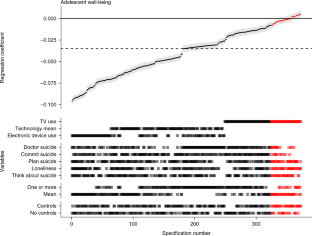
The average link between social-media use and well-being is also small and inconsistent. Large studies of teenagers have found negative associations, but social media explains only a limited share of differences in well-being. The National Academies has concluded that effects vary widely between adolescents and that current research does not justify blaming social media alone for population-wide mental-health trends (see Figure 1).
A meta-analysis found links between social-media use and symptoms such as anxiety and depression, but the results differed according to how use and mental health were measured and which studies were included. Those differences make it difficult to show that social media exposure itself causes the problems. 2
Most importantly, there is little direct evidence that universal bans work. Policy reviews describe age limits and other safeguards, but find uncertain effects, enforcement problems and limited evaluation of blanket bans. Existing observational studies can show that social media use and poor mental health occur together; they cannot establish that banning access would improve mental health, let alone that it would outperform other approaches. 3
The case against
Social media can still cause real and concentrated harm, especially for vulnerable adolescents. Research points to social comparison, cyberbullying, harmful content, disrupted sleep and compulsive use as possible pathways. The overall average effect may look modest while concealing serious consequences for particular young people. 5
Restrictions may therefore prevent some harms that parents and schools cannot easily control. Age limits, parental controls, content moderation, privacy rules, safer platform design and digital-literacy programs are all possible tools. Targeted limits could be especially useful for teenagers already experiencing severe distress or problematic use.
But the evidence does not show that a broad ban would be the best tool. Studies and expert reviews stress that content, context and personal vulnerability may matter more than access alone. Some teenagers also use online platforms for connection, support and information. The effects can differ by age, platform, intensity of use and the quality of implementation. 6
The bottom line
The evidence favours addressing the wider causes of adolescent mental-health problems, and it does so with high confidence. Research strongly supports the view that mental health is shaped by multiple conditions, while the average association between social media and well-being is limited and varied. Evidence for the effectiveness of a legal blanket ban is notably weaker.
That verdict is not a finding that restrictions are useless. Platform harms are credible, and targeted safeguards may be justified for vulnerable teenagers. The strongest conclusion is narrower: the available evidence does not show that banning all teenagers from social media would improve mental health more effectively than tackling poverty, family adversity, bullying, school pressure, discrimination, substance use and access to care (see Figure 3). Direct comparisons between universal bans, targeted safeguards and upstream support remain unresolved.
Pros — Supporting Arguments
Cons — Opposing Arguments
Figures & data

All contributions are reviewed for clarity, balance, and evidence. The strongest insights are elevated into the argument graph — with credit to you.
Help improve this analysis →