The United Kingdom’s withdrawal from the European Union has delivered fewer benefits than its economic and political costs
Bottom line (updated 2026-09-01): The evidence leans toward Brexit bringing fewer gains than its money and political costs. Still, we cannot easily compare lost income with gains in control and the power to make rules.
What's this about?
People disagree about whether Brexit gave the United Kingdom more benefits than the costs of leaving the European Union.
What supporters say
- Brexit cut trade with Europe and will likely lower the UK’s long-term wealth and work output.
- Less foreign money came into the UK, while new border checks raised costs for many firms.
- Brexit gave the UK more control over rules, but this freedom can make trade harder.
- New fights over power between the UK and its nations have kept causing political strain.
What critics say
- The UK gained the power to make its own trade deals with countries outside Europe.
- Ending free movement gave the UK more control over who could come from EU countries.
- Brexit let UK voters choose their own laws and rules without EU control.
How to read this
The number of points on each side does not show who is right; strong proof matters more.
The bottom line
The evidence leans toward Brexit bringing fewer gains than its money and political costs.
Still, we cannot easily compare lost income with gains in control and the power to make rules.
The claim is that Brexit has brought fewer benefits to the United Kingdom than the economic and political costs of leaving the European Union. The evidence points in that direction, but the conclusion remains qualified because sovereignty and policy freedom are difficult to compare with economic losses.
The case for
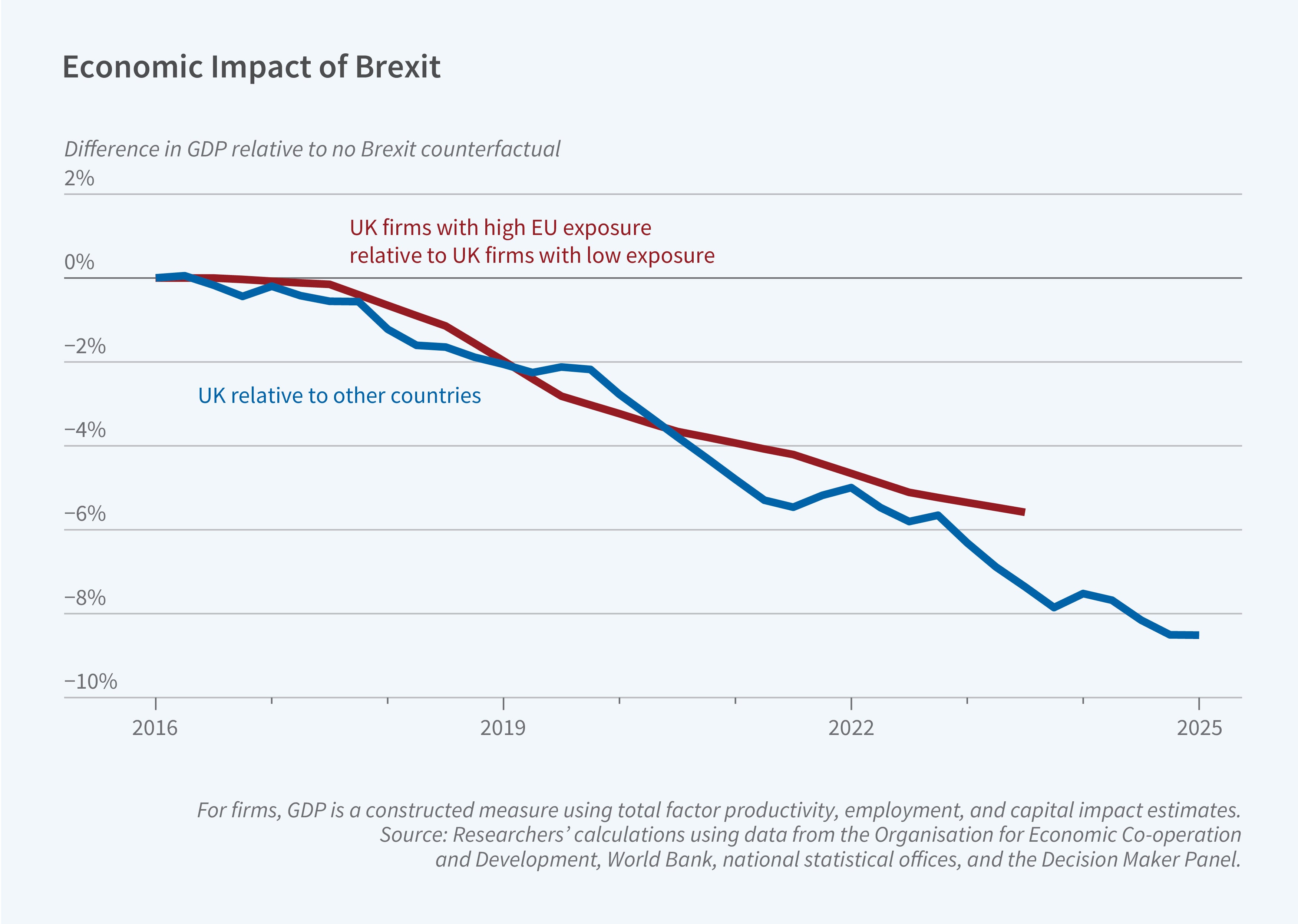
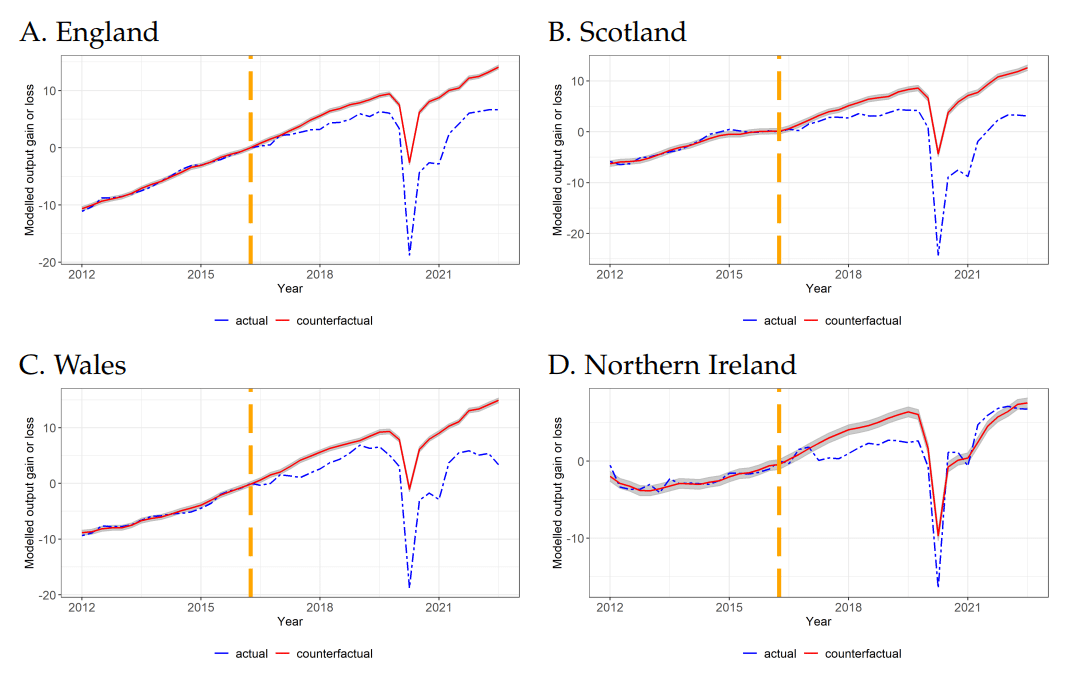
The strongest evidence concerns trade and long-term economic performance. The Office for Budget Responsibility estimates that, compared with remaining in the EU, Brexit will reduce the UK’s trade intensity and long-run productivity. Its analysis separates these effects from shocks such as the COVID-19 pandemic (see Figure 1). Research linked to the Centre for Economic Performance similarly finds that Brexit-related barriers reduced goods trade and output. The Institute for Fiscal Studies has argued that the long-term public-finance costs of weaker trade, investment and productivity are likely to exceed savings from lower EU contributions. 1
Brexit also appears to have weakened investment and raised costs for companies trading across the UK-EU border. Centre for Economic Performance research found that the referendum and the subsequent Brexit process reduced foreign investment compared with a similar counterfactual UK. Firms, especially smaller businesses and goods exporters, have faced new customs checks, regulatory requirements and other delays. Diverging from EU rules may give Britain more freedom, but it can also force companies to comply with two systems. 2
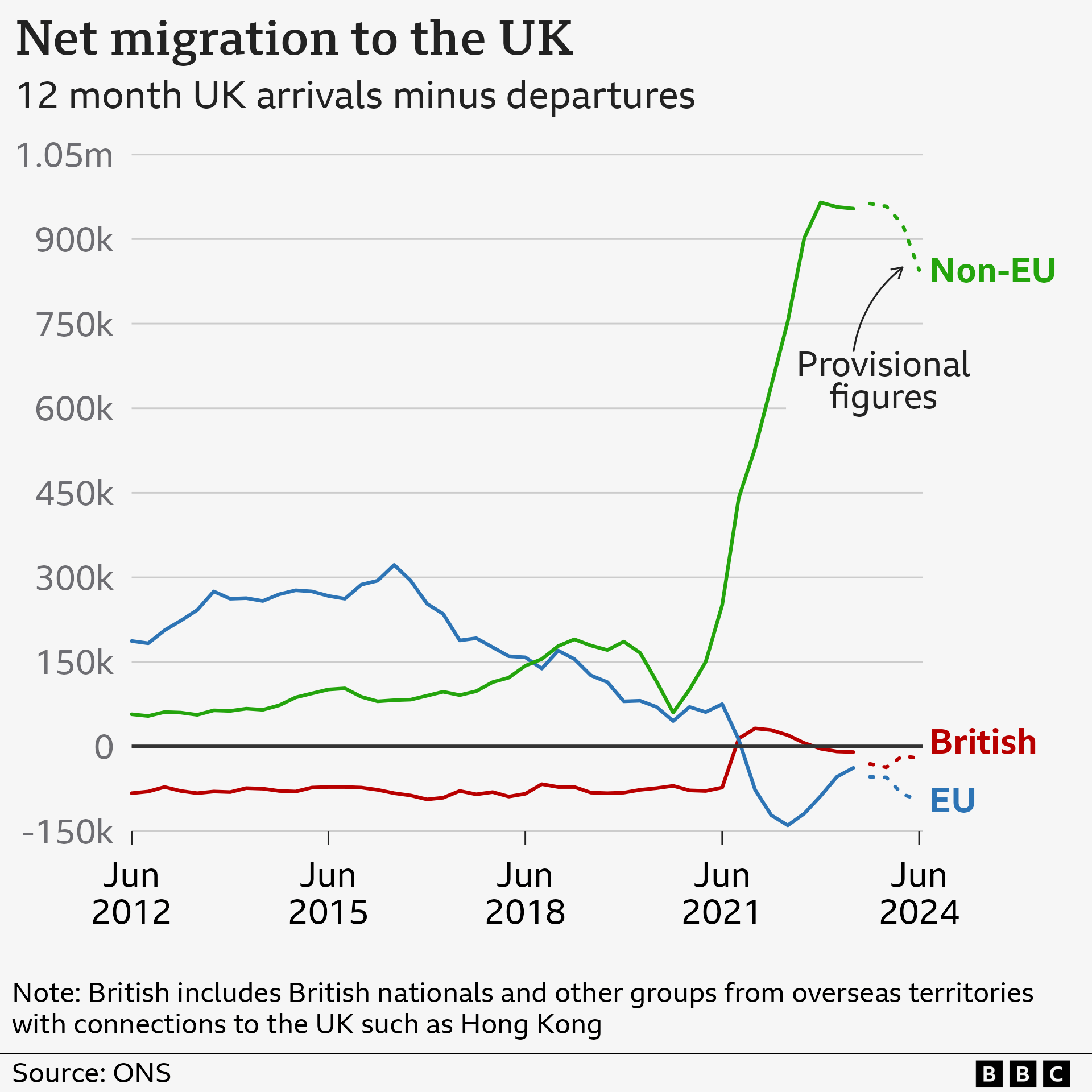
The new immigration system changed who could come to Britain, but it did not clearly reduce overall migration. Ending free movement lowered migration from EU countries, while migration from outside the EU rose substantially. Some industries that had relied heavily on European workers have faced shortages and adjustment costs. The change therefore delivered more national control over immigration than a clear reduction in total arrivals. 3
There have also been political and administrative costs. The Institute for Government has recorded continuing tensions over the distribution of power within the UK, particularly involving Scotland and Northern Ireland. The National Audit Office has highlighted the complexity and uncertainty surrounding Northern Ireland’s distinct trading arrangements. 4 Public opinion offers supporting, though weaker, evidence: many voters now say Brexit has gone worse than expected, and support for closer relations with the EU has increased. Views remain sharply divided by age, region and how people voted in 2016. 5
The case against
Brexit did deliver greater formal political authority to Westminster. The UK regained control over laws, immigration rules and many regulatory choices that had previously been shaped through EU institutions. That autonomy is a real benefit, even though it does not appear directly in measures such as GDP. 6
The country also gained an independent trade policy. The House of Commons Library records new UK trade agreements and Britain’s accession to the CPTPP trade partnership. These agreements create options that EU membership did not provide. However, many early deals largely carried over arrangements the UK already had through the EU, so their immediate economic gains have been limited. 7
Ending free movement also gave governments more ability to design immigration rules around national priorities, using visa conditions and other controls. Whether that benefit outweighs the costs depends partly on how much voters value control and flexibility, rather than only on whether migration totals fall. Reduced free movement may have made policy more responsive to public demands, even as it contributed to labour shortages in some sectors. 8
The bottom line
The evidence favours the claim, but only moderately and with low confidence about the exact balance. Independent assessments repeatedly find that Brexit reduced trade, investment and long-term economic performance compared with continued EU membership. Those losses, alongside labour-market pressures and constitutional strain, appear to outweigh the measurable economic benefits of leaving.
But this is not a precise financial calculation. The economic estimates depend on a counterfactual—what would have happened if Britain had stayed in the EU—and are complicated by the pandemic, energy shocks, global trade changes and domestic policy decisions. At the same time, sovereignty, regulatory freedom and the possibility of future trade gains have no agreed monetary value.
The clearest conclusion is therefore directional rather than numerical: Brexit created real political autonomy and policy choices, but the documented economic and administrative costs currently appear larger. Future regulatory reforms, trade deals or closer UK-EU cooperation could change that assessment.
Figures & data
All contributions are reviewed for clarity, balance, and evidence. The strongest insights are elevated into the argument graph — with credit to you.
Help improve this analysis →