Energy companies can be held legally liable for damages caused by climate change
What's this about?
People disagree about whether energy firms can legally pay for harm from a warming world.
Science can link some warming to their fuels, but courts still face hard proof questions. A court must also decide what duty the firm broke and how much harm it caused.
What supporters say
- New climate studies can link major fuel makers to part of the heat their products helped cause.
- Courts in some places have made big energy firms follow duties to cut pollution.
- People may also sue firms for false or misleading claims about the harms of their fuels.
What critics say
- A court’s decision that a duty exists does not mean it will order a firm to pay money.
- It remains hard to prove that one firm caused one flood, fire, or other loss.
- In the United States, laws made by judges put strong limits on some climate suits.
How to read this
The number of points on each side does not show which side is right; the strength of the proof matters more.
The bottom line
The claim is partly true, but only in some places and in limited ways. Science strongly supports links between fuel makers and warming, yet winning money for one clear loss remains hard.
The claim that energy companies can be held legally responsible for climate-change damage is partly supported, but only in a limited and jurisdiction-specific sense. Courts and scientists have developed ways to connect fossil-fuel producers to climate harm, yet proving that one company must pay for a particular loss remains difficult.
The case for
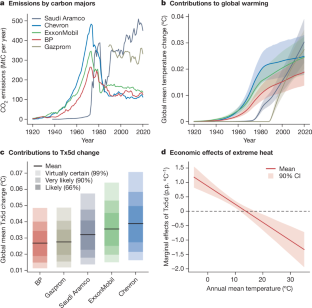
Climate science can now link major fossil-fuel producers to part of the warming they helped cause. The IPCC says human activity has unequivocally warmed the atmosphere, ocean and land, and has connected that warming to changes in some extreme events. Other peer-reviewed research traces cumulative carbon emissions to rising temperatures and develops methods for estimating how much warming is associated with major producers. 1
That evidence does not decide the legal question by itself. But it could support a claim that a company’s contribution should not be treated as either zero or the entire cause of an injury. In some courts, a claimant might argue for responsibility in proportion to the company’s contribution, subject to local rules on causation and damages. Carbon-majors research provides the scientific bridge from producer-level emissions to attributable warming, but it does not itself establish a legal duty or liability under any particular country’s law (see Figure 1).
Some legal systems have recognized climate-related duties involving private energy companies. In the Dutch case against Shell, a district court relied on a duty of care to order the company to reduce emissions across its group. That was an emissions-reduction ruling, not an award of compensation, but it shows that a court may impose climate obligations on a major producer.
The case of Lliuya v. RWE also demonstrates that a claim seeking compensation for a company’s proportionate share of climate-related flood risk can move through litigation. The case does not show that damages will ultimately be awarded. It does, however, indicate that such a legal theory can be tested in court.
Another possible route focuses not on emissions alone but on alleged misleading marketing, concealment, misrepresentation or failure to warn. These claims could avoid some problems involved in treating global greenhouse-gas emissions as one general nuisance. Their success would still depend on proving what companies said, which consumer or tort laws apply, whether the claims were filed in time and which court has authority. 3
The case against
Scientific attribution does not automatically establish the legal requirements needed for compensation. Climate losses usually result from emissions by many producers and consumers over decades, together with natural variability and local conditions. Moving from proof of general warming to proof that one company legally caused a specific loss remains unresolved in many cases. 5
In the United States, one major legal route has already been narrowed. The Supreme Court’s decision in *American Electric Power v. Connecticut* held that the Clean Air Act displaced federal common-law nuisance claims seeking regulation of greenhouse-gas emissions. Other cases have faced disputes over jurisdiction, removal to federal court, standing, political questions, displacement and causation. 4
Even when a court recognizes a climate-related duty or allows a claim to proceed, that does not mean the claimant will receive money for past losses. The Shell judgment addressed prevention and emissions reduction rather than compensation. Reviews of climate litigation show different results depending on the country, legal theory and remedy sought (see Figure 2).
The central gap in the evidence is the small number of final decisions requiring a named energy company to pay for a clearly specified climate loss under a settled legal rule. The record shows legal experimentation and uneven accountability, not a simple pattern in which filing more cases proves that the claims will succeed. 6
The bottom line
The evidence supports the claim in a qualified way, but not as a general rule that energy companies can routinely be ordered to pay climate damages. Scientific support for linking producers to some share of climate change is strong, and courts in certain legal systems have recognized climate-related obligations or allowed related claims to proceed.
The evidence is weaker on the crucial next step: proving defendant-specific legal causation, dividing responsibility among contributors and obtaining compensation for a particular loss. Whether a company must pay will depend on the jurisdiction, the legal theory, procedural defenses, evidence of duty and causation, and the remedy being sought. Confidence is high in this limited conclusion: energy companies can face legally viable climate claims, but universal liability for damages has not been established.
Figures & data
All contributions are reviewed for clarity, balance, and evidence. The strongest insights are elevated into the argument graph — with credit to you.
Help improve this analysis →