Courts can apply consistent, enforceable constitutional standards to identify and remedy partisan gerrymandering
What's this about?
People disagree about whether courts can use clear, lasting constitutional (based on a constitution) rules.
These rules would spot and fix unfair party-based map drawing.
What supporters say
- Math tools can show how voting maps turn votes into seats, though each tool makes some guesses.
- Courts in Pennsylvania and North Carolina ordered new maps after finding unfair party-based districts.
- Partisan symmetry (equal treatment for both parties) could give courts one fair rule.
What critics say
- Different math tests can reach different answers about whether a map treats parties unfairly.
- Court fixes may not stay stable because judges lack one shared rule for handling these cases.
- The Supreme Court found no workable federal standard for judging party-based map drawing.
- Where voters live can create odd map results, even without plans to help one party.
How to read this
The number of points on each side does not show which side is right; stronger proof matters more.
The bottom line
Courts can measure party effects, and some state courts have ordered useful fixes.
Still, the evidence leans against the claim: courts lack one clear, lasting federal rule.
Courts can measure the partisan effects of election maps, and some state courts have ordered remedies. But the evidence does not show that judges have a single, durable constitutional rule for deciding when partisan gerrymandering becomes unlawful.
The case for
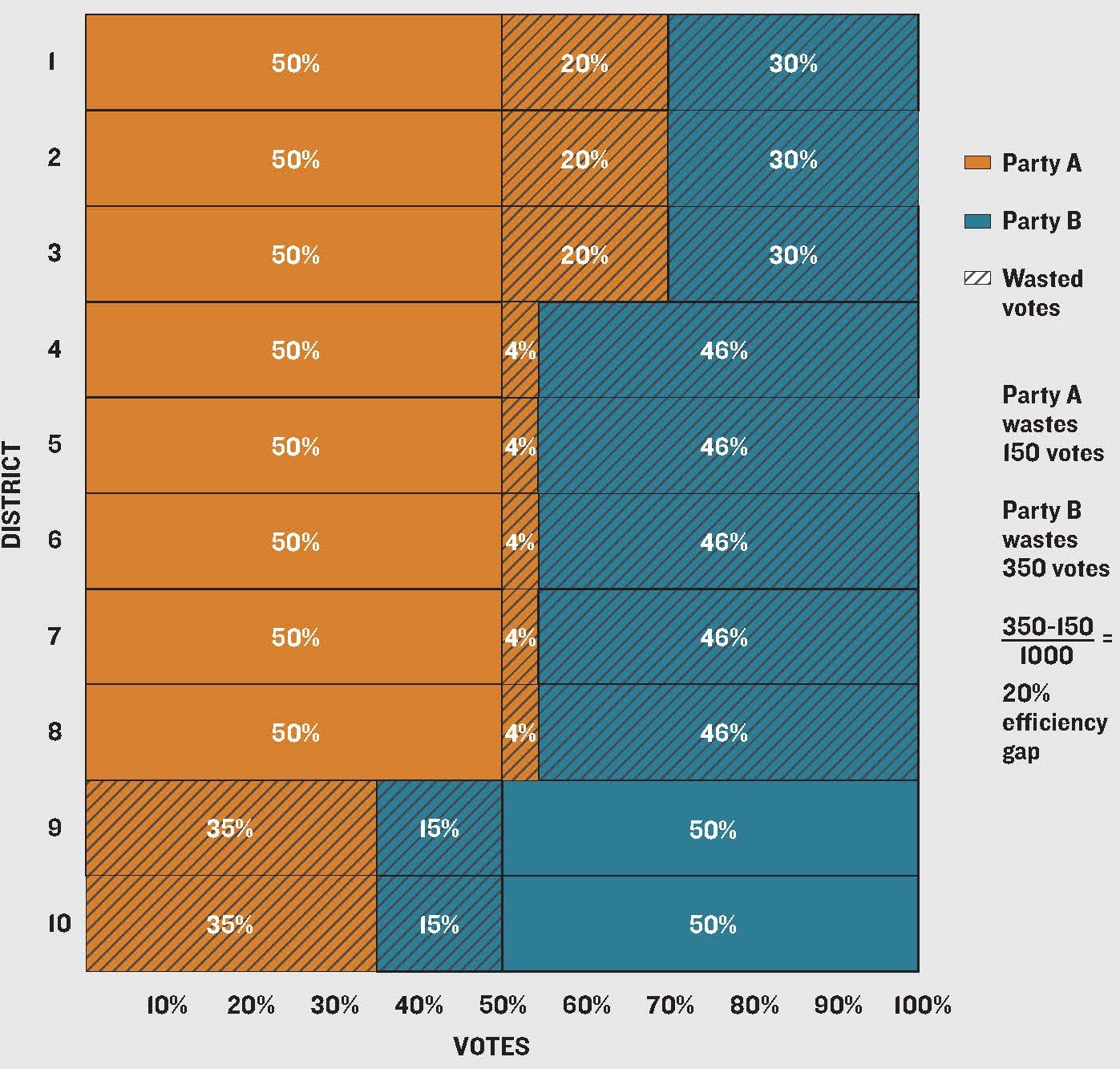
Statistical tools can make partisan effects visible to courts. The efficiency gap counts “wasted” votes to estimate how a map converts votes into seats. Partisan-symmetry analysis asks whether competing parties receive comparable treatment when they win similar shares of the vote. These methods can turn a disputed political effect into evidence that courts can examine, although each depends on assumptions about turnout, competitiveness and geography. (see Figure 3) 1
A second approach compares an enacted map with large collections of alternative maps that follow the same legal and geographic rules. This can show whether a plan produces an unusually extreme partisan result rather than merely an outcome that one party dislikes. Research on North Carolina found highly unusual outcomes when its map was compared with many alternatives, suggesting that partisan effects can be measured even if measurement alone does not prove a constitutional violation. (see Figure 1)
State courts have shown that constitutional findings can lead to practical remedies. Courts in Pennsylvania and North Carolina concluded that extreme or unfair partisan districting conflicted with state constitutional protections. They required replacement maps or new remedial processes. 2 Those cases show that courts can identify a legally recognized injury and order a workable response, though they relied on state constitutional language rather than a common federal rule.
Supporters also argue that partisan symmetry could provide a neutral constitutional principle. It does not automatically favor either party and could, in theory, establish a shared standard for judging unequal treatment. But the idea requires decisions about how much asymmetry is too much and which counterfactual comparisons should matter. 3
The case against
The strongest objection is that different measurements can produce different answers. Efficiency-gap results can change with turnout and district competitiveness. Map-ensemble results depend on how alternative plans are created and what counts as a neutral baseline. Symmetry analysis also requires assumptions about hypothetical elections and a legal judgment about the level of imbalance that should be unconstitutional. A single map could therefore appear unlawful under one measure and acceptable under another. (see Figure 2) 5
The Supreme Court has not supplied a controlling federal test. In *Vieth*, *LULAC*, *Gill* and *Rucho*, the justices declined to establish a workable standard; *Rucho* held that partisan-gerrymandering claims were political questions beyond the reach of federal courts. *Gill* rejected a statewide efficiency-gap theory on standing and remedy grounds. This is direct evidence against the broad claim that courts can consistently enforce a federal constitutional rule. 4
Election results also can mislead. Partisan geography may create large seat advantages without deliberate manipulation, because voters from one party may be heavily concentrated in particular areas. A large gap between votes and seats therefore does not, by itself, prove unconstitutional intent or conduct. 6
Even successful state-court remedies may not last. The later reversal of *Harper v. Hall*, after a change in North Carolina’s court composition, showed how judicial standards can depend on a state’s constitutional text and the makeup of its courts. That raises doubts about whether remedies are stable across time and jurisdictions. 7
The bottom line
The evidence favors a qualified version of the claim, but not its broad wording. Courts can measure partisan effects, and some state courts have imposed remedies. Yet the strongest evidence shows that no generally accepted, enforceable federal constitutional standard has been settled.
A possible future framework could combine evidence of intent, several partisan-effect measures, historical and geographic comparisons, and neutral-map ensembles. Relying on agreement among methods might be more reliable than setting one numerical cutoff. But courts would still have to decide the key legal questions: what level of advantage is forbidden, how much intent matters, and what remedy is justified.
So the claim is technically plausible but not established as a general rule. Confidence in that conclusion is high: it rests on Supreme Court decisions, methodological research and concrete state cases. The main uncertainty is whether courts can turn those tools into a neutral threshold and a durable remedy without repeating the instability already seen in federal and state litigation.
Figures & data
All contributions are reviewed for clarity, balance, and evidence. The strongest insights are elevated into the argument graph — with credit to you.
Help improve this analysis →