The semiconductor supply chain should be prioritized as a national security interest
What's this about?
People disagree about whether a nation should treat chip supply as a key part of its safety. Chips power armed forces, phones, cars, power grids, and many daily tools.
What supporters say
- A lack of key chips can hurt armed forces and vital systems, such as power and phone links.
- Chip making needs many steps, rare tools, and skilled workers across many lands.
- If one step fails, firms may not find a quick new source for that chip part.
- Some lands now use rules and funds to guard key chip skills from rivals.
What critics say
- A nation cannot quickly make every kind of chip within its own borders.
- Trade with other lands gives firms useful skills, parts, and lower costs.
- Wide trade bans could raise prices and harm firms that need chips for normal goods.
- Rules should focus on the few chips that matter most for armed forces and vital systems.
The bottom line
The facts suggest that nations should treat key chip supply as a safety concern. But they should build backup plans for the most vital chips, not try to make every chip at home.
Semiconductor supply chains should be treated as a national-security concern, the evidence suggests—but not as a reason to make every chip at home or to apply sweeping trade restrictions. The strongest case is for targeted resilience around the most critical technologies and components.
The case for
Chips sit inside military systems, communications networks, power infrastructure, vehicles and countless consumer products. When supplies are disrupted, the effects can spread far beyond the companies that directly need the parts, limiting wider economic production. That supports treating access to essential semiconductors as a matter of national resilience, even though the available evidence does not measure the precise military impact of a chip cutoff. A shortage of critical chips can impair defense and essential infrastructure 1.
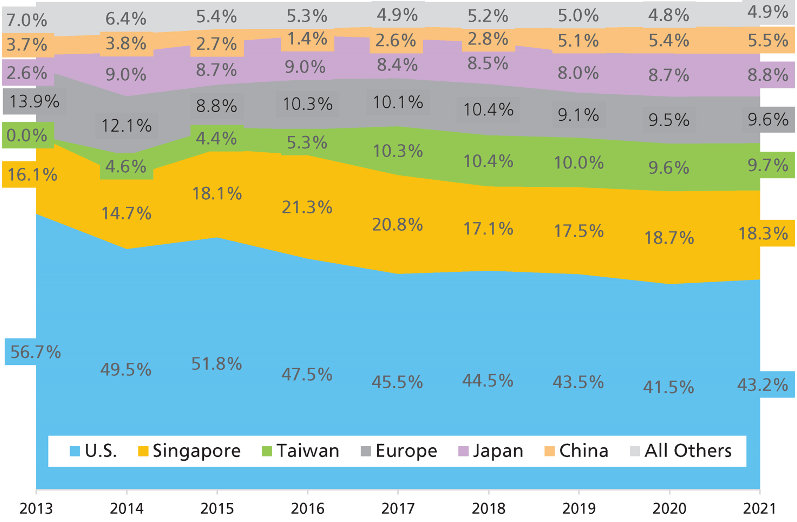
The supply chain is also unusually difficult to replace in a crisis. Chip production is not a single factory operation that can easily be moved from one country to another. It depends on many specialized stages, materials and technical capabilities distributed across different countries; a disruption at one stage may have no quick substitute (see Figure 1). That makes global specialization a strategic vulnerability as well as an economic advantage 2.
Governments have already begun to frame dependable chip access in these terms. Japan’s 2022 Economic Security Promotion Act, for example, linked semiconductor access with economic security and strategic autonomy. Policy and legal analyses also show governments using investment rules and CHIPS Act-style guardrails to limit technology transfer and reduce dependence in sensitive areas. These tools provide a case for protecting genuinely sensitive technologies, though they do not prove that broad protectionism is necessary 3.
A practical approach would treat chips differently depending on their importance and how easily they can be replaced. Rather than pursuing one all-encompassing solution, governments could map suppliers, diversify purchases among allies, maintain stockpiles, improve cybersecurity, support research and build selected domestic capacity. The evidence favors this kind of portfolio strategy over treating every semiconductor as equally important.
The case against
The most serious objection is that national-security priority can be mistaken for a call for complete domestic self-sufficiency. Modern semiconductor production is internationally interdependent, with specialized inputs and manufacturing steps spread across borders. Reproducing all of them within one country could be expensive and might still leave dependence on foreign equipment or materials. Resilience does not necessarily mean autarky 4.
There is also a risk that security-based industrial policy becomes too broad or poorly governed. Subsidies, export restrictions and investment guardrails can raise legal and trade-policy concerns, particularly when governments cannot clearly show why a measure is necessary and proportionate. The existence of national-security tools supports focused action, but it also strengthens the argument for clear limits and accountability 5.
Expanding fabrication capacity may bring environmental and local costs as well. Large industrial projects can put pressure on water supplies, energy systems and pollution controls. The evidence reviewed is not specific enough to calculate the net environmental effects of semiconductor plants, but it is enough to show that these effects should be part of any decision to expand manufacturing 6.
The record has important gaps. It does not offer direct comparisons of the cost and effectiveness of domestic manufacturing, allied diversification, stockpiles or other resilience measures. It also lacks firm-level evidence, official supply-chain assessments and production-share data that would help establish the scale of particular geopolitical risks.
The bottom line
The evidence strongly supports making semiconductor supply continuity and protection of critical chip technologies a national-security priority. But it supports calibrated, targeted measures much more strongly than a push for comprehensive domestic chip production.
Governments have a credible reason to guard against disruption and coercive dependence in crucial parts of the supply chain. Yet the best response is likely to combine domestic capacity in selected areas with allied partnerships, stockpiles and other safeguards—not to attempt to duplicate the entire global semiconductor system at home. Confidence in that limited conclusion is high, while the best policy mix remains uncertain because there is little direct evidence on the costs and results of specific interventions.
Figures & data

All contributions are reviewed for clarity, balance, and evidence. The strongest insights are elevated into the argument graph — with credit to you.
Help improve this analysis →