European governments should prioritize buying defence equipment from European suppliers over non-European suppliers
Bottom line (updated 2026-10-14): The evidence supports building a stronger defence industry in Europe. But it does not show that Europe should favor its own suppliers over better price, speed, or gear that works well with allies.
What's this about?
People disagree about whether Europe should favor defence gear from Europe (European gear) over gear from other places.
What supporters say
- A stronger defence industry in Europe could help countries prepare for future wars.
- Countries could buy together, cut waste, and avoid each nation making its own gear.
- Buying from Europe could keep key skills, plants, and repair work close during a crisis.
- Heavy reliance on United States suppliers could create risks if politics or supply lines change.
What critics say
- Gear made in Europe may still fail to work well with gear from other countries.
- European suppliers may not have the right gear ready when countries need it fast.
- Suppliers from outside Europe may offer proven tools and make them in large amounts.
- Favoring suppliers from one place could cut rivals, raise prices, and protect weak firms.
How to read this
The number of points on each side does not show who is right; strong proof matters more than a long list.
The bottom line
The evidence supports building a stronger defence industry in Europe.
But it does not show that Europe should favor its own suppliers over better price, speed, or gear that works well with allies.
European governments face a choice over whether to give defence companies from Europe an advantage in public contracts. The strongest argument is that this could reduce dependence on outside suppliers, but the evidence does not support making European origin more important than capability, price, speed or interoperability.
The case for
Buying more from European suppliers could strengthen security of supply. A larger European industrial base would provide more production, maintenance and research capacity within Europe, potentially improving readiness in a crisis. It could also preserve skills and facilities that are difficult to rebuild quickly once they disappear. 1 2
Europe’s defence market is highly fragmented, with countries often buying separately and ordering too little to achieve economies of scale. A purchasing preference could provide more predictable demand, but the benefits would be greater if governments bought together, used common standards and coordinated their capability plans. Joint procurement could reduce duplication and help sustain production between crises. 3
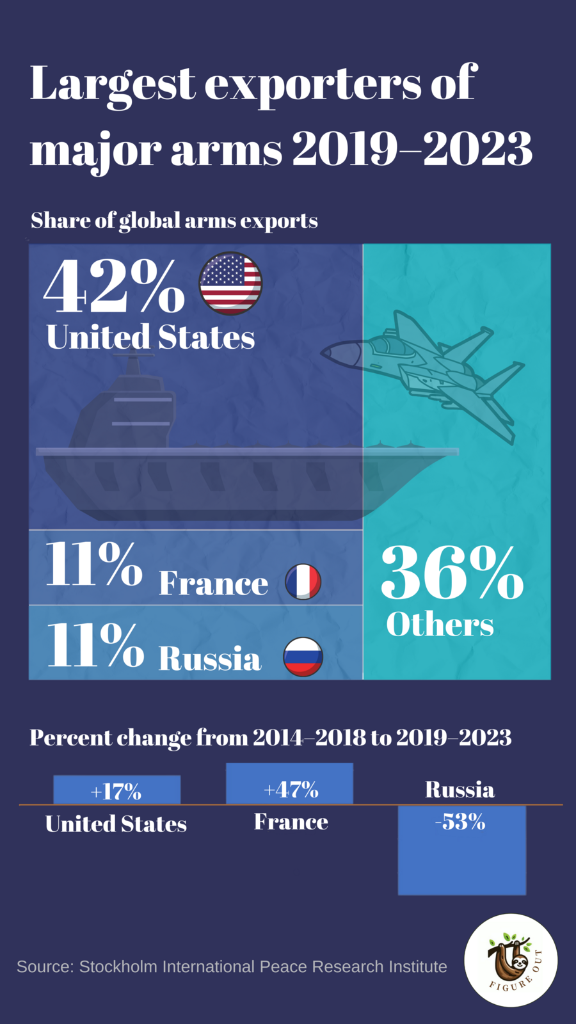
Europe’s dependence on external suppliers, particularly the United States, also creates strategic exposure. SIPRI reports that European arms imports nearly doubled between 2014–18 and 2019–23, with the United States supplying a dominant share of deliveries (see Figure 1). That pattern supports concerns about political dependence and possible supply disruption. 4
But those figures do not show that European equipment would be cheaper, arrive faster or perform better. They point to a reason to diversify supply, not conclusive proof that a geographic preference is the best remedy.
The case against
An unconditional preference for European suppliers could reduce competition and raise costs. It might also protect inefficient producers, encourage national duplication and weaken the value governments get from defence spending. Policy analysis from ECIPE and Bruegel warns that closed procurement systems can produce these results. 5
There is also a practical military concern: European companies may not be able to meet urgent needs. Since Russia’s invasion of Ukraine, governments have often turned to established non-European suppliers because they could deliver proven systems more quickly. External suppliers have met a substantial share of the increase in European demand, while European production remains constrained. 6
European origin does not guarantee interoperability, either. Equipment must work with allies’ communications, logistics, procedures and command systems. A non-European system built to NATO standards may be more compatible than a European system bought without coordination. Conversely, joint European purchasing could improve commonality. Geography alone cannot decide the issue. 7
External suppliers can also offer mature technology, large production runs and specialised equipment that Europe may not be able to reproduce quickly. The United States, in particular, has established systems and deep integration with NATO. Cutting off access to those capabilities could harm military effectiveness even if it reduced dependence. 8
The bottom line
The evidence favours a conditional preference for capable European suppliers, not an unconditional rule based on origin. European governments should give European companies priority when they can meet operational requirements, delivery schedules, lifecycle-cost tests and interoperability standards. They should retain exceptions when an outside supplier offers a decisive capability or can fill an urgent gap.
The strongest evidence concerns Europe’s fragmentation, dependence on external suppliers and limited industrial capacity. It is much weaker on the key causal question: whether giving European suppliers a purchasing preference itself produces better military outcomes. Most available sources are institutional studies, government documents or industry arguments, rather than comparisons of the results achieved by European and non-European systems.
The best policy would therefore combine joint European procurement, common standards, transparent competition and targeted support for strategically important industries. European demand can help build scale, but origin alone will not deliver it. The EDA’s comparison of collaborative and overall equipment procurement illustrates why preference without joint acquisition may fail to produce efficiency or interoperability (see Figure 2).
Confidence in this conclusion is low. The case for strengthening Europe’s defence industry is substantial, but it remains uncertain whether geographic preference can generate timely, affordable and interoperable equipment without sacrificing the competition and technology available from external suppliers.
Figures & data

All contributions are reviewed for clarity, balance, and evidence. The strongest insights are elevated into the argument graph — with credit to you.
Help improve this analysis →