China’s concentration of clean-industrial manufacturing gives it durable strategic leverage over the global energy transition
Bottom line (updated 2026-11-06): China now has strong influence because it makes many important clean-energy goods cheaply. However, we are not sure this influence will last or reach beyond key supply-chain chokepoints.
What's this about?
People disagree about whether China’s clean-energy factories give it lasting power over the world’s shift to clean energy.
The key question asks if this power will last, even when other nations build their own factories.
What supporters say
- China makes many key clean-energy goods, such as solar panels, wind parts, batteries, and machines that make green fuel.
- China can use export limits on items like graphite, gallium, and germanium to pressure other nations.
- China’s huge, linked factory system helps it make clean-energy goods at lower cost.
- China plans more factory growth, so it may keep meeting much of the world’s future demand.
What critics say
- Plans by other nations already support new factories and could spread clean-energy production across more countries.
- Better recycling and new materials may lower the need for minerals from China over time.
- Too many Chinese factories could create weak profits and hurt their long-term strength.
- Making many goods in one country does not always create lasting political power over other nations.
How to read this
The number of points on each side does not show who is right; the strength of each point’s proof matters more.
The bottom line
China now has strong influence because it makes many important clean-energy goods cheaply.
However, we are not sure this influence will last or reach beyond key supply-chain chokepoints.
China’s dominance in clean-energy manufacturing gives it significant influence over the global energy transition. But whether that influence will remain durable—and extend beyond key supply-chain bottlenecks—is still uncertain.
The case for
China controls several linked manufacturing bottlenecks, rather than relying on a single product. The International Energy Agency says China has at least 60% of global manufacturing capacity for most mass-produced clean technologies, including solar panels, wind equipment and batteries, and about 40% of electrolyser capacity. Its position is also strong in refining several critical minerals. 1 (see Figure 1)
Battery supply chains are especially difficult to replace simply by moving final assembly elsewhere. Chinese companies are deeply involved in cathodes, anodes, battery cells and equipment, while China exported 58% of the world’s processed battery minerals in 2023. 1 (see Figure 2) This depth means that other countries may remain dependent on Chinese inputs even when they build their own factories.
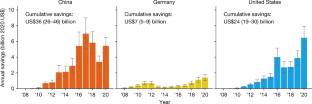
China’s scale and close integration also keep costs down. A peer-reviewed study estimated that globally connected solar supply chains saved installers in the United States, Germany and China about $67 billion between 2008 and 2020. The International Renewable Energy Agency has identified similar structural advantages in China’s solar, wind and battery industries. 2 (see Figure 3)
That creates a difficult choice for governments. Building alternative supply chains could improve security, but it would also make clean-energy projects more expensive and could slow their construction. China’s cost advantages therefore give its manufacturers continuing influence over both purchasing decisions and the pace of deployment.
Concentration also provides a potential policy weapon. China has restricted exports of graphite products used in battery electrodes and imposed controls on gallium and germanium, which are used in products including solar panels and electric vehicles. 3 These steps show that control over processing can be turned into licensing requirements or trade restrictions, although they demonstrate the ability to apply pressure more clearly than successful coercion.
China’s position may remain large as demand grows. The IEA estimates that existing and announced projects could leave China with roughly 65% of global clean-technology manufacturing output in 2030. 4 That projection is less certain than today’s production figures, but it suggests China is positioned to remain central to a rapidly expanding market.
The case against
Manufacturing concentration does not automatically amount to geopolitical control. Buyers can build inventories, impose tariffs, seek alternative suppliers or support domestic production. Dependence can also create mutual vulnerability rather than one-sided power. Current evidence shows exposure to China more clearly than it shows Beijing winning durable concessions or changing other governments’ energy policies. 5
Diversification is already under way. Southeast Asia has become a significant clean-technology manufacturing hub, supported by foreign investment and government industrial policies. Clean-technology leadership has also shifted between countries in the past. 6 These developments show that production can move, even if reproducing China’s scale remains expensive and slow.
China’s own overcapacity and intense competition could weaken its advantage. The Center for Strategic and International Studies reports falling prices, excess capacity and shrinking profit margins in Chinese solar manufacturing. One commercial forecast projects that China’s shares of solar-module and battery manufacturing could fall by as much as 19 percentage points by 2030. That is a forecast, not an observed result, and should be treated cautiously. Cheap exports may preserve China’s influence in the short term, while weak profits and factory closures could reduce the number of viable producers over time. 7
Recycling, new battery chemistries and alternative processing facilities could also reduce dependence on Chinese materials. The IEA expects global battery-recycling capacity could exceed 1,500 gigawatt-hours in 2030 if announced projects are completed. But recycling will not greatly reduce demand for newly mined materials until enough old batteries reach the end of their useful lives. 8
The bottom line
The evidence favours a qualified version of the claim, but only with low confidence. China has substantial bargaining power at important bottlenecks—especially solar wafers and polysilicon, battery anodes and cells, and selected mineral-refining processes. Its industrial scale, expertise and integrated supply chains will be difficult to replace quickly.
But China does not control the energy transition as a whole. It has less decisive influence over project finance, electricity-grid construction, resource ownership, demand policies and some downstream equipment. Tariffs, subsidies, new factories, Southeast Asian investment, recycling and substitute technologies are all aimed at creating alternatives.
The central uncertainty is not whether China matters. It clearly does. The unresolved question is whether it will remain commercially indispensable and politically able to use that position as diversification and substitution advance. On today’s evidence, China has meaningful near- and medium-term leverage over selected supply-chain costs and risks, while its long-term, system-wide geopolitical leverage remains only partially established.
Figures & data
All contributions are reviewed for clarity, balance, and evidence. The strongest insights are elevated into the argument graph — with credit to you.
Help improve this analysis →