Remote work reduces urban office real-estate demand

Updated 2026-07-30 4 supporting · 3 opposing arguments
Aldo's Synthesis high
Based on the strength of the Arguments below
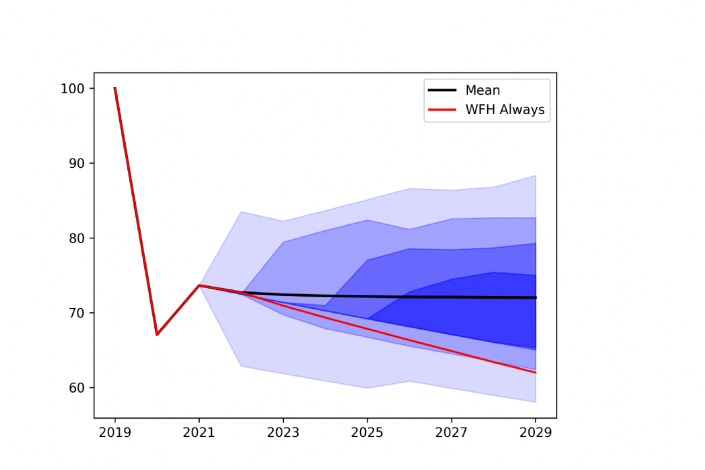
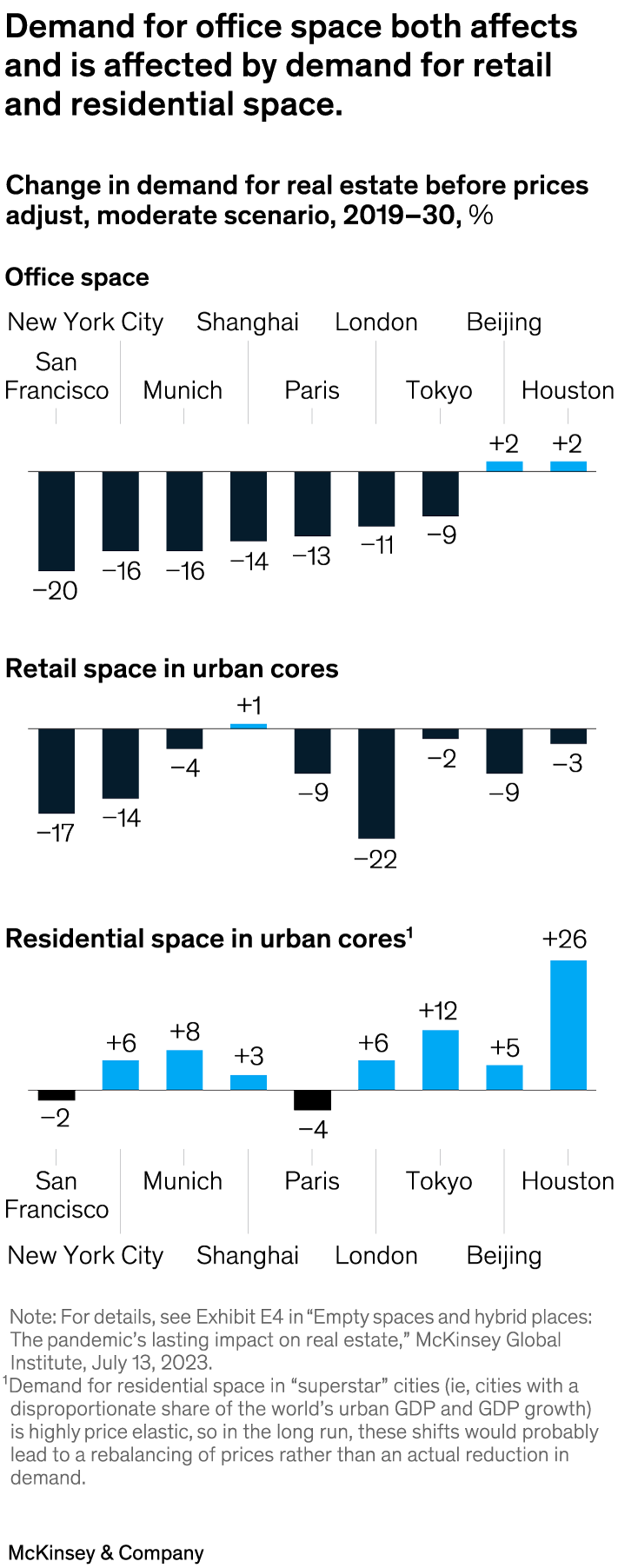
The claim asks a comparative question: whether persistent remote and hybrid work leave organizations demanding less urban office real estate than they would in an otherwise comparable predominantly in-person world. The relevant inquiry is therefore not whether offices disappear, nor whether every city experiences a continuous decline, but whether remote work reduces demand relative to the counterfactual after accounting for economic growth, financing conditions, lease timing, and changes in office quality. The evidence can support the directional claim even if it cannot assign every observed vacancy, rent, or valuation change to remote work alone. The strongest support for the claim is that several independent forms of evidence identify persistent telework as a structural pressure on office demand, rather than merely recording a coincident pandemic-era downturn (see Figure 1). A peer-reviewed synthesis and urban model links less frequent commuting to lower demand for centrally located office and retail space, while IMF analysis finds offices particularly exposed to work-from-home behavior and telework-related structural pressure. Institutional and government analyses also connect low physical utilization, elevated vacancies, approaching lease expirations, and declining valuations as mutually reinforcing features of office-market weakness, although they do not treat telework as the sole cause. Persistent under-occupancy supplies the mechanism through which remote work can become lower contracted demand: when fewer workers regularly attend, employers can eventually consolidate floors, share desks, or lease smaller premises. Bureau of Labor Statistics evidence establishes that remote work remained substantially more prevalent than before the pandemic, making the mechanism persistent rather than dependent on a short-lived emergency. Workplace research documents downsizing and flexible layouts alongside continued collaborative use, indicating that hybrid work can reduce square footage without eliminating the organizational functions served by offices. The post-pandemic relationship between headcount and space use further supports the claim because hybrid scheduling and desk sharing permit organizations to accommodate workers with less office capacity. Portfolio benchmarking reports uneven weekday utilization, excess capacity, and active space optimization even where organizational headcount has recovered. Institutional synthesis likewise links remote work to lower office occupancy and central-city commercial values, while recognizing uncertainty over the eventual remote-work rate and the speed of market adjustment. Market indicators are consistent with this behavioral mechanism: government, institutional, and access-card sources report office-sector weakness, low attendance, elevated vacancy, and valuation declines after remote work became widespread. These outcomes corroborate reduced demand but do not, on their own, identify remote work's exact causal share because valuation and financing variables move simultaneously. The strongest challenge is not that remote work has no effect, but that observed office-market deterioration cannot be cleanly equated with the size or permanence of that effect. IMF and U.S. Office of Financial Research analyses identify tighter financial conditions, refinancing exposure, and other cyclical pressures alongside telework, so falling prices may reflect higher capitalization rates and credit stress even when tenant demand is unchanged. Cross-country and sector divergence also cautions against interpreting a single aggregate price series or pandemic-era before-and-after comparison as a pure measure of remote-work demand. Office demand can also persist or stabilize because hybrid work preserves some need for physical space and does not imply an indefinitely falling absorption path. Industry forecasts projected weak or negative near-term absorption but allowed for a later return to modest positive absorption, depending on economic and employment conditions. Those forecasts are weaker than observed transactions and do not directly establish the asserted collaboration, mentoring, client, and cultural functions, but they do rebut an interpretation of the claim as requiring perpetual aggregate contraction. Economic growth may offset lower space intensity per worker, so aggregate demand can recover even while remote work leaves it below the no-remote-work counterfactual. Broad commercial-property price data cannot resolve that counterfactual because they aggregate property types and incorporate interest-rate effects. Evidence of continuing optimization and uncertainty about long-run work patterns therefore permits stabilization, but it does not show that a recovered market would demand as much space as a comparable predominantly in-person economy. The effect is best understood as a lagged counterfactual reduction rather than an immediate one-for-one translation from lower attendance into vacant space. Federal Reserve analysis describes office weakness as involving both remote work and financing pressure, which means utilization, rents, values, and leased area need not adjust together. Forecast evidence suggests that absorption can move from negative toward positive as conditions improve, even though such forecasts are assumption-sensitive and do not negate a lower-demand counterfactual. Remote work changes the composition of demand as well as its quantity, allowing aggregate contraction to coexist with continued demand for selected collaborative, flexible, or amenity-rich offices. Industry research records both downsizing and redesign toward flexible layouts and employee interaction, supporting adaptation rather than uniform abandonment. Accordingly, resilient leasing in a favored building or district is compatible with weak aggregate absorption and does not by itself refute the broader claim. Geography and industry exposure are important boundary conditions because remote work varies across sectors and urban-market outcomes vary with work-from-home exposure, financing conditions, and local economic assumptions (see Figure 2). Urban modeling places office demand within a wider equilibrium involving commuting, central commercial activity, and outward shifts in housing demand, rather than treating the office market in isolation (see Figure 3). Transaction and industry evidence supports greater weakness where work from home is more consequential and a weaker link between office employment and absorption, but financing shocks and industry-source interests limit mechanical generalization. Occupancy evidence should be interpreted as direct evidence of underuse and potential downsizing pressure, not as a complete measure of present leasing demand. Government labor data establish persistence and industry variation in remote work but do not themselves estimate square footage demanded. Similarly, reports of flexible layouts and downsizing indicate organizational adjustment, but their industry provenance and selected participants counsel caution about population-wide effect sizes. The principal gap is not the absence of evidence for the direction of effect, but the lack of a single clean estimate of its magnitude across places, property classes, and time horizons. Attendance, leased area, net absorption, rents, and valuations measure different stages or dimensions of adjustment, so none is a complete substitute for the counterfactual quantity organizations would lease under predominantly in-person work. Long leases obscure timing, while interest rates, refinancing stress, employment growth, and local economic conditions complicate causal attribution. Source composition creates an additional qualification because several occupancy, portfolio, and forecast findings come from industry organizations or nonrandom building samples. Those sources add operational detail but leave unresolved questions about representativeness and potential institutional interests. The bundle also provides stronger documentation of U.S. office markets and central-city mechanisms than of every country, suburban node, or smaller city, limiting the precision of universal extrapolation. On the present record, the evidence supports with high confidence the directional claim that persistent remote and hybrid work reduce urban office demand relative to a comparable predominantly in-person world, while leaving the magnitude and distribution of that reduction materially uncertain. The result is compatible with delayed adjustment, positive absorption during economic recoveries, and resilience in selected high-quality buildings because the claim concerns a counterfactual demand level, not universal office abandonment or uninterrupted decline. The dominant uncertainty driver is causal quantification: separating remote work from financing and macroeconomic shocks while accounting for lease lags, geographic heterogeneity, and unresolved institutional interests in parts of the industry evidence.

Supporting Arguments

P1Remote-capable markets experienced larger office-demand losses
Lease-level research finds larger revenue and value declines where employment was more amenable to remote work, strengthening the causal case beyond a simple before-and-after comparison. Transaction evidence and institutional analyses independently identify offices as unusually exposed to persistent telework.
77/100 · Direct Evidence
P2Persistent under-occupancy gives firms an incentive to shed space
Access-card and workplace data show offices remain underused, particularly on Mondays and Fridays. As leases expire, firms can respond by consolidating floors, sharing desks, or taking smaller premises, turning lower attendance into lower leased-space demand with a lag.
76/100 · Logical Inference
P3Office employment no longer guarantees proportional space demand
Industry data report a post-pandemic disconnect between office-job growth and net absorption. Hybrid scheduling and desk sharing allow employers to accommodate the same headcount in less space, weakening the historical relationship between employment and leasing.
45/100 · Data Analysis
P4Vacancy, absorption, and valuation indicators point downward
Government and industry sources document elevated vacancy, weak or negative absorption, and falling office valuations after remote work became widespread. These indicators are consistent with reduced demand, although prices additionally reflect higher interest rates and financing stress.
70/100 · Data Analysis

Opposing Arguments

C1Office demand persists for collaboration and organizational functions
Hybrid work does not mean employees never need offices: firms continue to use them for collaboration, mentoring, client interaction, and culture. Some employers therefore retain meaningful space and reconfigure it toward meeting rooms and amenities instead of eliminating it.
24/100 · Expert Opinion
C2Economic growth can offset remote-work space reductions
Even if each employee requires less space, rising office employment or business formation can stabilize or eventually increase aggregate absorption. Forecasts that move from negative toward positive absorption illustrate why the claim need not imply a permanent, uninterrupted decline.
63/100 · Logical Inference
C3Observed price declines are not a pure measure of remote-work demand
Higher interest rates raise capitalization rates and refinancing costs, reducing property values even with unchanged tenant demand. Pandemic disruption and macroeconomic weakness also affected transactions, so raw price declines cannot by themselves establish how much remote work reduced demand.
64/100 · Direct Evidence

All contributions are reviewed for clarity, balance, and evidence. The strongest insights are elevated into the argument graph — with credit to you.

Help improve this analysis on ProConWiki →
𝕏 Share Facebook LinkedIn