College degrees are no longer worth the cost
Aldo's Synthesis high
Based on the strength of the Arguments below
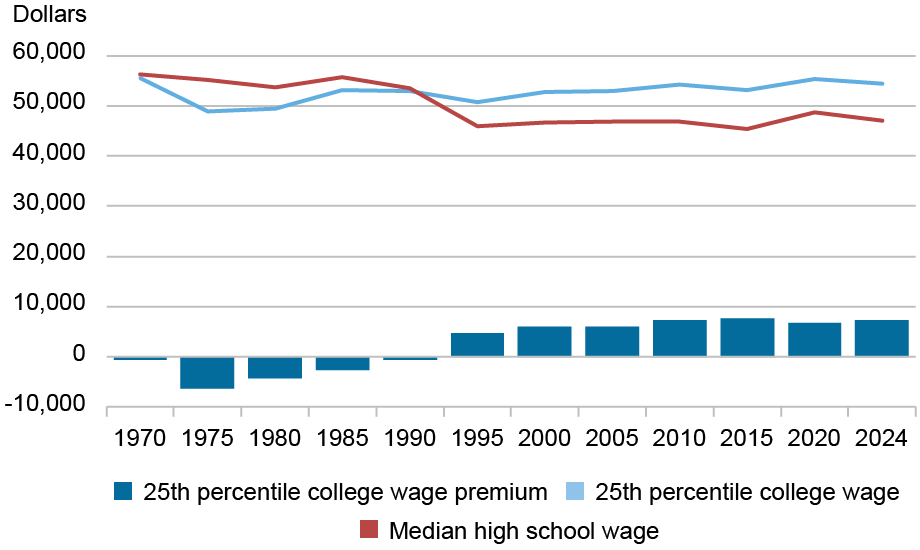
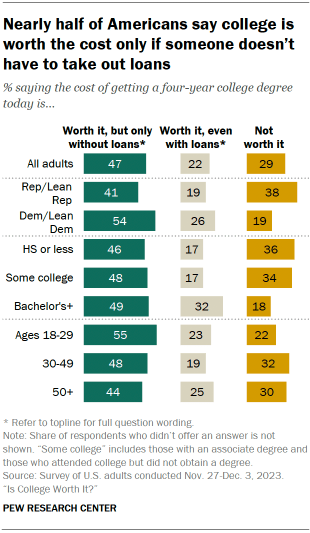
The claim asks whether college degrees generally fail to deliver enough economic or nonfinancial benefit to justify tuition, debt, foregone earnings, and other costs, rather than whether particular degrees disappoint particular students. That distinction matters because evidence of substantial downside risk can coexist with a positive return for the typical completer, while an average premium can obscure serious losses within particular programs or circumstances. The central inquiry is therefore comparative and conditional: what students pay, whether they finish, what they study, what work follows, and what noncollege option they forgo all bear on whether the investment is justified. The strongest support for the claim is that aggregate gains conceal a meaningful set of programs and graduates for whom college produces weak or negative financial returns (see Figure 3). Program-level return-on-investment analysis finds both high-return and negative-return credentials after incorporating costs and completion risk, with strong modeled outcomes in fields such as engineering, computer science, nursing, and economics but poor outcomes in some fine-arts and low-earning graduate programs. Major-level data likewise show pronounced differences in earnings and employment, while recent graduates experience substantial underemployment, including work in jobs that do not normally require a degree. Lifetime-earnings distributions also overlap: some workers without bachelor's degrees out-earn degree holders, and field and occupation materially shape outcomes, so the average premium cannot establish value for every prospective student. Debt and noncompletion can convert uncertain value into concrete financial harm. Federal data establish that student borrowing is widespread and that debt burdens vary substantially by degree level, institutional sector, and student characteristics. Reviews identify noncompleters as especially vulnerable because they incur tuition, opportunity costs, and potentially debt without receiving the full credential payoff, while weak labor-market outcomes can make repayment particularly burdensome. These findings provide a strong case against treating enrollment as presumptively worthwhile, but they establish concentrated and heterogeneous downside rather than the broader proposition that degrees generally no longer justify their costs. The claim also invokes nonfinancial value, but the supporting case in this record principally concerns earnings, employment, debt, and completion rather than direct measurement of benefits such as learning, health, civic participation, autonomy, or personal development. The strongest challenge is that multiple forms of evidence continue to show a substantial average economic advantage for bachelor's-degree holders and positive expected returns for most bachelor's programs (see Figure 1). A Georgetown synthesis estimated median lifetime earnings of about $2.8 million for bachelor's holders, approximately 75 percent more than for high-school graduates, although it also documented substantial overlap between education groups. A peer-reviewed review and an expert synthesis concluded that college remained a sound average investment, especially for students who complete, and that aggregate earnings gains generally exceed tuition and debt costs. Even a program-level analysis designed to identify poor-value credentials concluded that many degrees have high expected returns while only a subset have negative modeled returns after costs and completion risk. Cost measurement also weakens arguments based on headline tuition or debt alone. NCES reports substantial differences between published tuition and net price after grants, as well as major variation by institution type and family income, so sticker price can materially overstate what some students pay. Likewise, debt totals establish a substantial financing cost for many graduates but do not by themselves determine whether the borrower's lifetime net return is positive or negative. Taken together, the persistence of large earnings differences, favorable average-investment assessments, positive expected returns across many programs, and the distinction between sticker and net price contradict the categorical assertion that college degrees generally have ceased to be worth their costs. The evidence supports a conditional judgment centered on program, net price, completion probability, financing, and labor-market alternative rather than a single verdict for all students. Government cost and debt data show that students face different net prices and financing burdens, while program and major analyses show large differences in earnings, employment, and modeled return. Accordingly, a high-return technical or health program at a manageable net price presents a materially different investment from a costly low-earning program, and even outcomes within a major are not uniform. Completion probability is a pivotal boundary condition, but it is partly responsive to institutional design rather than fixed at enrollment. Long-term randomized evidence from CUNY's ASAP program found that comprehensive academic, advising, and financial supports substantially increased associate-degree completion in the studied population. That trial does not establish effects for all colleges, but it shows that additional educational investment can improve credential attainment in at least one defined setting. Observed education premiums should not be treated as the exact causal payoff available to every individual. The principal lifetime-earnings comparisons are descriptive and cannot fully separate education's effect from preexisting differences in preparation, resources, and career plans. Even so, broader reviews represented in the record still judge average returns positive, so selection concerns qualify the magnitude and individual applicability of the premium rather than eliminating the evidence of value. The principal evidentiary gap is that the record is much stronger on financial outcomes than on the claim's nonfinancial component. It contains no direct valuation of learning, health, civic, social, or personal benefits and no framework for comparing those benefits with tuition, time, or debt. Individual return estimates also remain sensitive to counterfactual and forecasting choices. The program-level analyses depend on modeled earnings absent college, completion assumptions, tuition, foregone earnings, and available earnings data, which makes them more persuasive as evidence of variation than as precise forecasts for a named student. The record also does not supply a unified causal estimate that follows comparable students through alternative educational choices while fully accounting for completion, financing, taxes, discounting, and changing labor markets. The curated figures create an additional scope limitation: two address financial returns and one concerns public perceptions, but the frozen evidence bundle contains no source record from which the perception figure's underlying factual trend can be independently evaluated. The available outcome evidence supports examining heterogeneity between average and individual results, while the supplied public-opinion visualization may help readers distinguish perceived value from measured return (see Figure 2). Finally, unresolved conflict-of-interest classifications limit confidence in how much weight to assign some institutional reports, expert syntheses, and advocacy-oriented program analyses, even though the record also includes government data, peer-reviewed review evidence, and a randomized trial. On the current evidence, the broad claim is not sustained: college remains a positive average financial investment for many completers and most modeled bachelor's programs, although a meaningful minority of programs and students experience weak or negative outcomes. Confidence in that directional judgment is high because the record combines government data, program-level analyses, reviews, and randomized evidence, while those sources converge on heterogeneity rather than universal value or universal failure. The dominant uncertainty driver is unresolved conflict-of-interest classification, compounded at the individual level by uncertain completion, counterfactual earnings, program choice, net price, and the unmeasured nonfinancial benefits invoked by the claim. The most defensible conclusion is therefore neither that college is categorically worth its cost nor that it generally is not, but that value must be assessed using the specific program, realistic completion prospects, actual net price and borrowing, and the student's best available alternative.
Supporting Arguments
P1Some programs produce weak or negative financial returns
Program-level estimates find meaningful numbers of credentials whose additional earnings do not cover tuition and foregone work, particularly in certain fields and institutions. Because these estimates depend on modeled counterfactuals, they are stronger as evidence of wide variation than as exact forecasts for every student.
81/100 · Data Analysis
P2Debt and rising attendance costs can make the downside severe
Many students finance college with loans, and net prices can remain substantial even after grants. For borrowers with low post-college earnings or no completed credential, repayment pressure can make enrollment financially damaging even if the average graduate gains.
68/100 · Logical Inference
P3A degree does not guarantee graduate-level employment
Recent graduates experience meaningful underemployment, and outcomes differ sharply by major. A student who pays a high price but enters work that does not require a degree may realize much less value than aggregate wage-premium figures imply.
62/100 · Direct Evidence
P4Average premiums conceal many disappointing individual outcomes
Lifetime-earnings distributions overlap: some workers without bachelor's degrees out-earn degree holders, while field and occupation materially affect pay. Therefore, a population average cannot establish that college is worthwhile for every prospective student.
75/100 · Data Analysis
Opposing Arguments
C1Bachelor's holders still earn more and face less unemployment
Current national labor data show a large earnings advantage and lower unemployment for bachelor's-degree holders compared with high-school graduates. Although selection contributes to the association, the persistence and size of the gap contradict the blanket claim that degrees have ceased to carry labor-market value.
51/100 · Direct Evidence
C2Lifetime gains generally exceed costs for completers
Multiple syntheses estimate very large lifetime earnings differences by education, and reviews conclude that college remains a good average investment for students who graduate. Tuition, taxes, discounting, and foregone earnings reduce that gross advantage but generally do not erase it for the typical bachelor's completer.
78/100 · Data Analysis
C3Most bachelor's programs appear to have positive expected ROI
Even analyses designed to expose poor-value credentials conclude that most bachelor's programs generate positive expected financial returns. Their identification of losing programs supports selective skepticism, not the universal assertion that college degrees as a class are no longer worthwhile.
74/100 · Data Analysis
C4Sticker tuition exaggerates what many students actually pay
Published tuition is not the same as net price because grants and scholarships reduce costs, sometimes substantially. Claims based solely on headline tuition figures can therefore understate ROI, though living expenses and foregone earnings remain real costs.
75/100 · Direct Evidence
All contributions are reviewed for clarity, balance, and evidence. The strongest insights are elevated into the argument graph — with credit to you.
Help improve this analysis on ProConWiki →