Civilian regional airports become strategic security vulnerabilities during geopolitical conflicts
Bottom line (updated 2026-11-10): The evidence supports a narrower claim: some local airports can become serious risks during conflict. An airport becomes more at risk when it helps war efforts, carries strong meaning, or faces fighting nearby.
What's this about?
People disagree about whether local airports become major security risks during wars.
The answer depends on how people use each airport and what happens nearby.
What supporters say
- Closing a key airport can hurt travel, food, aid, and health care across a wide area.
- Recent wars show that fighters have attacked or shut down some civilian airports.
- Civilian airports may help move troops, supplies, government workers, or other war goods.
What critics say
- A map can show which airports matter most, but it cannot show what an enemy plans to attack.
- A busy airport does not become a target just because many people and goods pass through it.
How to read this
The number of points on each side does not show who is right; strong proof matters more than a long list.
The bottom line
The evidence supports a narrower claim: some local airports can become serious risks during conflict.
An airport becomes more at risk when it helps war efforts, carries strong meaning, or faces fighting nearby.
Civilian regional airports can become important security vulnerabilities during geopolitical conflicts—but connectivity alone does not make them strategic targets. The evidence points to a conditional risk: airports are most exposed when their transport role overlaps with military logistics, political symbolism or direct conflict activity.
The case for
Highly connected airports can act as critical transport nodes. Network studies show that shutting down a central airport can cause much larger losses in regional connectivity than closing a randomly selected airport. Because airports link people and supplies across regions, even a closure or loss of access could weaken medical deliveries, food distribution and relief operations—not just passenger travel. The potential effects can extend far beyond the airport itself. 1 (see Figure 1)
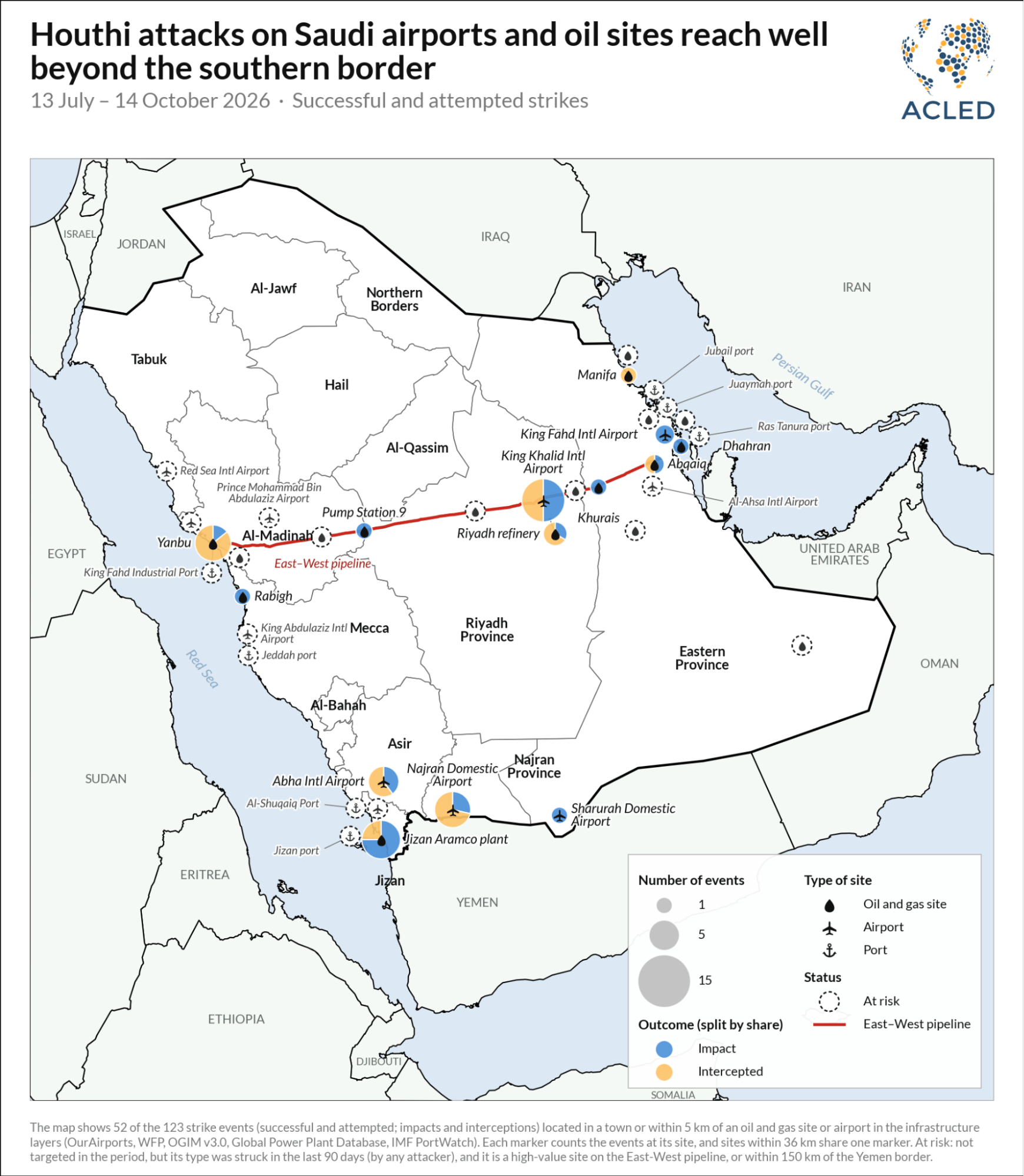
Recent conflicts show that civilian airports can become operationally and politically important during hostilities. ACLED has recorded at least 21 attacks or attempted strikes involving at least six Saudi airports. Reporting from Syria has also described strikes that disabled the airports in Damascus and Aleppo. The International Civil Aviation Organization, or ICAO, separately warns that conflict zones pose risks to civil aviation and related infrastructure. 2 (see Figure 2)
Airports may also acquire strategic value because civilian transport systems can have military uses. Security analyses identify civilian organizations, transport infrastructure and dual-use technologies as possible contributors to military logistics. Airport-security research likewise treats airports as potential targets or channels for attacks that fall below the level of conventional warfare. This means an airport’s importance may go beyond its commercial function when it supports government movement, military supply or other conflict-related activity. 3
Together, these findings support a narrower conclusion: a regional airport can become highly vulnerable when its central place in the transport network coincides with conflict exposure or dual-use activity. ICAO’s risk-management approach supports treating airports and nearby airspace as exposed in conflict zones.
The case against
The main weakness in the claim is the jump from being important if disrupted to being likely to be chosen as a target. Network studies model what would happen if an airport failed, whether through technical disruption, a pandemic or a planned removal. They do not show that armed groups or governments specifically select the most connected regional airports. Connectivity may make an airport consequential without making it a target. 4
The strongest opposing point is that network models do not measure an adversary’s intentions. They cannot separate the role of centrality from other factors that may explain attacks, such as proximity to fighting, military use, government presence or symbolic value. There is also no cross-conflict evidence showing how often civilian regional hubs are attacked compared with military airports, ports, roads or other infrastructure. 5
The conflict examples also have important limits. The Saudi evidence concerns one particular war and includes attempted strikes. Accounts of damage to Syrian airports rely partly on state reporting and do not independently establish the attackers’ objectives. Neither source provides a representative rate of airport targeting across conflicts.
Legal status must also be kept separate from operational risk. Under international humanitarian law, civilian objects remain protected unless, and for as long as, they qualify as military objectives under the applicable rules. An airport does not lose its civilian protection simply because it is strategically useful, well connected or important to regional transport.
The bottom line
The evidence moderately supports a qualified version of the claim. Civilian regional airports can become serious security vulnerabilities during conflict, and disruptions to major transport nodes may produce effects well beyond the facility itself. Reported attacks, ICAO guidance and research on dual-use infrastructure reinforce that risk.
But the evidence is much weaker for the broader idea that regional connectivity by itself predicts targeting. Network research is relatively strong on the consequences of disruption, while conflict reporting shows that airports can be attacked—but neither establishes that centrality independently drives an adversary’s decision. The most defensible conclusion is therefore heightened, site-specific risk—not a universal rule that connected civilian airports are strategic targets.
Figures & data
All contributions are reviewed for clarity, balance, and evidence. The strongest insights are elevated into the argument graph — with credit to you.
Help improve this analysis →