Dependence on private satellite networks gives operators wartime leverage over states
Bottom line (updated 2026-10-16): Private space networks can give firms real power during war, especially when states have few other choices. The proof does not show that firms usually decide the result of wars by themselves.
What's this about?
People disagree about whether private space networks can gain power over states during war. This matters most when a state depends on one network and lacks quick backup plans.
What supporters say
- A cyberattack or outage could cut off many users across a wide area, making one network a war-time choke point.
- A company can limit or allow access at key times, which may change what troops can do.
- Fast, wide service can make armies rely on private networks before governments build other choices.
What critics say
- Armies can use mixed systems, so they do not need to trust one network alone.
- Government deals can set rules that limit what a private company may do.
How to read this
The number of points on each side does not show who is right; strong proof matters more than a long list.
The bottom line
Private space networks can give firms real power during war, especially when states have few other choices. The proof does not show that firms usually decide the result of wars by themselves.
Private satellite networks can give wartime operators meaningful leverage over governments, especially when a state depends heavily on one system and has few quick alternatives. But the evidence does not show that private companies generally control military outcomes on their own.
The case for
The clearest example comes from Ukraine, where Starlink became important to military communications. Its operational role was significant enough that the Pentagon formally bought access to the network. 1 When reports emerged that SpaceX had restricted some Ukrainian uses, including drone-related activity, they showed how a private company’s decisions about permitted use could affect battlefield capabilities when a military relies on its service.
Commercial satellite networks can also become wartime chokepoints. The cyberattack on Viasat’s KA-SAT system around the start of Russia’s invasion disrupted satellite internet access across Ukraine and parts of Europe. A peer-reviewed study treated the incident as evidence that weaknesses in commercial satellite systems can have strategic and geopolitical consequences. 2 A failure or compromise of one network can therefore affect many users across a broad area, rather than merely interrupting an ordinary commercial service.
Dependence can deepen quickly. Commercial systems offer militaries speed, lower launch costs, innovation and wide coverage, while government-built alternatives may take years to develop. RAND has described the U.S. Defense Department’s growing reliance on commercial satellite communications, alongside the policy and security risks that come with it. 3 This creates the greatest leverage when a provider expands faster than governments can build sovereign substitutes.
The broader lesson is conditional rather than universal. Concentrated dependence, weak alternatives and provider discretion can turn useful connectivity into meaningful influence over a state’s wartime choices. A peer-reviewed analysis has concluded that privately owned infrastructure can become an autonomous geopolitical actor, although the Ukraine and Starlink cases show a high-risk pathway more clearly than they show how often this occurs in other conflicts.
The case against
Dependence does not necessarily mean that a private operator acts independently of the state. Governments can limit provider discretion through contracts, procurement rules and control of military versions of commercial systems. The Pentagon’s formal Starlink contract illustrates one way the government can preserve access while reducing unilateral control by the provider. Department of Defense rules also require procurement through approved government contracts and impose security and administrative conditions. 4
The Starshield debate further complicates claims that SpaceX alone determines military access. Reporting by the Associated Press described disputes over who was responsible for restrictions and cited statements that the U.S. government, rather than SpaceX by itself, controls the military system. In such cases, leverage may belong to a public-private arrangement rather than to the company alone.
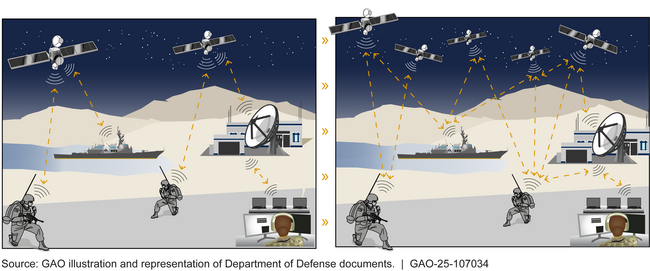
States can also reduce their exposure by combining commercial services with government systems and multiple communication routes. The Government Accountability Office describes an integrated Defense Department architecture using different paths and access points to improve resilience. That shift away from separate systems is intended to reduce reliance on any one provider or connection. 5 Diversification does not remove dependence on commercial capacity, but it can make a provider’s threat to withdraw service less decisive.
The main uncertainty is attribution. Available evidence often does not reveal how particular contract terms, switching costs, government controls or classified capabilities affect leverage in a specific war. The evidence is also heavily concentrated on Ukraine and Starlink, making it difficult to know how widely the pattern applies.
The bottom line
The evidence supports the claim in a qualified sense, but only with low confidence. Dependence on a private satellite network can create significant wartime leverage when access is concentrated, alternatives are slow or weak, and the provider—or the wider public-private system—can decide how the network is used.
However, the evidence is not strong enough to conclude that private operators generally exercise independent strategic control over states. Government contracts, military oversight and hybrid communications architectures can limit that power. The strongest conclusion is that concentrated dependence creates a meaningful vulnerability; whether it becomes decisive depends on diversification and the extent of state control.
Figures & data
All contributions are reviewed for clarity, balance, and evidence. The strongest insights are elevated into the argument graph — with credit to you.
Help improve this analysis →