Control of strategic Red Sea ports by armed non-state groups can materially increase global shipping costs and insurance premiums
What's this about?
People disagree about whether armed groups could raise ship costs by holding key Red Sea ports. The answer depends on how long the trouble lasts.
What supporters say
- Ships may sail around Africa, which adds fuel costs, travel time, and more days at sea.
- Trouble at a key sea route can slow ships, cause delays, and raise costs in faraway places.
- Ships near missile, drone, or boarding threats may pay more for war-risk insurance.
What critics say
- Ships can use other routes, and extra ships may limit the rise in costs.
- Most proof comes from attacks on ships, not from armed groups holding ports for a long time.
How to read this
The number of points on each side does not show who is right; stronger proof matters more.
The bottom line
The evidence shows that attacks and route blocks can raise world shipping costs. But we're not sure how much long-term port control would raise them.
The case for higher costs is real, but proof for this exact claim is weaker. Insurance rises most clearly for ships near the danger.
Armed groups controlling strategic ports on the Red Sea could raise shipping costs and insurance premiums worldwide. But the evidence is much stronger for disruption caused by attacks than for the specific case of sustained control over a port, and the global effects would depend heavily on how long the disruption lasted.
The case for
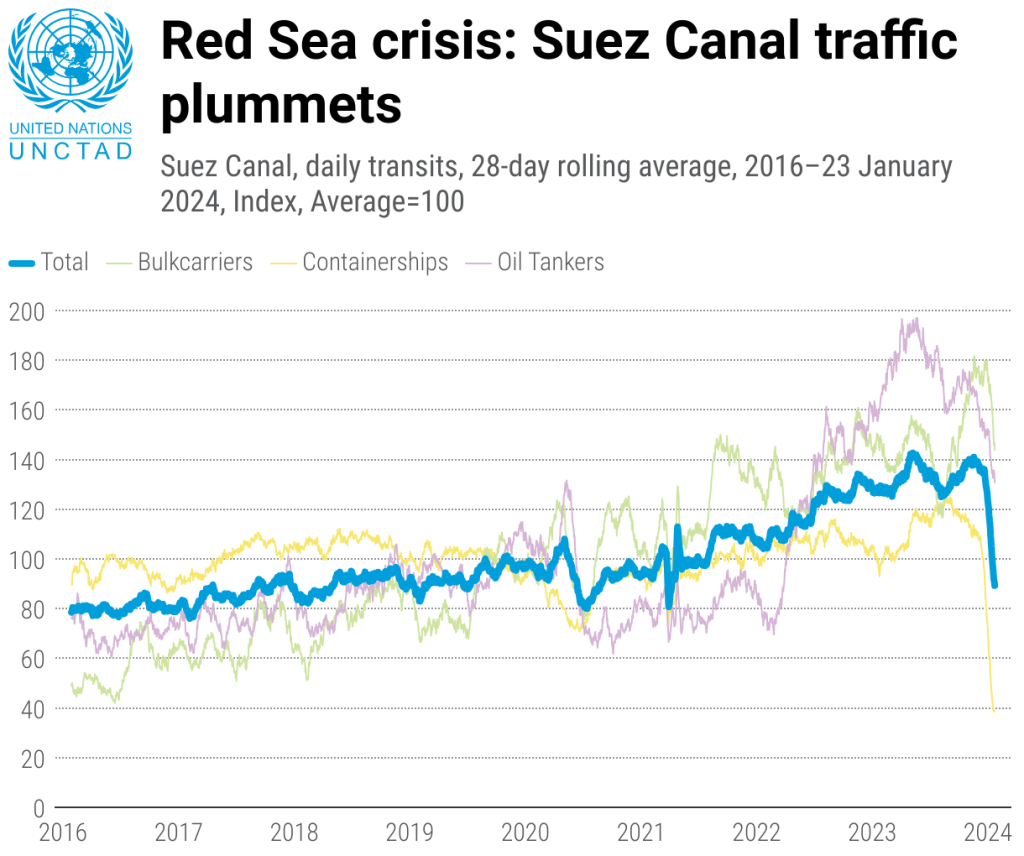
The clearest mechanism is rerouting around Africa. When carriers avoid the Red Sea and Suez Canal, ships must travel around the Cape of Good Hope. That adds distance, fuel use and days at sea, while also tying up more vessels to move the same amount of cargo. UNCTAD, the IMF and academic studies of shipping routes have documented sharp falls in Suez traffic, increased use of the African route and pressure on freight rates after Red Sea attacks. The IMF’s PortWatch analysis shows the scale of this traffic shift (see Figure 1). 1
Because the Red Sea is a major link between Europe and Asia, disruption can affect more than ships near the conflict. Longer journeys can disrupt schedules, reduce the effective capacity of the shipping network and create shortages of containers or vessels in other regions. UNCTAD and IMF analyses have linked Red Sea insecurity to wider pressure on freight markets. The 2021 Suez Canal blockage, although it was not caused by an armed group, also illustrates how a chokepoint problem can spread through global shipping networks (see Figure 2). 3
Insurance costs can rise as well. Ships entering areas exposed to missiles, drones, boarding or other attacks may face additional war-risk premiums or surcharges. Studies of piracy and maritime insecurity identify insurance, security measures, delays and rerouting as related costs of armed threats. However, these increases are most clearly established for voyages directly exposed to danger, rather than for all shipping worldwide. 2
The case against
The main weakness is the gap between the evidence and the precise claim. Most available research examines attacks and the market’s response to perceived danger, not a clean comparison between normal operations and sustained formal control of a strategic port by an armed non-state group. Attacks launched from elsewhere may cause carriers to reroute without the group controlling the port itself. The existing evidence therefore supports the general cost mechanism, but does not measure the extra effect of port control. 4
Nor would disruption necessarily produce equally large effects around the world. Carriers can use alternative routes, while inventories, existing contracts and spare shipping capacity can absorb part of a temporary shock. The World Bank and European Central Bank found clear effects on transport costs and delivery times, but said broader economic consequences depended on the disruption’s duration, the share of trade affected and the network’s ability to adapt.
Insurance is also not priced uniformly. Premiums vary according to the vessel, cargo, flag, owner, destination, escort arrangements and the insurer’s estimate of attack risk. The evidence supports higher premiums for exposed voyages, but not a common increase across the global shipping fleet. 5
The bottom line
The claim is supported conditionally, with low confidence in its full and specific form. There is strong evidence that Red Sea insecurity can increase shipping costs, especially when carriers reroute around Africa. There is also credible, though less precisely measured, evidence that exposed voyages face higher war-risk insurance prices.
What remains uncertain is whether sustained control of a Red Sea port by an armed non-state group would create disruption broad and lasting enough to produce a materially global increase in both shipping costs and insurance premiums. Duration, geographic spread and escalation would matter most. Brief or contained disruption could be partly absorbed by rerouting and spare capacity, while a prolonged crisis could create wider and more persistent effects (see Figure 3).
Figures & data

All contributions are reviewed for clarity, balance, and evidence. The strongest insights are elevated into the argument graph — with credit to you.
Help improve this analysis →