US military strikes against Yemen’s Houthis are more likely to deter attacks than to escalate the wider regional conflict
What's this about?
People disagree about whether US strikes on Yemen’s Houthi group stop attacks or make a wider war more likely. The evidence remains unclear.
What supporters say
- Without a strong reply, the Houthis might think they could attack ships without facing much harm.
- US strikes damaged some missiles, launch sites, air defenses, and command centers, which may limit some attacks.
What critics say
- Houthi attacks on ships and warships continued after major US and British strikes.
- The strikes brought the United States into more direct fighting with groups across the region.
- More attacks may strengthen the Houthis’ reasons to keep fighting instead of making them stop.
How to read this
The number of points on each side does not show who is right; the strength of each point matters more.
The bottom line
The strikes caused some short-term harm and showed that the United States would fight back. However, they did not stop Houthi attacks, and they brought new risks of wider fighting.
The claim that US strikes on Yemen’s Houthi movement are more likely to deter attacks than widen the regional conflict remains unproven. The evidence points to some short-term military effects, but also to continuing attacks, prolonged disruption and new risks of escalation.
The case for
US and coalition strikes imposed direct costs on the Houthis. Pentagon statements say the attacks targeted missiles, launch sites, air defenses and command facilities. US Central Command also reported repeated interceptions of missiles, drones and unmanned boats after the January 2024 strikes. These actions destroyed or damaged some weapons and platforms, and showed that Washington was willing and able to respond. That could reduce the success of individual attacks, even if it did not end the Houthi campaign. 1
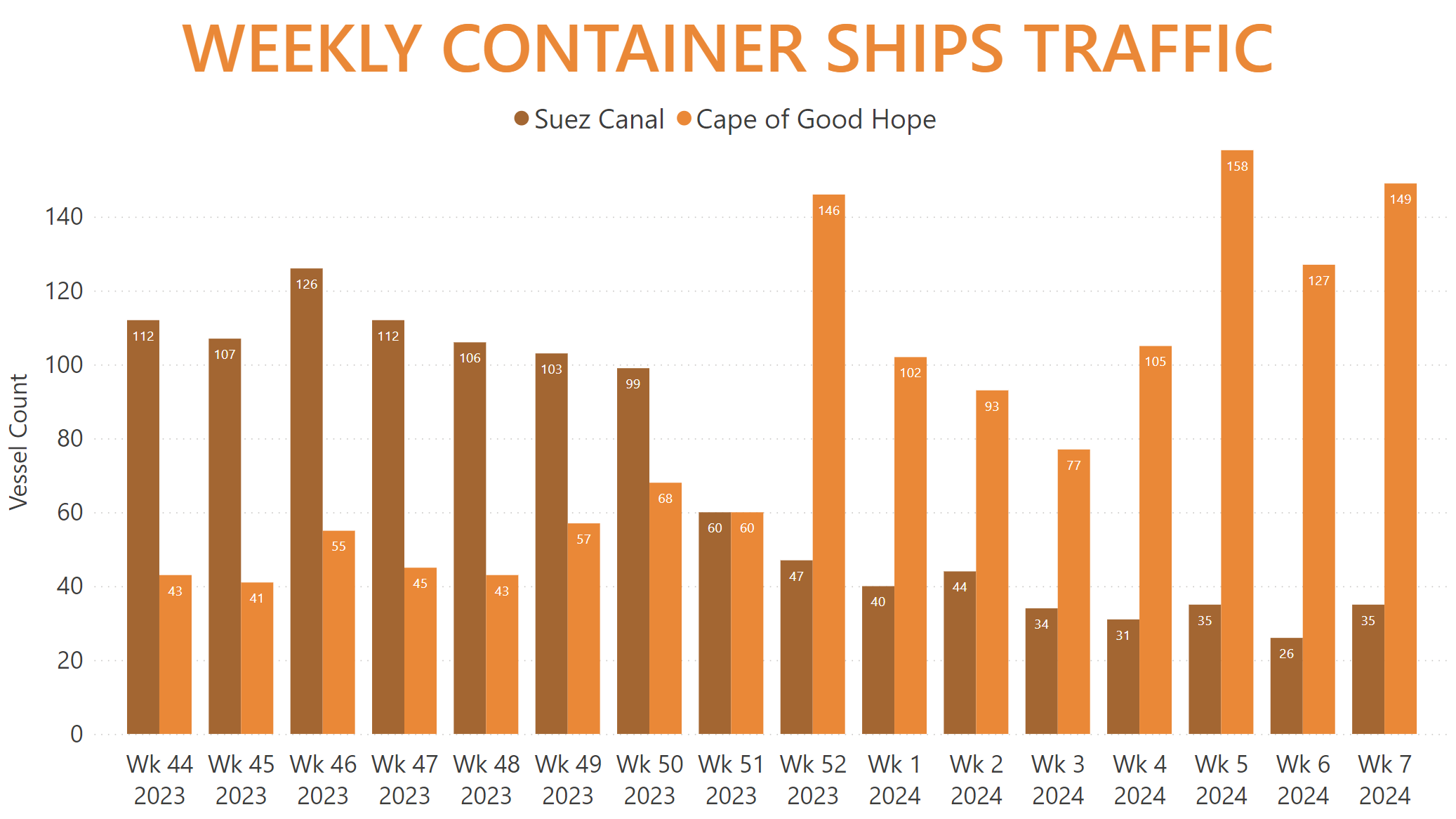
There is also a case that failing to respond might have encouraged more attacks. Warnings alone could have appeared empty while commercial and military vessels remained exposed. Reports from UNCTAD and the IMF documented major diversions away from the Suez Canal, longer voyages around the Cape of Good Hope and continuing economic damage. Against that background, visible military action may have seemed more credible than threats alone as a way to discourage at least some future attacks. 2 These findings are reflected in the continuing disruption to shipping (see Figure 1).
But the pro-deterrence case is mainly an inference from military capability, public signaling and individual defensive successes. It does not show how many attacks would have taken place without the strikes. Nor does it demonstrate that the strikes reduced attacks more than a different policy would have done.
The case against
The strongest challenge is straightforward: Houthi attacks continued after major US and British strikes. UN Security Council records, US military statements and reporting by Reuters and the Associated Press document repeated attacks on commercial and military vessels. That persistence is evidence against strong immediate deterrence, although it cannot prove that the strikes had no effect or that the attack rate would not have been even higher without them. 3
The strikes also changed the nature of the crisis. What began as attacks on shipping became sustained direct US and British military action against a non-state group linked to Iran. Analyses by the Congressional Research Service and the International Crisis Group warn that this can widen the conflict, complicate diplomacy in Yemen and create more opportunities for retaliation or miscalculation. Research on US-Iran tensions similarly identifies cycles in which signaling and retaliation produce further escalation. 4
Military pressure may also fail to address why the Houthis are acting. Analyses by Chatham House and the Council on Foreign Relations describe domestic, ideological and regional motives, while stressing that the movement is not simply controlled by Tehran. The International Institute for Strategic Studies has noted that mobile, dispersed launch systems limit what airstrikes alone can achieve. Punishment could even reinforce the narrative the Houthis use to justify continued operations. 5
The record therefore shows a possible split between tactical deterrence and strategic failure. Strikes and interceptions may have reduced damage in particular incidents or temporarily weakened launch capacity. Yet shipping has not quickly returned to normal, and the campaign has not ended. Continuing rerouting and reduced Suez traffic are more relevant to the broader question of strategic deterrence than interception counts alone (see Figure 2). Repeated attacks and interceptions occurred alongside persistent disruption and direct confrontation (see Figure 3).
The bottom line
The evidence favours a limited tactical-deterrence interpretation, but only weakly. US action likely imposed costs and may have reduced the effectiveness of some attacks. However, continuing Houthi operations, prolonged shipping disruption and credible escalation risks make it impossible to conclude confidently that deterrence was more likely than a wider regional conflict.
The central problem is the missing comparison: there is no reliable estimate of what would have happened without US strikes. The available record is stronger on what occurred—attacks, strikes, interceptions and shipping diversions—than on why it occurred or how much the strikes changed the outcome. Overall confidence is low, and the claim is not established.
Pros — Supporting Arguments
Figures & data


All contributions are reviewed for clarity, balance, and evidence. The strongest insights are elevated into the argument graph — with credit to you.
Help improve this analysis →