Over the next decade, continued U.S. military and diplomatic involvement in the Middle East will benefit America more than it harms it
Bottom line (updated 2026-10-31): The proof does not clearly show that U.S. involvement will help more than harm over ten years. A small, careful role may help, but open-ended war likely brings too many costs and risks.
What's this about?
People disagree about whether America should keep troops, ties, and talks in the Middle East.
The question asks if this role will help America more than it hurts America.
What supporters say
- U.S. troops may stop nearby nations from starting attacks or harming key sea routes.
- Talks, shared plans, and shared facts may lower threats to people in America.
- Staying involved may keep China, Russia, or Iran from filling a power gap.
What critics say
- Efforts to build strong ties with local groups have often had only small results.
- Past wars have cost America trillions of dollars, plus huge care costs for former troops.
- Long wars can hurt many people and may create more violence and danger.
- U.S. attacks may help America’s foes gain more power and support.
How to read this
The number of points on each side does not show who is right; stronger proof matters more.
The bottom line
The proof does not clearly show that U.S. involvement will help more than harm over ten years.
A small, careful role may help, but open-ended war likely brings too many costs and risks.
The claim is that keeping U.S. troops, partnerships and diplomacy in the Middle East through the next decade will do more good than harm. The evidence does not support a confident general verdict; it points instead to a narrower conclusion that limited, carefully managed involvement may be worthwhile.
The case for
A continuing U.S. presence can deter attacks and reassure partners, particularly in the Gulf and around major waterways. After 1991, the United States became the region’s de facto guarantor of Gulf security, according to the Congressional Research Service. Deployments and military signals toward Iran can also communicate that attacks on U.S. partners or key regional interests may bring a response, even though such signals can raise the risk of escalation. 1
The strongest argument for involvement is not open-ended war. It is a combination of diplomacy, intelligence cooperation, maritime security and selective deterrence. RAND has argued that a sustainable strategy built around diplomacy and partnerships could reduce instability, limit threats to the U.S. homeland and reduce the need for repeated military intervention. Maintaining access, intelligence relationships and influence could also give Washington more leverage during crises. 2
Supporters also warn that pulling back could leave openings for China, Russia or Iran. U.S. ties with friendly governments and some nonstate groups may preserve influence that would otherwise be lost. But this is mainly a strategic possibility, not a demonstrated calculation showing that the benefits would exceed the costs over 10 years. 3
The case against
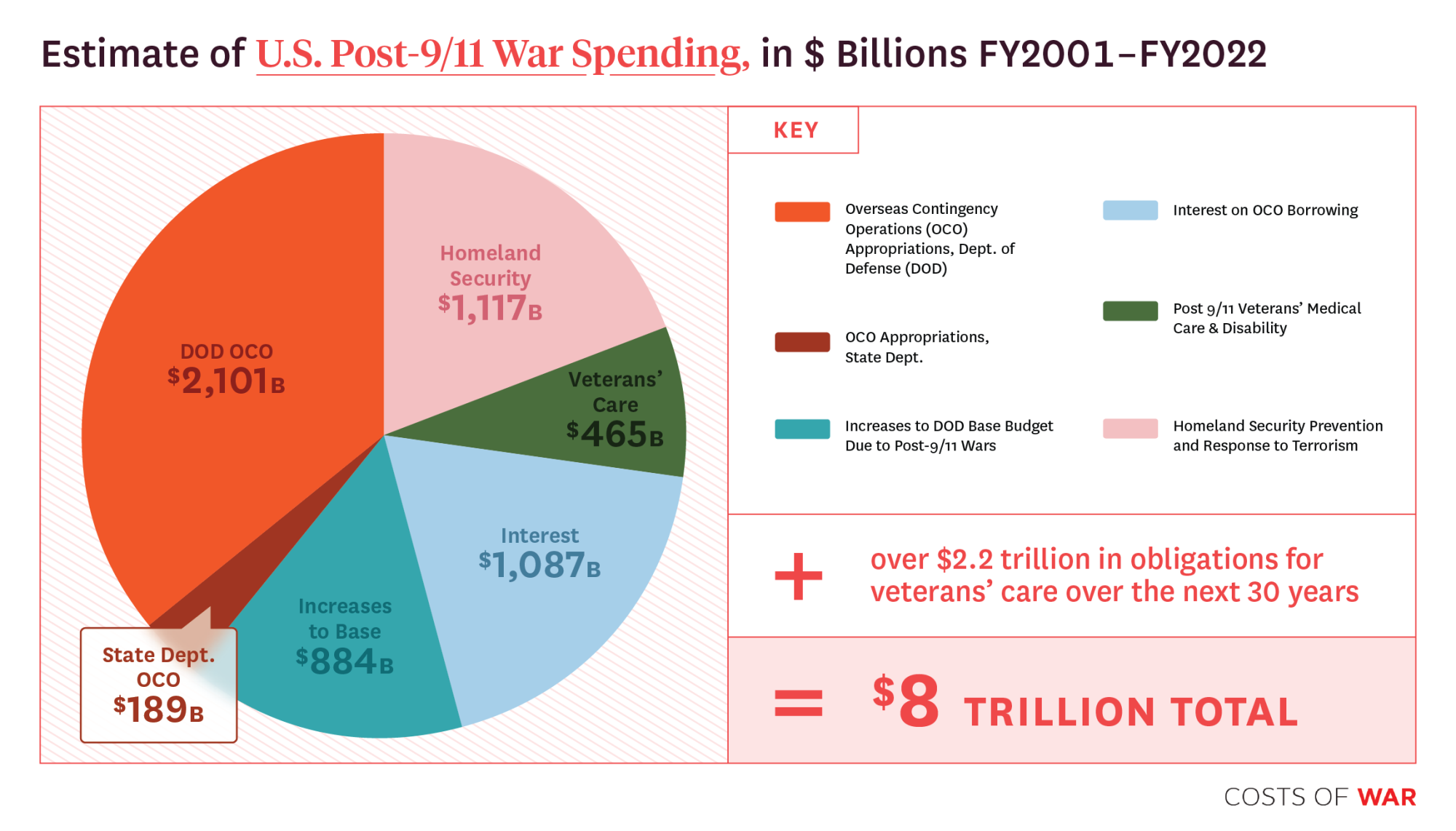
The costs of long-term military involvement are more clearly documented than its future benefits. Brown University’s Costs of War project estimates that post-9/11 wars generated more than $8 trillion in federal spending or obligations through 2021. Care for veterans from those conflicts is projected to cost roughly $2.2 trillion to $2.5 trillion through 2050. These figures cover several theaters, not only the Middle East, but they show how military commitments continue long after troops leave and compete with other national priorities (see Figure 1). 4
Military intervention can also produce results that undermine U.S. goals. A U.S. Army study of the Iraq war concluded that Iran became the conflict’s main strategic beneficiary, illustrating how removing a hostile government can strengthen a regional rival. That evidence weighs most heavily against invasion and occupation, rather than against limited deterrence or diplomacy. 5
Operations can create humanitarian and security damage that lasts beyond the immediate fighting. Research on the post-9/11 wars documents displacement and civilian deaths, along with damage to health systems, infrastructure and livelihoods. These effects can weaken U.S. legitimacy, fuel instability and encourage anti-American mobilization, although researchers cannot always determine their exact scale or responsibility. 6
Partnerships have also produced mixed results. Peer-reviewed research finds that U.S. military doctrine and cultural assumptions have often transferred poorly to Arab partners. RAND has warned that local governments may pursue goals different from Washington’s, drawing the United States into conflicts while producing forces that are neither capable nor fully aligned with U.S. interests. 7
The bottom line
The evidence does not show, with high confidence, that continued U.S. involvement in the Middle East will benefit America more than it harms it. The case for involvement is credible when it means a limited and adaptable posture: diplomacy, intelligence sharing, maritime protection, carefully bounded deterrence and partnerships subject to safeguards.
The case against is stronger when involvement means recurring combat, broad security guarantees, unconditional arms transfers or large-scale interventions. The costs of those policies—including spending, escalation, humanitarian harm and strengthened rivals—are better established than the promised future gains.
Overall, the evidence favors conditional involvement, not the broad claim as stated, and only with low confidence. There is no common, reliable 10-year comparison measuring security, influence, regional stability and financial costs across alternatives such as continued engagement, withdrawal or offshore balancing. The central uncertainty is whether engagement prevents dangers that would otherwise emerge—and whether the costs of maintaining it exceed those avoided risks.
Figures & data

All contributions are reviewed for clarity, balance, and evidence. The strongest insights are elevated into the argument graph — with credit to you.
Help improve this analysis →