Student loan forgiveness is good economic policy

Updated 2026-07-29 5 supporting · 5 opposing arguments
Aldo's Synthesis high
Based on the strength of the Arguments below
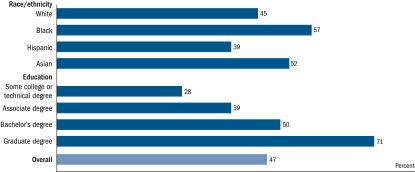
The claim asks whether government cancellation of student-loan debt is, on balance, an economically beneficial use of public resources, rather than merely whether cancellation benefits its recipients. That inquiry requires comparison of household financial relief, mobility, distributional equity, and possible macroeconomic gains against fiscal opportunity cost, inflation, incentive effects, and feasible alternatives. It also requires distinguishing broad, one-time cancellation from targeted discharge and income-contingent repayment, because the economic case may change materially with policy design. The strongest economic rationale for forgiveness is that student debt can constrain financially vulnerable households, so reducing it may repair balance sheets and ease barriers associated with debt service and impaired credit. Federal Reserve household data show that education debt is concentrated among younger and college-educated households but also reaches households with low current wealth and people who did not complete degrees. Administrative credit research further finds that greater student borrowing causally reduced young-adult homeownership through higher debt-to-income ratios and weaker credit outcomes, supporting—but not directly proving—the proposition that relief could reverse part of that constraint. A second benefit channel is greater willingness to move, change jobs, start businesses, or form households when debt pressure is reduced. Survey-experimental evidence records intentions in those directions under hypothetical forgiveness, but it does not establish that entrepreneurship, mobility, or family formation actually rises after broad cancellation. Model simulations likewise project possible gains in GDP and employment from added household spending, but those estimates depend on model assumptions, a very broad cancellation scenario, and analysis from an institution that has advocated cancellation. Forgiveness also has a distributional case when hardship is measured through racial debt burdens and current net wealth rather than lifetime earnings alone. The supplied studies report that Black borrowers tend to carry debt longer and experience worse repayment outcomes, and that relief can narrow racial differences in debt burdens and improve measured net wealth (see Figure 2). The estimated magnitude and persistence nevertheless vary with the cancellation amount, household definition, and treatment of future earnings, while cancellation alone does not establish that racial wealth disparities from other sources would disappear. The principal objection is fiscal: broad cancellation transfers substantial value to borrowers at a federal cost measured in hundreds of billions of dollars, so recipient gains cannot be treated as net social gains without accounting for taxpayers and displaced uses of funds. CBO estimated that the 2022 executive cancellation plan would raise the subsidy cost of outstanding loans by about $400 billion, while Penn Wharton estimated roughly $469 billion for cancellation alone and about $605 billion over ten years when associated income-driven-repayment changes were included. Those estimates are budgetary rather than complete welfare analyses, but their scale makes opportunity cost central to any claim that cancellation is the best use of public resources. Broad forgiveness also has an imperfect distributional fit because substantial benefits can flow to borrowers with comparatively high expected earnings. A peer-reviewed distributional study finds that universal and capped cancellation allocate substantial benefits to higher-income borrowers and that income-driven repayment can be more progressive per dollar of government cost; an additional analysis reaches a regressive ranking using expected lifetime income and present-value payments (see Figure 1). That objection does not show that every cancellation design is regressive, because rankings change with income horizon and policy structure, but it weakens the case for undifferentiated relief as an efficient anti-poverty instrument. The macroeconomic case is similarly limited: cancellation can raise demand, but its inflation effect is expected to be positive and relatively small, while its stimulus is delayed compared with an equal cash transfer because loan balances would otherwise be repaid over time. Consequently, stimulus is a stronger justification when recipients are liquidity constrained and the economy has slack than when inflationary pressure is already a concern, and model-based output estimates do not establish high returns per budgetary dollar. Finally, one-time cancellation does not itself alter the conditions under which later students borrow, and forgiveness rules can influence labor-market or borrowing incentives. Administrative evidence from Public Service Loan Forgiveness shows that eligibility tied to qualifying employment changes occupational and employer choices, demonstrating that forgiveness design can affect behavior. However, that targeted program does not identify whether a one-time national cancellation would materially raise future tuition or borrowing, so the broader moral-hazard objection remains plausible but empirically underdetermined. The evidence supports a conditional distinction: targeted discharge or income-contingent payment relief has a more specific economic rationale than blanket cancellation because eligibility can be linked to hardship, institutional wrongdoing, or public service. GAO findings on delayed and operationally weak borrower-defense processing support discharge where loans arose from college misconduct while showing that even well-targeted relief depends on effective administration and oversight. Public Service Loan Forgiveness evidence likewise pertains to relief earned through ten years of qualifying employment and therefore supports conclusions about targeted incentives, not universal cancellation. Income-driven repayment is a particularly important comparator because reducing required payments when earnings are low can lower delinquency or default and improve consumption smoothing without forgiving an equal amount for every borrower. Its comparative advantage is not automatic, because administrative complexity and take-up remain concerns, but the evidence indicates that repayment insurance can capture important benefits while linking support to low earnings. Distributional conclusions are also conditional on the measurement frame: forgiveness looks less progressive under expected lifetime income and educational attainment, but more progressive when attention shifts to current wealth, repayment distress, incomplete degrees, or racial debt burdens. No single ranking resolves the policy question, because the studies show that results vary with annual versus lifetime income, household unit, cancellation amount, and treatment of future earnings and wealth. Accordingly, borrower-level improvements establish benefits but not net economic superiority: the relevant test is whether those gains and chosen distributional objectives exceed fiscal, inflationary, and incentive costs relative to workable alternatives. The main evidentiary gap is not the absence of material on either side, but the limited direct evidence comparing the total social return of broad cancellation with the best feasible alternatives under a common welfare framework. Several favorable channels are inferred from debt burdens, hypothetical intentions, targeted programs, or macroeconomic simulations rather than observed outcomes following universal national cancellation. Direct evidence on long-run tuition, borrowing, institutional behavior, entrepreneurship, housing-price offsets, and repeated-relief expectations remains limited. Source-position uncertainty also affects part of the record because at least some macroeconomic and racial-equity materials are advocacy-oriented, and the supplied structural classification identifies unresolved conflict-of-interest classifications as the key uncertainty driver. These limitations narrow the defensible conclusion from a categorical judgment about all forgiveness to a design-sensitive assessment of which borrowers receive relief, at what fiscal cost, and compared with which alternative. On the supplied evidence, the broad claim is balanced rather than established: student-loan forgiveness can be good economic policy when tightly directed toward persistent hardship, misconduct, or a defined public benefit, but the evidence does not show that broad cancellation is generally the most beneficial use of public resources. Confidence in that design-sensitive conclusion is high because strong and varied sources establish both meaningful borrower constraints and large fiscal and distributional tradeoffs. The dominant uncertainty is whether the observed household benefits of relief exceed its opportunity cost relative to targeted discharge and well-administered income-driven repayment, compounded by unresolved source-position classifications in part of the literature.

Supporting Arguments

P1Debt relief can improve borrowers' financial stability
Quasi-experimental evidence shows that discharging distressed student debt reduced defaults and other indebtedness rather than merely shifting borrowing elsewhere. This indicates that relief can repair household balance sheets and reduce costly financial distress, especially when targeted at borrowers unlikely to repay in full.
62/100 · Direct Evidence
P2Forgiveness may reduce barriers to mobility and productive risk-taking
Observed debt discharge increased geographic and job mobility, while survey evidence suggests that relief could encourage entrepreneurship, job changes, and household formation. These channels may improve labor matching and long-run productivity, although evidence on actual entrepreneurship remains limited.
61/100 · Direct Evidence
P3Lower debt burdens may facilitate homeownership
Federal Reserve research finds that greater student borrowing causally reduces young-adult homeownership through both debt-service constraints and weaker credit outcomes. Forgiveness could reverse part of that effect, though its housing impact may be offset if increased demand raises home prices where supply is constrained.
68/100 · Logical Inference
P4Targeted relief can address unequal racial debt burdens
Black borrowers tend to borrow more, remain indebted longer, and default more often, so carefully designed relief can disproportionately reduce their debt burden and improve measured net wealth. Cancellation alone, however, cannot eliminate racial wealth gaps rooted in income, housing, inheritance, and labor-market disparities.
48/100 · Data Analysis
P5Cancellation can provide macroeconomic stimulus
Debt cancellation raises disposable cash flow and can support consumption, employment, and output, particularly when recipients are liquidity constrained. Model-based estimates of large GDP gains are uncertain, and the stimulus per budgetary dollar is likely smaller than for direct transfers because loan payments occur over many years.
63/100 · Data Analysis

Opposing Arguments

C1Broad forgiveness carries a large fiscal opportunity cost
Independent estimates place the federal cost of the 2022 cancellation initiative in the hundreds of billions of dollars. Those resources could instead fund need-based college aid, early education, income transfers, deficit reduction, or other programs that may produce greater benefits per dollar.
66/100 · Data Analysis
C2Universal cancellation can favor high-lifetime-income borrowers
College and graduate-degree holders often have higher expected lifetime earnings, and broad cancellation forgives their balances regardless of whether they face genuine repayment hardship. Distributional studies generally find that income-driven relief is more progressive per fiscal dollar than blanket or simple capped cancellation.
86/100 · Data Analysis
C3Forgiveness does not solve the causes of future borrowing
One-time cancellation leaves tuition levels, weak program quality, institutional accountability, and the structure of federal lending largely intact. Without reforms, later cohorts can accumulate new balances, making repeated cancellation politically likely and increasing fiscal exposure.
61/100 · Logical Inference
C4Debt cancellation can add to inflationary pressure
By reducing borrowers' future payments, cancellation increases disposable income and aggregate demand. Federal Reserve analysis suggests the inflation effect is likely positive but modest, so this objection is strongest when the economy is already operating near capacity rather than as a claim that cancellation necessarily causes high inflation.
81/100 · Data Analysis
C5Expectations of repeated relief may distort borrowing incentives
If borrowers and schools expect future debts to be canceled, students may become less sensitive to prices and institutions may face weaker pressure to control tuition or improve value. This moral-hazard effect is economically plausible, but direct empirical evidence on how a one-time national cancellation changes future tuition and borrowing is limited.
38/100 · Logical Inference

All contributions are reviewed for clarity, balance, and evidence. The strongest insights are elevated into the argument graph — with credit to you.

Help improve this analysis on ProConWiki →
𝕏 Share Facebook LinkedIn