Standing desks measurably improve sustained attention and focus compared with seated desks
What's this about?
People disagree about whether standing desks help people pay attention and focus better than seated desks. Studies do not show a clear, steady gain in focus across a full workday.
What supporters say
- Standing usually does not hurt work results, and it may help some people feel more awake.
- Some desk users say they feel more productive when they stand and sit less.
- A short study found that standing could change stress and thinking feelings during a 45-minute work period.
- Sit-to-stand desks may help people avoid long sitting times while keeping their work level steady.
What critics say
- Feeling more productive does not prove that someone can focus longer or work better.
- Studies do not agree about whether standing improves attention, thinking, or work output.
- Short tests cannot show what happens during a normal full day at work.
- A desk that helps one person or task may not help everyone in the same way.
The bottom line
Research does not yet show that standing desks reliably improve sustained attention over seated desks. They often let people work without a large drop in results, but we’re not sure they boost focus.
Standing desks are often promoted as a way to stay sharper at work. But the available research does not show that standing, rather than sitting, reliably produces better sustained attention or focus across a normal office day.
The case for
There are reasons to think standing desks may help some workers in some circumstances. Several studies suggest that standing does not generally harm task performance, and may improve certain measures linked to engagement. That is not the same as proving a broad improvement in attention, but it leaves open the possibility of benefits for particular tasks or people. 1
Research on desk converters has also found that users reported feeling more productive while spending less time sitting. Those findings matter because workers’ experience of their day can affect how they view their performance. But perceived productivity is not an objective test of sustained focus, and it cannot by itself show that standing improves attention.
A 45-minute study of office workers offers limited support for short-term effects. It found that brief periods of standing could affect stress-related, subjective or cognitive states. This provides a plausible basis for modest benefits under specific conditions, such as during a short task or a particular part of the day.
The strongest positive conclusion, however, is more restrained: standing or sit-to-stand desks can often allow people to work without a major decline in performance. For many users, that may be valuable in its own right, especially if the goal is to reduce prolonged sitting while keeping work output steady.
The case against
The broader claim—that standing desks measurably improve sustained attention compared with seated desks—has not been established. Reviews of research on standing and active workstations find that results on productivity, cognition and attention are limited and inconsistent, even though performance is usually not substantially worse than at conventional desks. 2
One major difficulty is that studies vary widely. They use different kinds of workstations, from static standing desks to setups involving walking or cycling; they test different tasks; and they run for different lengths of time. Evidence from treadmills or cycling desks is only indirect evidence about ordinary standing desks, because those interventions combine movement with posture change.
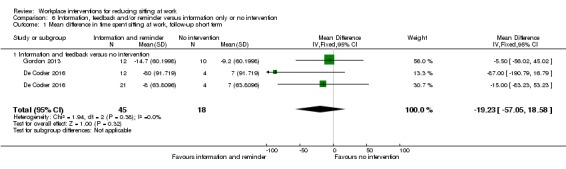
Research also has not shown that repeatedly breaking up sitting throughout the day reliably produces lasting cognitive gains. Workplace sit-stand programs have stronger evidence for reducing sitting time than for improving concentration or other work outcomes (see Figure 2). Longer-term and randomized studies support that distinction: less sitting is a well-supported result, while better focus is not.
Many direct comparisons of sitting and standing are based on short laboratory tests. These can show whether a person completes a controlled cognitive task while standing, but they are a weak substitute for measuring concentration through emails, meetings, problem-solving and interruptions across a full workday. 3 A small, 45-minute experiment cannot establish that a worker will stay more focused over months or during ordinary office routines.
There are further uncertainties. Some studies rely on self-reported productivity rather than objective attention measures, while others combine standing with exercise. The evidence base also includes unresolved questions about possible conflicts of interest. These limitations do not prove standing has no benefit; they mean the existing research does not directly answer the all-day focus question as well as it would need to.
The bottom line
Standing desks have not been shown to measurably improve sustained attention and focus compared with seated desks. The best-supported conclusion is that they can reduce time spent sitting and usually preserve task performance, with possible small, context-dependent benefits for engagement or how productive people feel.
That is a useful finding, but it should not be overstated. Maintaining performance while standing is not the same as improving sustained attention. Confidence in this conclusion is high because both reviews and individual experiments point away from a general focus advantage. The remaining question is whether better real-world, all-day studies might identify benefits for particular workers or tasks.
Supporting Arguments
Figures & data
All contributions are reviewed for clarity, balance, and evidence. The strongest insights are elevated into the argument graph — with credit to you.
Help improve this analysis →