Psychedelic-assisted therapy should be widely available
What's this about?
People disagree about whether mind-changing drug therapy should be easy for many people to get. It may help some people with severe trauma or low mood.
What supporters say
- Studies show that MDMA with talk therapy can help some people with severe PTSD, or trauma stress.
- Psilocybin with trained support can help some people with depression, even when other care failed.
- Some people felt better after one guided psilocybin session, which may offer hope for hard cases.
- Strict rules could make treatment safer than taking these drugs alone or from unknown sources.
What critics say
- Good results in small, careful studies do not prove that everyone should get this treatment.
- We still do not know enough about how big the benefits are or how long they last.
- The studies used much more than a drug, including planning, trained help, and follow-up care.
- People need checks for risk, safe places, emergency plans, and close care during treatment.
The bottom line
These treatments show real promise for some people with severe PTSD or depression. But the evidence supports careful treatment with strict rules, not broad access or use without trained help.
Psychedelic-assisted therapy has shown promise for people with severe PTSD and depression, but the evidence does not support making it freely or broadly available without strict safeguards. The strongest case is for carefully regulated treatment in specific conditions, not a general-purpose therapy or unsupervised drug use.
The case for
Clinical trials have found meaningful improvements for some hard-to-treat patients. MDMA-assisted therapy has outperformed placebo plus therapy for people with moderate-to-severe PTSD, improving both PTSD symptoms and daily functioning within an intensive psychotherapy program (see Figure 1). Psilocybin, given alongside psychological support, has also shown benefits in depressive disorders, including treatment-resistant depression. 1
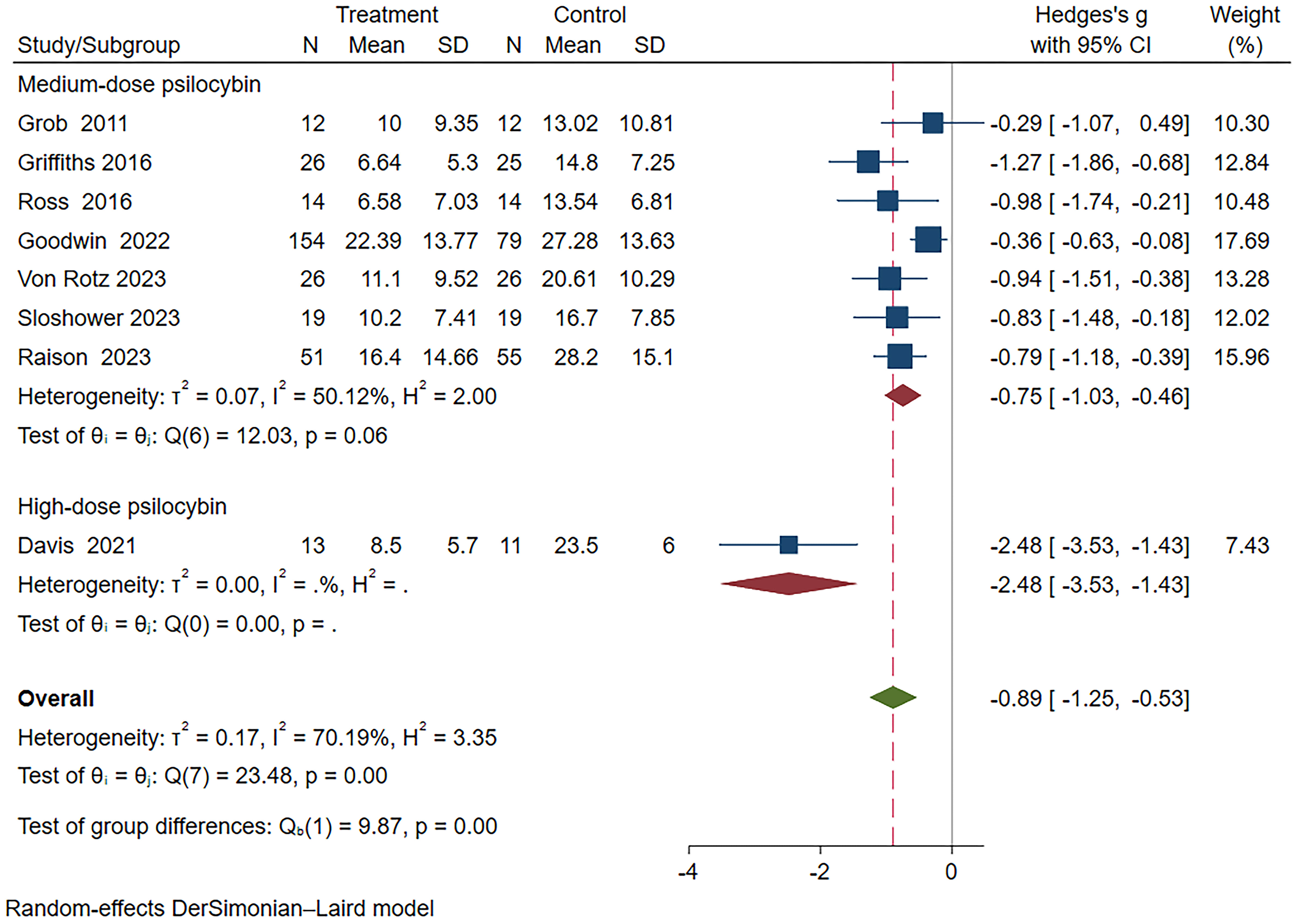
One attraction is speed. In some depression trials, patients improved after a single supported psilocybin session, and a broader review of studies found an overall antidepressant effect (see Figures 2 and 3). 2 For people who have not found relief through established treatments, this raises a strong ethical argument for offering access beyond research studies alone. 4
Supporters also argue that a regulated system could be safer than prohibition or informal use. In carefully screened and monitored studies, serious adverse events have been uncommon. But the treatment studied is not simply taking a drug: it includes preparation, trained therapeutic support, a controlled setting, follow-up care and careful patient selection. 3
That points toward a service model with licensed clinicians, informed consent, emergency plans, screening and ongoing monitoring. Such a system would better reflect how the treatments were tested than a market in which people obtain psychedelics without professional help.
The case against
The main objection is that promising trials do not justify unrestricted mass access. The studies so far do not fully establish how large the benefits are, how long they last, or how they compare with other treatments in everyday practice. Reviews have raised concerns about small study groups, short follow-up periods, varying therapy methods and the difficulty of keeping patients and therapists unaware of who received the active drug. Expectations alone may affect results, even if they do not mean the treatments have no real benefit. 5
Regulators reviewing MDMA-assisted therapy have flagged similar issues, including missing data, inconsistent therapy standards, study conduct and risk-management plans. They have also stressed that the treatment would require specialized controls if introduced into routine care. 8
Safety remains a major unanswered question. Trials may miss rare, delayed or situation-specific harms. Known concerns include acute psychological distress, cardiovascular effects, and the possibility of triggering mania or psychosis in vulnerable people. Risks may also arise from the unusually intimate relationship between therapist and patient, making strong professional boundaries and misconduct safeguards essential. 6
The people in trials also do not represent everyone likely to seek treatment. Many studies excluded patients with cardiovascular disease, a history of bipolar disorder, psychosis risk or medications that might interact with psychedelics. Ethnoracial minorities have also been substantially underrepresented, limiting confidence that results will apply equally across communities or that care will be culturally appropriate. 7
Wide availability could therefore deepen inequities if treatment remains expensive, concentrated in wealthy areas or delivered without diverse staff and culturally competent care. 9 A scaled-up system would need to address affordability and inclusion, not merely clinical effectiveness.
The bottom line
The evidence supports tightly regulated, clinically supervised and indication-specific access, especially for MDMA-assisted therapy for PTSD and psilocybin-assisted therapy for depressive disorders. It does not support unrestricted availability, routine use for every diagnosis, or unsupervised use.
This is a high-confidence conclusion because trials and reviews broadly agree on both points: these treatments can help selected patients under controlled conditions, and they require specialized safeguards. The biggest unanswered question is whether benefits and safety will hold up over longer periods, with more diverse patients, therapists and real-world treatment settings.
A responsible expansion would pair access with continued research: independent replication, longer follow-up, more diverse enrollment, transparent reporting of adverse events and clear standards for therapist training and supervision.
Pros — Supporting Arguments
Cons — Opposing Arguments
Figures & data
All contributions are reviewed for clarity, balance, and evidence. The strongest insights are elevated into the argument graph — with credit to you.
Help improve this analysis →