Social Security’s existing funding model is insufficient to sustain promised benefits over the long term
Bottom line (updated 2026-11-12): The evidence clearly shows that today’s system cannot pay every promised benefit forever. Social Security would continue, but Congress would need changes before the money fund runs out.
What's this about?
People disagree about whether Social Security can keep paying all promised benefits for many years. The main question concerns future money, taxes, and payments.
What supporters say
- Government forecasts show a lasting gap between Social Security’s money and its promised payments.
- The retirement money fund may run out in 2033, leaving enough money for only about 77% of promised payments.
- Fewer workers, longer lives, birth rates, immigration, and wage growth may put more stress on the system.
What critics say
- Social Security would not vanish after the money fund runs out; workers’ taxes could still pay most benefits.
- Congress could fix the problem with fairly small changes to taxes, benefits, or both.
How to read this
The number of points on each side does not show who is right; strong evidence matters more than a long list.
The bottom line
The evidence clearly shows that today’s system cannot pay every promised benefit forever. Social Security would continue, but Congress would need changes before the money fund runs out.
Social Security’s current financing system is projected to fall short of the money needed to pay all benefits promised under current law over the long term. That does not mean the program would suddenly disappear, but it does mean full scheduled benefits would require changes to taxes, benefits, or both.
The case for
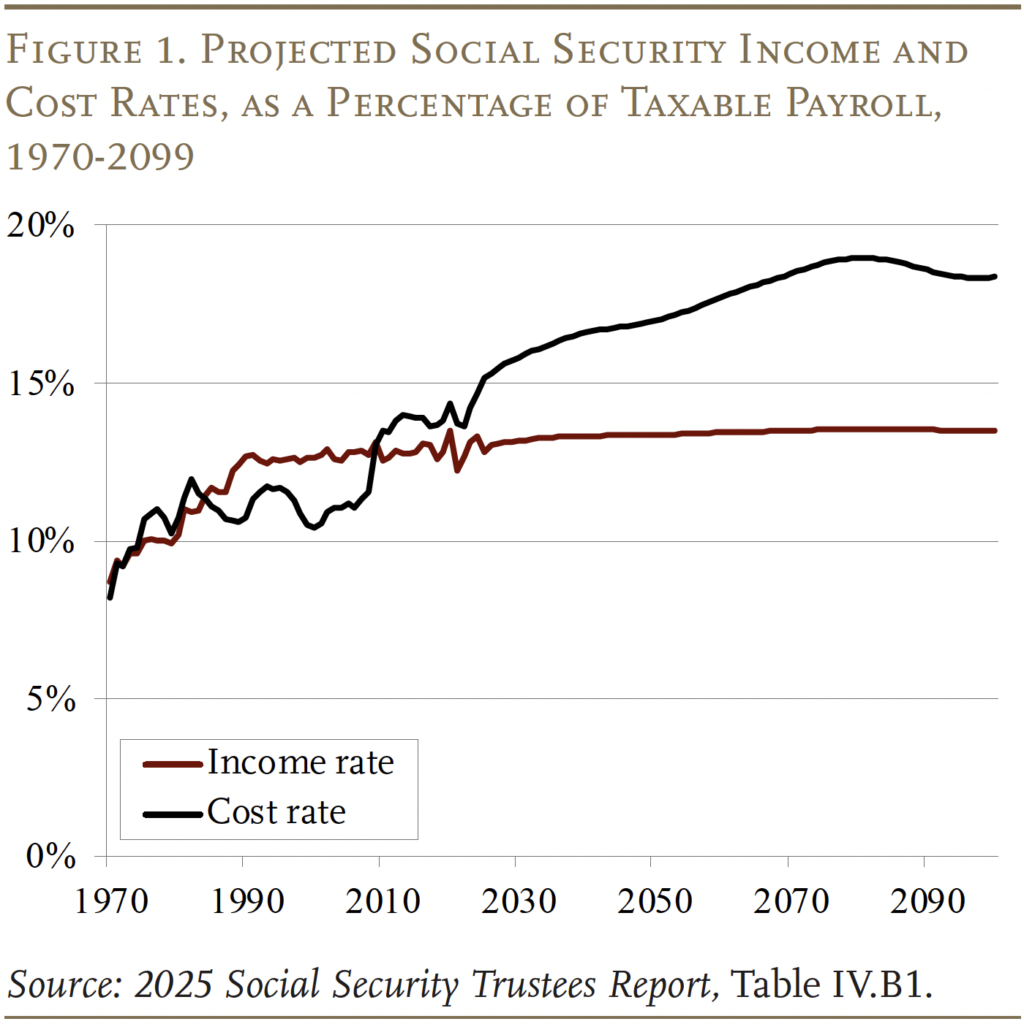
Official projections show a lasting financing gap. The 2025 Social Security Trustees report projects that the combined retirement and disability system will face a 75-year shortfall equal to 3.82 percent of taxable payroll. The Congressional Budget Office puts the gap at 4.3 percent of taxable payroll, or about 1.5 percent of the economy, over its own 75-year period. The two agencies use different methods, but they reach the same basic conclusion: current payroll taxes and trust-fund reserves are not expected to cover every scheduled benefit indefinitely. 1
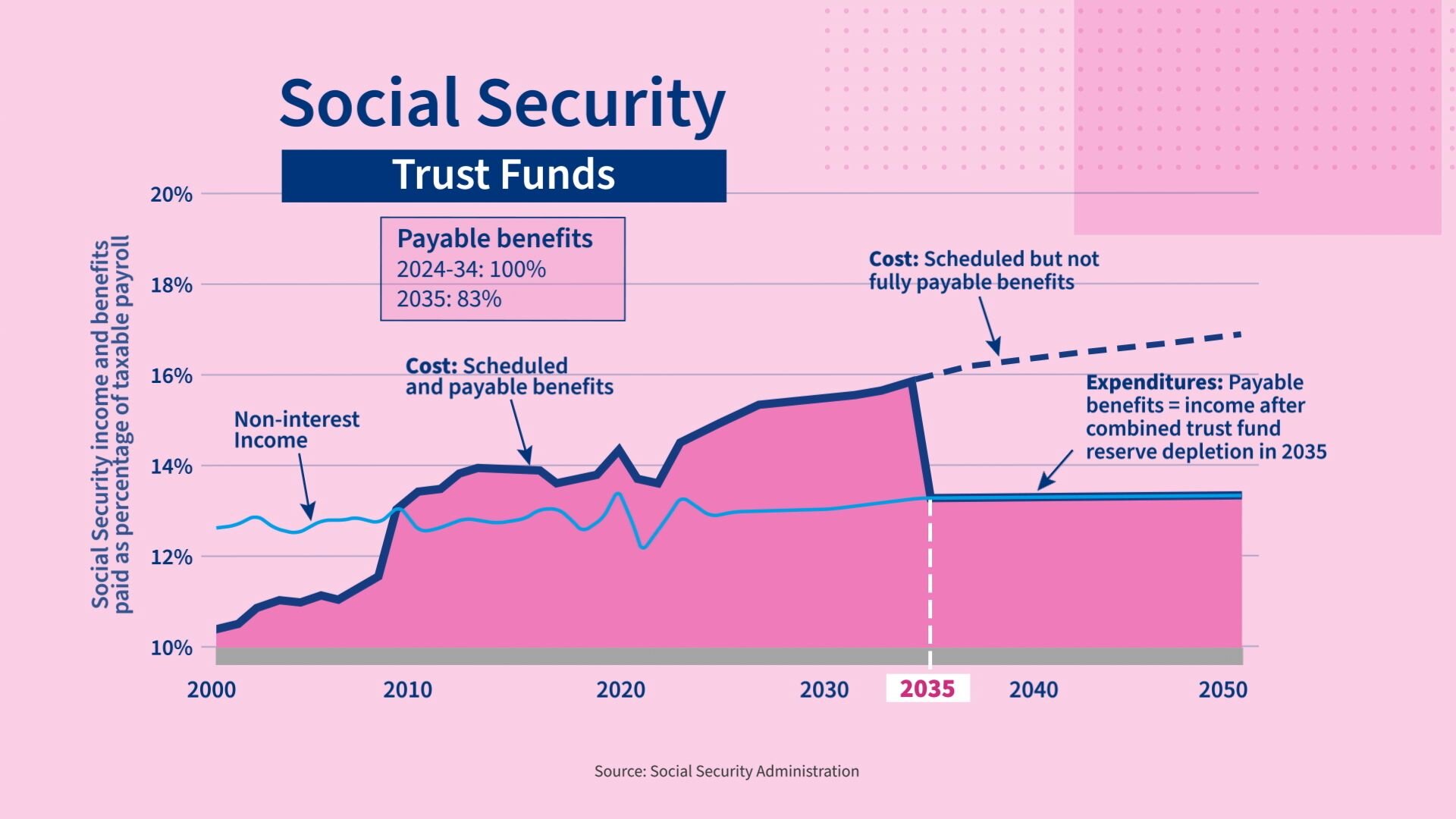
The problem becomes more immediate when the reserves are exhausted. The Trustees project that the retirement trust fund will run out in 2033. At that point, incoming program income would cover about 77 percent of scheduled retirement benefits. The Center for Retirement Research describes that as a potential 23 percent reduction in payable retirement benefits unless Congress acts. Current law promises scheduled amounts, but after reserves are depleted, available income would determine what the program can legally pay (see Figure 3). 2
Demographic and economic trends add pressure. The Congressional Budget Office projects scheduled Social Security spending will rise from 5.1 percent of gross domestic product in 2024 to 6.7 percent in 2098. Payroll taxes apply only to covered wages below an annual taxable maximum, so the number of workers, the size and distribution of their earnings, fertility, longevity, immigration and economic growth all affect future revenue. The Trustees’ projections likewise show program costs exceeding dedicated income over the long term, while the trust-fund ratio declines toward depletion (see Figure 1; see Figure 2). 3
The case against
The strongest qualification is that a financing shortfall is not the same as a collapse of Social Security. Even after the trust funds are depleted, payroll-tax income would continue to arrive. The immediate legal problem would be an inability to pay full scheduled benefits, not a complete end to payments. Most beneficiaries would still receive substantial benefits under that scenario. 4
Nor do the projections show that the system is impossible to repair. They show that policy changes would be needed. Congress could raise revenue, increase the amount of earnings subject to payroll taxes, change benefits, or combine several measures. The projected deficit is therefore a solvency challenge, not proof that failure is unavoidable. 5
The exact timing and size of the problem also remain uncertain. Future fertility, life expectancy, immigration, wage growth, interest rates and other conditions could produce better or worse results than the central forecasts. Those assumptions limit confidence in precise depletion dates and benefit-reduction estimates, even though the official projections consistently point in the same direction.
Social Security’s role in reducing poverty, including through provisions such as the special minimum benefit, is important to its social purpose. But those benefits do not eliminate the separate question of whether the program’s financing is sufficient. The available evidence does not compare every possible reform or show which approach would be fairest or politically achievable.
The bottom line
The evidence clearly favors the claim in its actuarial sense: under current law, existing payroll taxes and trust-fund reserves are projected not to finance all scheduled benefits forever. The strongest support comes from the broadly consistent Trustees’ and CBO projections, so the direction of the finding is relatively clear.
However, confidence is lower about the exact size and timing of the gap. The evidence does not suggest that Social Security will soon stop paying benefits, or that a particular reform is inevitable. It shows that preserving all scheduled benefits will require changes to financing, benefits, or both.
Figures & data

All contributions are reviewed for clarity, balance, and evidence. The strongest insights are elevated into the argument graph — with credit to you.
Help improve this analysis →