Should Albany voters approve Measure S? (November 3, 2026 ballot)
What's this about?
People disagree about whether Albany voters should approve Measure S on November 3, 2026.
The plan would change the tax on home sales and could raise money for city needs.
What supporters say
- Measure S would give Albany money that city leaders could use for many local needs.
- The plan would charge a higher tax rate on sales of more costly homes.
- The money could help pay for streets, parks, safety, fun programs, or nature care.
What critics say
- The higher cost of selling a home could lead to fewer sales and less tax money.
- Money from home sales can change a lot from year to year, so the city may not get $1 million each year.
- A higher sale tax could make people wait longer before moving to a new home.
How to read this
The number of points on each side does not show which side is right; the strength of each point matters more.
Albany voters will decide on Nov. 3, 2026, whether to replace the city’s flat real-property transfer tax with Measure S, a graduated tax on property sales. The measure could raise flexible local revenue, but its ultimate payoff depends on how buyers and sellers respond.
The case for
Measure S would give Albany a locally controlled source of general-fund revenue. The city’s impartial analysis estimates that the measure could raise about $1 million a year. Because it would be a general tax, the money could be used for valid city purposes, including street and park maintenance, recreation, public safety or environmental programs. However, the measure would not guarantee funding for any particular service. 1
The proposed rates also give the measure a plausible equity argument. Transactions below the 25th price percentile would face a lower 1% rate, while sales in higher price ranges would face rates of 2.5% or 3%. Policy analyses say graduated transfer taxes can make local revenue systems more progressive by seeking larger payments from high-value sales. But those analyses do not establish exactly how Measure S’s burden would be distributed in Albany. 2
The use of local price percentiles, rather than fixed dollar cutoffs, could offer another advantage. As prices change, the categories would adjust with the local market instead of becoming outdated. That may reduce incentives created by ordinary price growth, although it would not eliminate the possibility that buyers or sellers delay or restructure deals near a percentile boundary.
Transfer-tax revenue can also support broad city priorities because it is not legally tied to one program. That flexibility may help the city respond as needs change. Still, the projected $1 million is an estimate, not a guaranteed annual payment. 3
The case against
The strongest concern is that a higher cost for completing a sale could reduce the number of transactions. Research on United Kingdom stamp-duty schedules has found that higher transaction costs can discourage households from moving, supporting the idea that such taxes create a “lock-in” effect. The British system is different from Albany’s, however, so the size of any local effect remains uncertain.
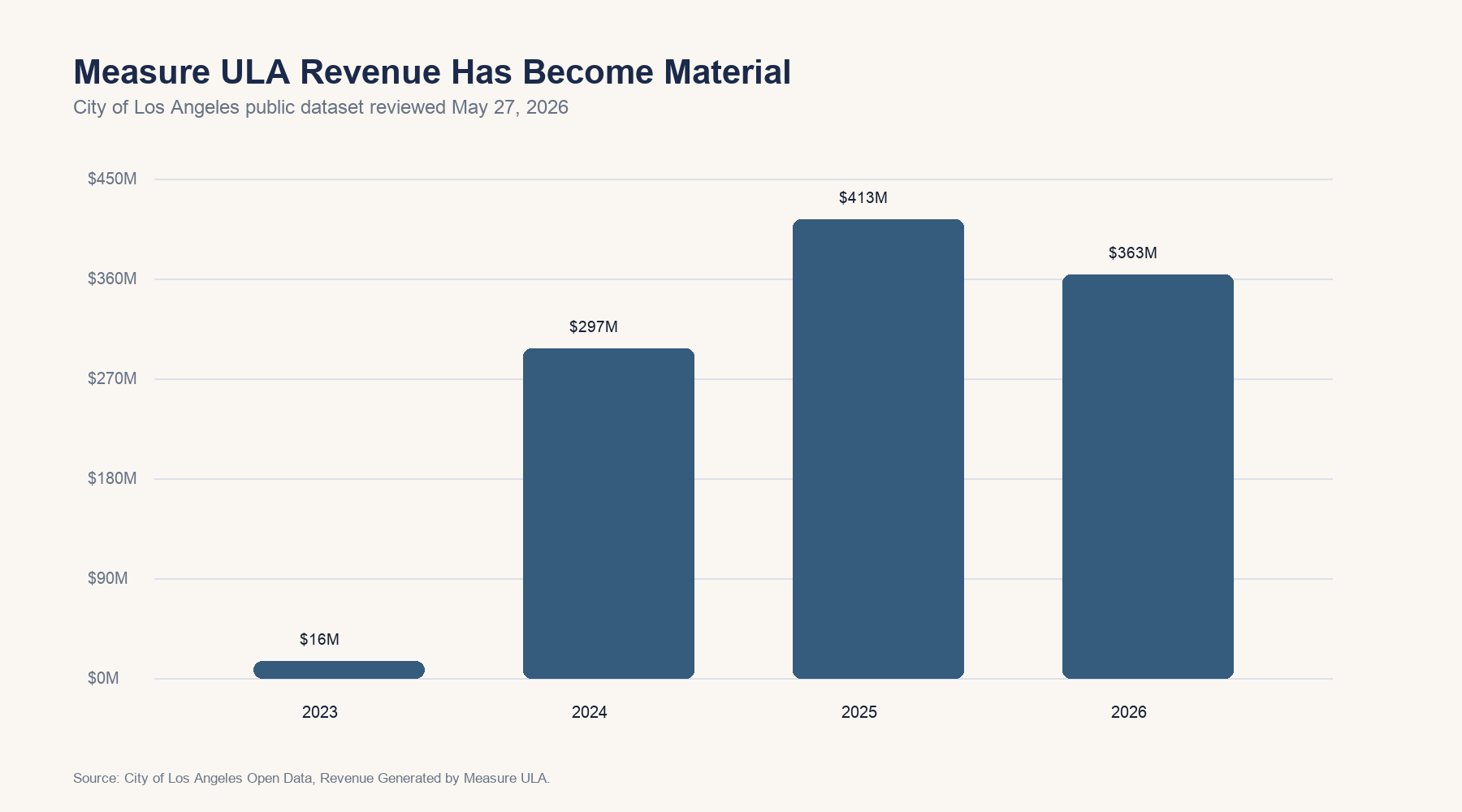
The closest California comparison is Los Angeles. RAND reported a 31% decline in high-value real-estate sales and more than 9,000 fewer housing units through the study period after Los Angeles adopted its Measure ULA transfer tax, while also finding that the tax generated substantial revenue (see Figure 1). If sales are delayed or avoided, Albany could collect less than expected. Fewer transactions could also weaken related property-tax growth or other public revenues. 5
Revenue may also be volatile. Transfer-tax receipts depend on sales volume, property prices and broader market conditions, so the official $1 million forecast could rise or fall substantially from year to year. Comparative evidence shows large historical swings in municipal transfer-tax revenue, although the cited volatility analysis came from a real-estate-industry-aligned organization and should therefore be treated cautiously. 6
The tax’s legal progressivity does not settle who would bear its economic cost. Buyers and sellers could divide the burden, or prices could adjust through negotiations. The evidence also does not show how Measure S would affect Albany’s transaction volume, household mobility, housing production or net revenue after behavioral changes. Los Angeles shows that a high-value transfer tax can produce significant collections (see Figure 2), but its market, scale, thresholds and spending rules differ from Albany’s proposal.
- City Attorney’s impartial analysis of Measure S acvote.alamedacountyca.gov
- Ballot Measures for General Municipal Election 2026 albanyca.gov
- City of Albany Biennial Budget FY2026–FY2027 albanyca.gov
- City Attorney’s impartial analysis of Measure S acvote.alamedacountyca.gov
- The Effects of the Measure ULA Transfer Tax on Housing and Homelessness rand.org
- L.A.’s ‘Mansion Tax’ Needs a Remodel rand.org
- Fiscal externalities of transaction taxes: Evidence from the Los Angeles Mansion Tax sciencedirect.com
- Fiscal externalities of transaction taxes: Evidence from the Los Angeles Mansion Tax communitytaxcoalition.org
- City Attorney’s impartial analysis of Measure S acvote.alamedacountyca.gov
- The Unintended Consequences of Real Estate Transfer Taxes realtorparty.realtor
Figures & data