Repeated executive resistance to judicial orders materially undermines separation of powers and public trust in government
Bottom line (updated 2026-11-03): The evidence clearly shows a risk to the balance of power between leaders and courts. The evidence about a broad drop in public trust remains less clear, because many causes shape trust.
What's this about?
People disagree about whether leaders who resist court orders can hurt the balance of government.
They also disagree about whether this resistance makes people trust government less.
What supporters say
- Repeated resistance can weaken the rule of law, which means everyone must follow the same basic rules.
- Political attacks on courts can make people doubt courts and other parts of government.
- When leaders ignore court orders, courts lose some real power to check those leaders.
What critics say
- Trust effects may depend on what people already expect from courts and government.
- Many things shape public trust, so court fights may not cause much change by themselves.
How to read this
The number of points does not show who is right; check how strong the proof behind each point is.
The bottom line
The evidence clearly shows a risk to the balance of power between leaders and courts.
The evidence about a broad drop in public trust remains less clear, because many causes shape trust.
Repeated executive resistance to judicial orders can harm the balance between branches of government and may weaken public trust. But the evidence is much stronger on the institutional damage than on the size of any general effect on public confidence.
The case for
The strongest case concerns the practical power of courts. A judicial ruling can constrain the executive only if officials comply. Research on executive discretion finds that control over compliance can limit what courts are able to decide in practice, shifting the balance of power toward the executive. Rule-of-law frameworks likewise treat effective judicial checks as a basic part of constitutional government. Comparative measures that combine respect for constitutional rules and court rulings with judicial independence illustrate this institutional link (see Figure 1). 1
Repeated refusal is more serious than a single dispute. Over time, it can turn a court’s formal authority into a conditional power—one that works only when executive officials choose to honor it. Guidance on judicial independence specifically identifies executive compliance with court decisions as a separate enforcement problem. Comparative studies of broader efforts to manipulate courts in Hungary, Poland and Turkey also find weaker accountability and rule-of-law performance. Those studies do not isolate repeated resistance to orders, but they support the broader warning that persistent interference can make it harder for courts to hold governments accountable. 2
There is also a plausible route to declining confidence in government. Surveys and reviews link political attacks on institutional legitimacy with lower confidence in courts and democratic processes. If executives repeatedly describe binding judicial orders as illegitimate, that may encourage citizens to see courts—and perhaps government institutions more broadly—as untrustworthy. 3 The effect may be especially damaging when resistance is paired with public attacks on judges or the legitimacy of judicial review.
The claim is strongest when resistance means repeated refusal to obey final, valid judicial orders. It is weaker when the term includes lawful appeals, good-faith disputes over jurisdiction or ordinary constitutional disagreement. Judicial authority depends partly on constitutional design and democratic acceptance, so not every challenge to a ruling amounts to unlawful defiance.
The case against
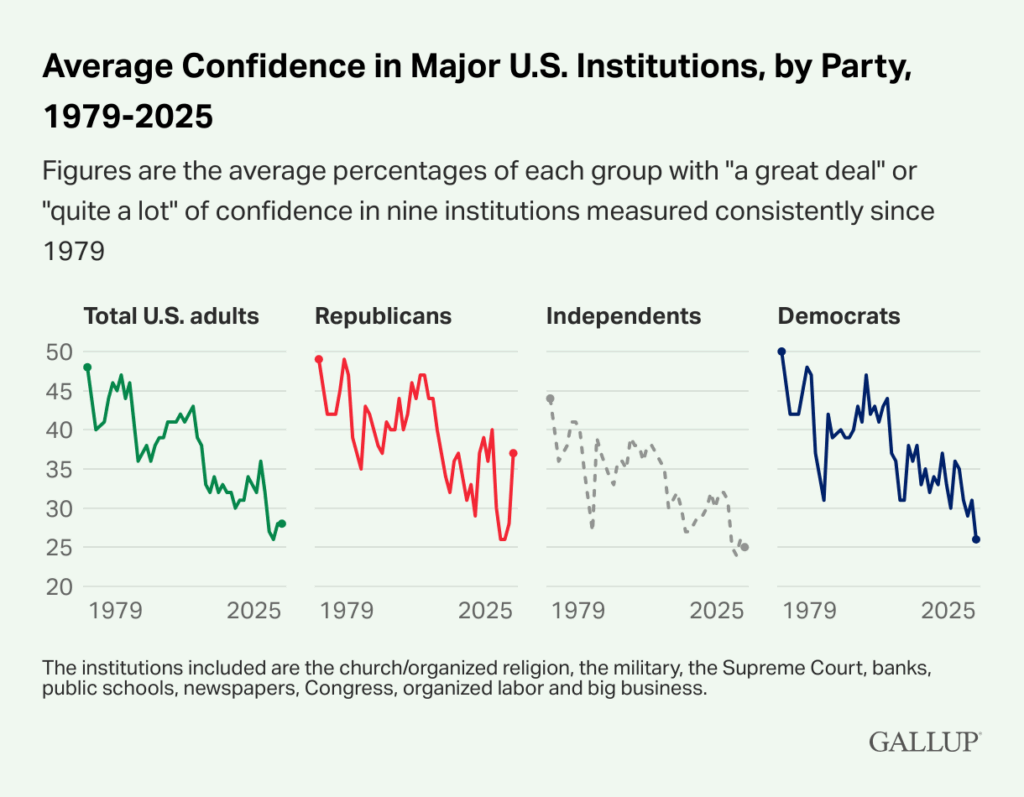
The main challenge concerns causation and variation in public reactions. Falling trust in institutions cannot by itself show that executive resistance caused the decline. Reviews identify many other influences, including political polarization, the substance of judicial decisions, economic conditions and broader institutional deterioration (see Figure 2). The available research therefore supports a possible trust-eroding mechanism, but does not show that resistance is the main or independent cause.
Citizens also do not respond uniformly. A peer-reviewed study of Colombia’s tutela system found that reactions to information about noncompliance depended partly on people’s prior expectations. The same executive conduct may be viewed very differently by citizens who begin with confidence in courts and those who already distrust them. This weakens any universal prediction that resistance will reduce public trust. 4
Trust in government has multiple competing causes, and public confidence may rise or fall for reasons unrelated to court compliance. 5 The comparative evidence has limits as well: studies of judicial manipulation and expert-coded rule-of-law indexes capture wider patterns such as court-packing and political pressure. They cannot precisely assign deterioration to resistance to judicial orders alone, and uncertainties in the underlying classifications make the scores imperfect measures of cause and effect.
The bottom line
The evidence strongly supports the claim’s separation-of-powers dimension. Repeated refusal to comply with final, valid judicial orders can materially weaken the judiciary’s ability to check executive power. That institutional harm is more directly supported than the claim that such resistance generally reduces public trust.
The trust conclusion is plausible but conditional, not firmly established across all settings. The evidence shows mechanisms and varied public reactions, but lacks a direct, general estimate of how much repeated executive noncompliance independently lowers trust after accounting for polarization, economic conditions, judicial decisions and wider institutional decline. Overall, the balance is even rather than one-sided: institutional damage is well supported, while the broader public-trust effect remains context-dependent and requires stronger causal evidence.
Pros — Supporting Arguments
Cons — Opposing Arguments
Figures & data

All contributions are reviewed for clarity, balance, and evidence. The strongest insights are elevated into the argument graph — with credit to you.
Help improve this analysis →