Political leaders’ cryptocurrency ties reduce trust in financial regulation
Bottom line (updated 2026-11-11): The evidence supports a broad idea: money ties can make leaders seem less fair. But we are not sure yet whether crypto ties alone cause a clear drop in trust.
What's this about?
People disagree about whether leaders with crypto ties can make people trust money rules less.
Crypto means a type of online money that can rise or fall in value quickly.
What supporters say
- Crypto scandals can link leaders’ power with failures in money rules.
- A leader’s money ties can make fair rules look less fair.
- Telling people about money ties can lower their trust in a leader’s words.
- Tokens sold by leaders can make possible conflicts much easier to notice.
What critics say
- Clear reports, strong rules, and checks may help keep people’s trust.
- We still have little proof that crypto ties directly lower trust in money rules.
How to read this
The number of points on each side does not show which side is right; strong proof matters more.
The bottom line
The evidence supports a broad idea: money ties can make leaders seem less fair.
But we are not sure yet whether crypto ties alone cause a clear drop in trust.
Political leaders’ financial ties to cryptocurrency ventures may reduce public trust in financial regulation, especially when those ties appear connected to policy decisions. But the evidence is stronger for the general mechanism than for a direct, crypto-specific effect.
The case for
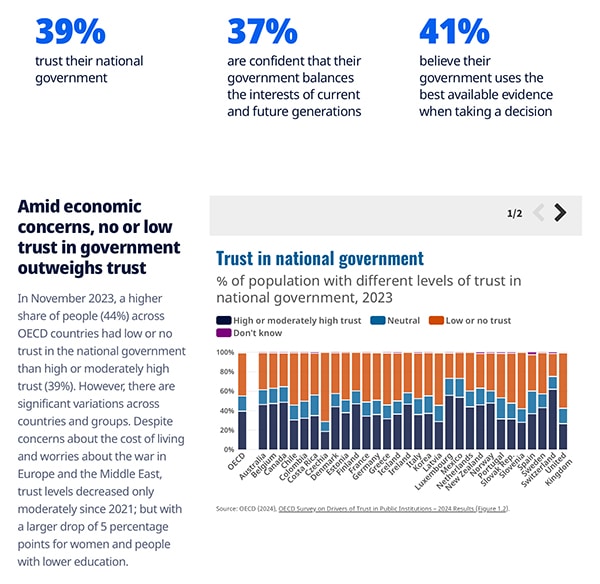
Visible private interests can make regulation look less impartial. Research on trust in public institutions points to fair treatment, reliability and the way officials use public power as important drivers of confidence. The OECD also warns that unmanaged private interests can damage trust in government. Applied to a leader with a financial stake in an industry they help regulate, that suggests even an unproven conflict can make decisions appear self-serving. (see Figure 1) 1
Studies outside politics support this basic psychological pathway. A randomized study of medical opinion leaders found that disclosing financial interests reduced trust, with larger interests producing larger declines. The U.S. Government Accountability Office has likewise warned that conflicts in retirement advice can raise doubts about the integrity of the financial system and weaken people’s willingness to save. These findings do not prove that voters react in exactly the same way to a politician’s crypto holdings, but they show that disclosure can affect perceived impartiality. 2
Cryptocurrency can make such concerns unusually visible. Reports about Trump- and Melania-linked meme coins, sharp price changes and a dinner for major $TRUMP buyers have raised questions about whether presidential-family interests could benefit from digital-asset policies. Tokens, market movements and privileged access can make the connection between private financial gain and public authority easier to see. The reports document controversy, not a measured drop in trust, but they provide a clear setting in which concerns about divided loyalties may grow. 4
Crypto scandals can reinforce the same impression. Justice Department records describe political contributions linked to FTX and the conviction and sentence of Sam Bankman-Fried. Securities regulators alleged that FTX misrepresented its safety and risk controls and diverted customer assets. Such events can connect political influence, private finance and weak oversight in the public mind, even though the records do not establish that trust in financial regulators actually fell afterward. 3
The case against
The main objection is a lack of direct evidence. The strongest studies examine medicine, retirement advice or corruption generally, rather than elected leaders with crypto interests. Existing crypto-related evidence consists mainly of official records, institutional analysis and news reports documenting controversies. It does not provide a clean test of whether public trust changed after a leader’s crypto relationship became known. 5
That leaves several competing explanations. Any decline in trust could result from the scandal itself, partisan conflict, general dissatisfaction with regulation or pre-existing views about cryptocurrency. Political identity may also shape the reaction: one person may see a leader’s crypto ties as corruption, while another sees them as support for innovation.
Safeguards may also limit the damage. Disclosure, recusal, independent management of assets and enforcement could reassure the public if they are credible and visible. Research summarized by Cornell found that disclosure can sometimes create misplaced reassurance rather than reduce trust. An industry analysis also argues that transparency and political-finance safeguards may address influence concerns without banning crypto donations, although that source is advocacy-oriented and provides weaker support. 6
The details matter. Reporting on World Liberty Financial records concerns that presidential-family crypto interests could benefit from digital-asset policies, while supporters disputed the existence of a conflict because family members managed the assets. That disagreement shows why the separation between ownership, management and decision-making is central. Observers may also disagree over whether family-held assets, promotional activity, donations or access arrangements count as conflicts at all.
The bottom line
The evidence leans toward the claim, but only with moderate confidence. General research on institutional trust and disclosed financial interests, together with prominent crypto controversies, supports the idea that political leaders’ crypto ties can make financial regulation look less impartial.
But the evidence does not yet show a clear, independent causal effect on public trust in financial regulators. The central unanswered question is whether the financial tie itself drives distrust, or whether it works mainly as a signal of scandal, partisan identity, suspected misconduct or weak safeguards. Ownership alone may matter less than how leaders use the relationship and whether credible protections are in place.
Figures & data
All contributions are reviewed for clarity, balance, and evidence. The strongest insights are elevated into the argument graph — with credit to you.
Help improve this analysis →