Llama-3.3-70B on DGX Spark generally requires aggressive quantization and is slower than 24B–32B models
What's this about?
People disagree about whether Llama-3.3-70B can run well on a DGX Spark.
The key questions are how much memory it needs and how fast it writes text.
What supporters say
- The full 70B model needs about 140 GB of memory, before space for other needed data.
- A DGX Spark has 128 GB of shared memory, so full-precision model files do not fit well.
- Low-bit model files, such as 4-bit files, need about 35–45 GB and leave more free space.
- Since 70B has over twice as many parts as 24B–32B models, it should make words more slowly.
What critics say
- The exact speed gap can change with the app, model file type, prompt size, and setup.
- A 70B model can still run on DGX Spark when users choose a low-bit model file.
- Some users may pick 8-bit files for more detail, though they leave less room for long chats.
- Tests show a general trend, but they do not prove one fixed speed rate for every task.
The bottom line
The evidence says Llama-3.3-70B can run on DGX Spark, but low-bit files make it far more useful.
It will usually write text more slowly than 24B–32B models on the same machine.
Running Meta’s Llama-3.3-70B-Instruct model on Nvidia’s 128-GB DGX Spark is possible, but it comes with practical limits. The evidence indicates that low-bit quantization is usually needed for comfortable operation, and that the 70-billion-parameter model will generally generate text more slowly than comparable 24B–32B models.
The case for
The clearest issue is memory. At FP16 or BF16 precision, Llama 3.3’s 70 billion parameters require about 140 GB for the model weights alone—already more than the DGX Spark’s 128 GB of unified memory. Real-world inference needs additional space for runtime operations, temporary buffers and the KV cache, which grows with the amount of context being processed. That makes unquantized deployment not just tight, but operationally impractical on this machine 1.
Lower-precision weights change that picture substantially. A 4-bit version of a 70B model is estimated to need roughly 35–45 GB, compared with around 70–80 GB at 8-bit and about 140 GB at FP16. That leaves far more room for the software environment and the cache needed for longer prompts and conversations. For that reason, 4-bit or similarly low-bit formats are the most practical choice for running the model with useful headroom on DGX Spark 2.
The speed claim also has a strong common-sense basis. Llama 3.3-70B has more than twice as many parameters as many dense 24B–32B alternatives. Generating each new token requires moving weights through memory and performing more computation; memory bandwidth, software kernels and cache behavior can all become bottlenecks. On the same hardware and under comparable settings, the larger model therefore has a directional disadvantage in decoding speed 3.
Available local-model benchmark reporting is consistent with that expectation: larger dense models tend to produce fewer tokens per second on fixed hardware. This does not establish a universal speed ratio, but it supports the narrower wording that the 70B model is “generally slower,” rather than always slower by a fixed amount.
The case against
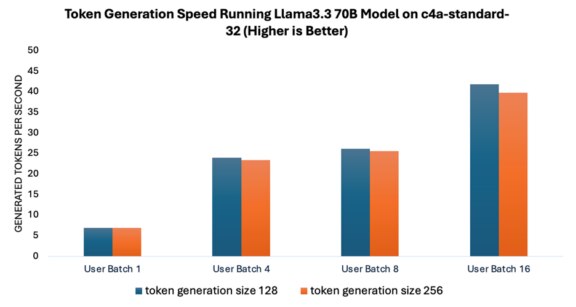
The model is not impossible to run on DGX Spark. Community repositories document configurations and benchmarks for Llama 3.3-70B on this specific device, showing that it can be deployed when the settings are chosen carefully (see Figure 1) 4. The concern, then, is not the machine’s absolute ability to load the model. It is whether there is enough spare memory for stable, useful serving conditions.
Nor does aggressive quantization necessarily make the model unsuitable. Research on methods including GPTQ and AWQ suggests that well-calibrated 4-bit quantization can retain much of a model’s useful task performance while sharply cutting memory use (see Figure 2) 5. The trade-off is real, but low-bit deployment should not be treated as proof of poor quality.
There is also an important caveat around 8-bit operation. Estimated 8-bit weights, at roughly 70–80 GB, sit below the DGX Spark’s nominal 128-GB capacity. But the remaining space must cover the operating environment, framework allocations, temporary memory and a workload-dependent KV cache. Whether 8-bit is workable therefore depends on the runtime, context length and other settings. The strongest conclusion is that 4-bit is generally the comfortable operational option, not that 8-bit is mathematically impossible.
Speed comparisons are similarly conditional. Quantization type, kernel quality, batch size, prompt length, context length and whether a test measures prompt processing or token-by-token generation can all affect results. A highly optimized low-bit 70B setup could narrow the gap against a poorly optimized smaller model.
The bottom line
The claim is well supported as a practical, qualified statement. FP16/BF16 Llama-3.3-70B does not fit operationally within DGX Spark’s 128-GB memory once normal inference overhead is included, while 4-bit quantization generally provides the headroom needed for useful deployment. Under comparable conditions, the 70B model should also generally decode more slowly than 24B–32B alternatives.
Confidence is high on the memory arithmetic and the broad speed expectation. It is lower for any exact tokens-per-second comparison, because there is no standardized, independently replicated DGX Spark test holding every relevant condition constant.
Figures & data
All contributions are reviewed for clarity, balance, and evidence. The strongest insights are elevated into the argument graph — with credit to you.
Help improve this analysis →