DeepSeek-R1-Distill-Qwen-32B fits on DGX Spark, but long reasoning traces can reduce responsiveness
What's this about?
People disagree about whether DeepSeek-R1-Distill-Qwen-32B can run on a DGX Spark and still feel quick.
It will likely fit, but long “thinking” text may slow replies.
What supporters say
- The DGX Spark has 128 GB of shared memory for its main chip parts.
- A 32-billion-part model at 4-bit size needs about 16 GB for its saved model data.
- That gap leaves room for extra work space and some chat history.
- Long thinking traces make more text, so the model must do more work before it finishes.
What critics say
- The model data alone does not show how fast the system will feel.
- The computer also needs memory for work files and saved chat details.
- Very long prompts or many users can use up that extra room quickly.
- We are not sure how each app setup will handle long, thought-heavy answers.
The bottom line
A 4-bit version will likely fit on a 128 GB DGX Spark.
But long reasoning traces can make replies take longer, especially when several people use it.
DeepSeek-R1-Distill-Qwen-32B can likely be loaded on Nvidia’s 128 GB DGX Spark when using a quantized version, but loading the model is not the same as getting fast, smooth responses. The main uncertainty is how the exact software setup handles long, reasoning-heavy answers.
The case for
The strongest part of the claim is the memory calculation. DGX Spark has 128 GB of unified CPU-GPU memory, while a 32-billion-parameter model stored at 4-bit precision needs roughly 16 GB for its weights before allowing for supporting data and runtime memory. That leaves substantial room for a quantized DeepSeek-R1-Distill-Qwen-32B checkpoint, as well as some capacity for the model’s working memory and conversation context 1 (see Figure 2).
That does not mean all 128 GB is freely available. The system must also hold runtime buffers and the KV cache, which stores information needed to process long prompts and generate answers. Still, the gap between an estimated 4-bit weight size and the hardware’s total memory makes local deployment plausible, especially if context length and the number of simultaneous users are chosen carefully.
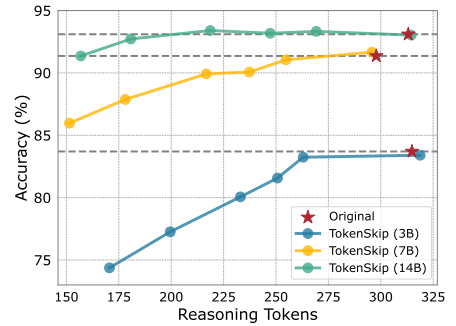
The second half of the claim is also well supported. DeepSeek-R1-style models are designed to produce visible reasoning before their final answer. Those traces can add many generated tokens, and each additional token requires another step of model computation. At a fixed generation speed, a longer trace means a longer wait for the user 2 (see Figure 1).
This matters even more when several requests are being served at once. Long reasoning outputs consume generation capacity that could otherwise be used for other users, so they can put pressure on interactive throughput and make a system feel less responsive 3. Research into shortening or controlling chain-of-thought output also supports the idea that reasoning length is a real driver of inference cost, rather than simply a stylistic choice.
The case against
A model that fits into memory does not automatically deliver useful performance. Actual responsiveness will depend on the inference engine, support for Nvidia’s GB10 hardware, memory bandwidth, the quantization method, context length and how many requests run at the same time. Existing performance results from other accelerators or specialized systems cannot provide a reliable tokens-per-second or latency estimate for this exact DGX Spark deployment 4.
Quantization also brings a trade-off. Reducing precision lowers memory use and can improve efficiency, but it can also reduce model quality in ways that vary by task. Studies of DeepSeek-family models and large language models more broadly have found that aggressive quantization can harm reasoning performance, so a model that loads successfully may not retain the quality required in practice 5.
Nor will every prompt produce a long reasoning trace. Output length changes with the task, the wording of the prompt, generation settings and stopping behavior. The risk is therefore workload-specific: some requests may remain quick, while harder problems or settings that encourage extended reasoning may take noticeably longer 6.
It may be possible to reduce the burden by limiting or compressing reasoning output. But this too can involve a trade-off, since work on chain-of-thought compression suggests that cutting traces may affect reasoning quality (see Figure 3).
The bottom line
The claim is supported. A practical, quantized version of DeepSeek-R1-Distill-Qwen-32B is likely to fit within DGX Spark’s 128 GB memory, and long reasoning traces can reduce responsiveness because they require more generated tokens.
Confidence is high in that broad distinction between memory capacity and real-world speed. But there is no controlled benchmark for this precise model, quantization format, inference engine and DGX Spark configuration. Until such testing reports context length, concurrency, tokens per second and end-to-end latency, no single performance expectation can be stated with confidence.
Figures & data
All contributions are reviewed for clarity, balance, and evidence. The strongest insights are elevated into the argument graph — with credit to you.
Help improve this analysis →