Llama-3.3-70B-Instruct requires aggressive quantization on DGX Spark and is slower than smaller dense models
What's this about?
People disagree about whether Llama-3.3-70B-Instruct needs very low-bit storage on a DGX Spark. They also disagree about how much slower it feels than smaller models.
What supporters say
- DGX Spark has 128 GB of memory, but the full 70B model needs about 140 GB at 16-bit detail.
- The model needs even more memory for the system, prompts, and new text.
- Quantization (shrinking number detail) lets low-bit copies fit into the machine more easily.
- A 70B model usually makes text slower than 24B-to-32B models because it has more parts to read.
What critics say
- “Aggressive” may overstate the case, since the best bit level depends on the task and memory use.
- A 4-bit copy saves much space, but long chats still need extra memory for saved chat details.
- Speed does not follow one fixed rule, since model files, software, and tasks can change results.
- The large model may trade speed for better skills, so slower output does not mean it lacks value.
The bottom line
A full 16-bit Llama-3.3-70B-Instruct model will not usually fit well on one DGX Spark. Low-bit quantization usually makes sense, and the 70B model will generally run slower than smaller dense models.
Llama-3.3-70B-Instruct can run on a single NVIDIA DGX Spark, but the evidence suggests that low-bit quantization is usually the practical choice. It also will generally generate text more slowly than smaller 24B-to-32B dense models when tested under comparable conditions.
The case for
The clearest issue is memory. DGX Spark has 128 GB of unified system memory, while Llama-3.3-Instruct is a dense 70-billion-parameter model. Storing its weights at roughly 16-bit precision takes about 140 GB before allowing for the operating system, inference software, and memory used for prompts and generated text. That makes a fully unquantized deployment on one unit ordinarily impractical. 1
Quantization addresses that problem by reducing the space taken up by the model’s weights. Low-bit GGUF versions of Llama-3.3-70B-Instruct are available for local inference, and DGX Spark deployment guidance specifically presents quantization as a way to run larger models within the machine’s memory limits. A 4-bit version can cut the weight footprint substantially, though its real-world memory needs still depend on context length and the KV cache used to track a conversation. 2
The speed argument also has a strong general basis. In text generation, a model must repeatedly read its weights and perform calculations for every new token. A 70B dense model therefore has substantially more weights to move and more computation to perform than a 24B-to-32B dense alternative, assuming broadly similar hardware and software settings. DGX Spark benchmark material reports generation performance that generally changes with model size in that expected direction (see Figure 1). 3
That does not produce a universal speed ratio, but it supports the everyday expectation: the larger model trades some generation speed for scale and capability. The evidence is strongest when comparing similar model files, quantization levels, runtimes and workloads.
The case against
The phrase “requires aggressive quantization” goes somewhat further than the memory arithmetic alone can prove. DGX Spark uses a shared 128 GB memory pool rather than a simple fixed graphics-memory limit, and whether a model fits depends on more than its raw weights. A short-context run with tightly managed memory may work under conditions that would not be practical for a longer, more typical deployment. 4
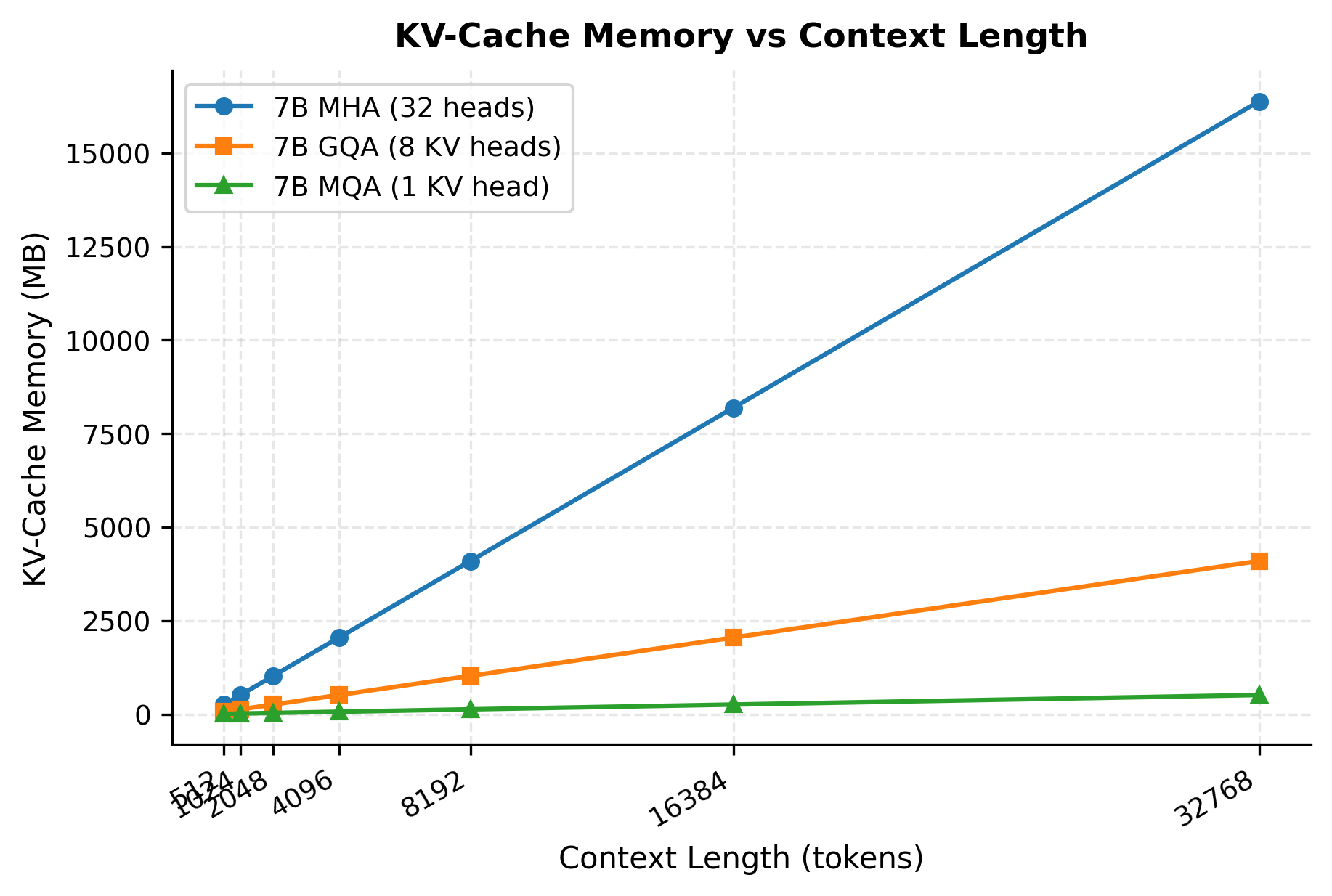
In other words, it is more accurate to say that low-bit quantization is the practical default for comfortable use, especially when there must be room for long prompts and runtime overhead. It is not proven that every possible single-Spark setup needs precisely the same degree of compression. Long contexts can consume enough additional KV-cache memory to become the deciding factor in both fit and performance (see Figure 3).
Likewise, a smaller parameter count does not guarantee a faster result in every benchmark. Measured throughput depends on the software backend, the specific build, the quantization method, context length, batch size, clock settings, and whether the test measures prompt processing or token-by-token generation. A well-tuned 70B setup could beat a poorly configured smaller model in a particular test. 5
Available DGX Spark reports point in the same broad direction, but they use differing methods and settings. There is limited standardized head-to-head evidence comparing Llama-3.3-70B-Instruct directly with named 24B-to-32B dense models on one Spark while holding all those variables fixed (see Figure 2).
The bottom line
The claim is substantially supported as a practical generalization. Unquantized 70B weights exceed the memory available on a single DGX Spark once normal overhead is included, while low-bit quantization makes Llama-3.3-70B-Instruct practical to deploy. 12
The model will also generally decode more slowly than matched 24B-to-32B dense models because of its much larger parameter count. 3 But neither point should be read as absolute: the required amount of quantization and the exact speed ranking depend heavily on context size, runtime software, quantization, batching and measurement conditions.
Figures & data

All contributions are reviewed for clarity, balance, and evidence. The strongest insights are elevated into the argument graph — with credit to you.
Help improve this analysis →