Large payroll disparities in Major League Baseball reduce the likelihood that small-market teams sustain postseason success
Bottom line (updated 2026-10-26): The facts give some support to the claim, mainly for regular-season wins and reaching the playoffs. They do not clearly show that big pay gaps stop small teams from making deep playoff runs many times.
What's this about?
People disagree about whether big pay gaps make it harder for small teams to win often in the playoffs.
What supporters say
- Teams with more pay money often play better during the long regular season.
- Recent playoff winners include teams with very large pay bills.
- Bigger cities and local TV deals give some teams more money to spend each year.
What critics say
- Teams with small pay bills still reach the playoffs again and again.
- More pay money does not always lead to more wins.
- The gap between team pay bills does not always match the gap in wins.
How to read this
The number of points on each side does not show who is right; strong proof matters more than a long list.
The bottom line
The facts give some support to the claim, mainly for regular-season wins and reaching the playoffs.
They do not clearly show that big pay gaps stop small teams from making deep playoff runs many times.
The claim is that large payroll gaps in Major League Baseball make it harder for small-market teams to sustain postseason success. The available research offers some support, but it is stronger for regular-season performance and reaching the playoffs than for repeatedly advancing once there.
The case for
Several peer-reviewed studies using MLB data from 1985 onward find a connection between salary levels, salary differences and team performance. In general, teams that spend more have had better regular-season results, making payroll an advantage in the race to qualify for October.1 The relationship is not perfectly straight: one study found an “inverse-U” pattern, in which spending helped winning up to a point before producing smaller or even negative returns. Even so, a persistent financial disadvantage can reduce a team’s average chances over many seasons without making success impossible in any one year.
MLB’s financial structure also gives wealthy clubs reasons and opportunities to maintain that advantage. Differences in market size and local media revenue can produce large gaps in what teams are able to spend. MLB has no hard salary cap or minimum payroll, allowing clubs with stronger revenue bases to outbid rivals or retain more talent. Those league-produced materials offer a plausible explanation for why spending advantages can persist, although they are not independent evidence and therefore provide limited support for the broader causal claim.2
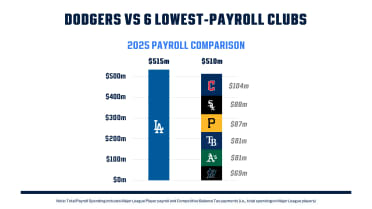
Recent postseason results are also consistent with the idea that payroll helps clubs remain competitive. A matchup involving the Dodgers’ exceptionally large payroll and a far lower-payroll opponent illustrates the scale of the gap. Broader payroll and standings comparisons point in the same direction, though they show patterns rather than proving that spending caused a particular team to win (see Figure 1).3
The case against
Low payroll does not prevent teams from reaching or succeeding in the playoffs. The Guardians and Rays, among other lower-spending clubs, have produced notable postseason results. Their records suggest that player development, roster construction and smart management can offset financial disadvantages, although the strongest documentation for these examples comes from descriptive records and a student research report rather than a major causal study.4
Payroll is also not a reliable step-by-step predictor of winning. The inverse-U finding means that expensive rosters can be inefficient, while well-run low-payroll teams can outperform richer clubs in particular seasons.5 That matters especially in the playoffs, where short series are affected by injuries, matchups and random variation.
Nor does payroll inequality map neatly onto leaguewide competitive balance. Parity depends on more than spending, including revenue sharing, league rules, player development, roster management and the playoff format. Reviews and studies cited in the analysis find that recent payroll patterns did not necessarily make the league less balanced. They also distinguish between uncertainty in individual games, overall team parity, how often teams make the playoffs and whether the same clubs repeatedly win.6
The bottom line
The evidence modestly favors the claim, with moderate confidence, but only in a narrower form. Payroll appears to improve a team’s average chances of building and maintaining regular-season contention, and large-market clubs have structural advantages that can persist over time.
The evidence is much weaker on the claim’s exact outcome: repeated postseason advancement by small-market teams. Most major studies examine winning percentage, salary differences or broad competitive balance rather than sustained playoff success. Postseason examples are mainly descriptive, and payroll is intertwined with organizational quality, player development, injuries and roster timing.
In short, large payroll disparities probably make sustained contention more difficult for small-market teams, particularly when it comes to reaching the playoffs consistently. But the available evidence does not show with high confidence that payroll differences independently determine whether those teams can repeatedly advance once the postseason begins.
Figures & data
All contributions are reviewed for clarity, balance, and evidence. The strongest insights are elevated into the argument graph — with credit to you.
Help improve this analysis →