Gig economy workers should be classified as employees
What's this about?
People disagree about whether gig workers, like app drivers and food couriers, should count as employees. The key question is how much the app company controls their work.
What supporters say
- Many gig workers lack health cover, paid time off, and plans for when they stop working.
- Workers often pay costs for cars, fuel, taxes, and insurance that a normal boss might pay.
- Pay can seem low after workers subtract those costs from what they earn.
- Companies should treat workers as employees when they control pay, rules, and work chances.
What critics say
- Not every person who earns money through an app needs the same work rules.
- Some workers may use apps only now and then, rather than depend on them for most income.
- A work contract's label does not settle whether someone counts as an employee.
- Some reports use worker polls or groups that support labor rights, so we should read them with care.
The bottom line
Evidence supports employee status when an app company strongly controls work and workers depend on it for income. We do not yet have enough proof to give every app worker employee status.
Gig economy workers should be treated as employees when platforms substantially control their work and workers depend on them for income, the evidence suggests. But a blanket rule covering everyone who earns money through an app would go further than current research can support.
The case for
The strongest argument for employee status is that many platform workers face the same problems as other workers in insecure jobs, while doing work that is central to the companies they serve. They may lack employer-backed retirement plans, insurance and other workplace protections, and can bear costs that a traditional employer would normally absorb. Employee classification could close major gaps in income security and benefits. 1
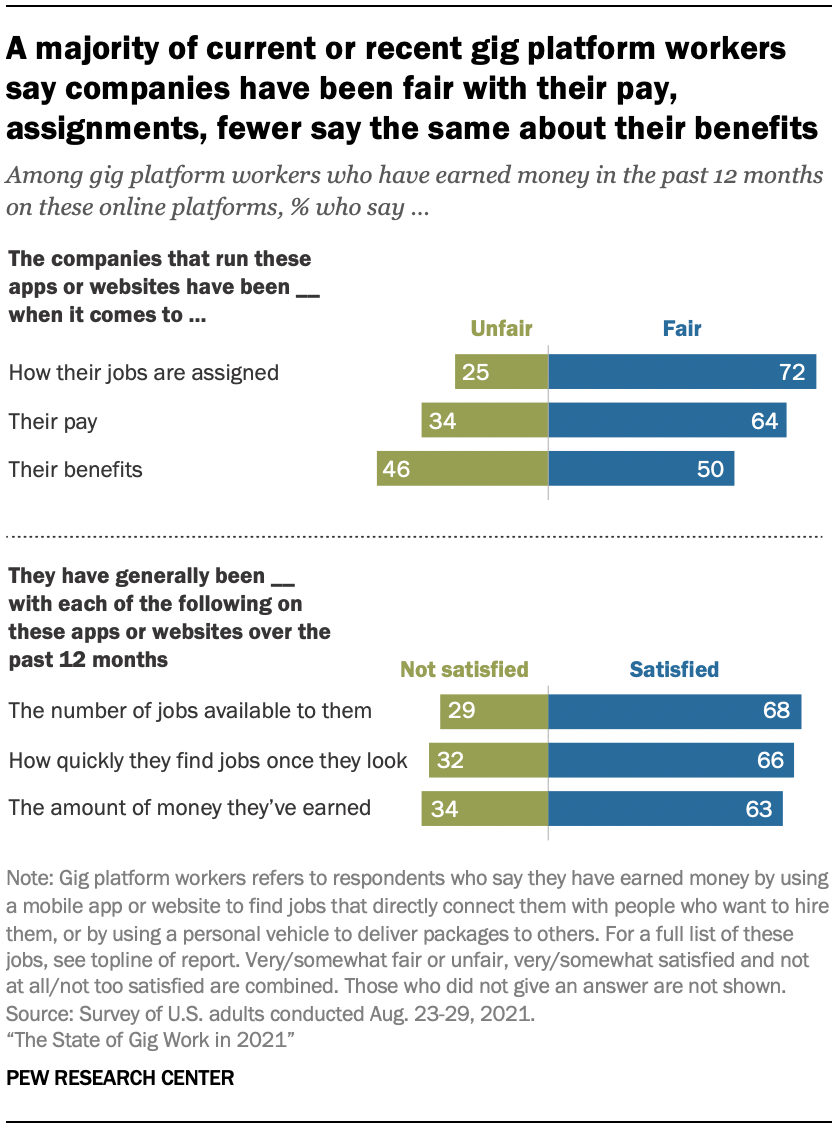
Research cited by the Government Accountability Office, Pew and the International Labour Organization shows that people outside conventional employment often have weaker access to benefits and protections. Other reports on platform work describe low pay once expenses are counted, limited benefits, and workers taking on the risks of insurance, payroll taxes and fluctuating customer demand. Some of that evidence comes from labor-policy groups and surveys, so it should be read with care, but the broader concern is well established.
The case becomes particularly strong where a platform acts much like an employer. The U.S. Labor Department says a worker’s label in a contract is not decisive. Instead, it considers such issues as who controls working conditions, whether workers can truly make independent profits or losses, how much they invest in their own business, how permanent the relationship is, and whether their work is central to the company’s business. A driver or courier may be able to decline individual jobs, yet still face significant platform control over pay opportunities and operating conditions. Control and economic dependence, rather than the mere use of an app, are the key tests. 2
Safety and health are another concern. A review of research has linked platform work to workplace hazards, stress, unstable income, algorithm-driven management and weak occupational-health protections. A study in Hong Kong found that flexible access to work often existed alongside limited social protection and exposure to risk. Employment protections could help address these problems. 4
Reclassification would also shift some business risks back to the companies that organize the work, rather than leaving workers to shoulder costs tied to insurance, taxes and unpredictable demand. 3
The case against
The central objection is that gig work is not one thing. Some workers rely heavily on a single platform and have little real independence. Others use apps occasionally, set their own prices or methods, maintain their own client relationships, and operate more like independent businesses. Treating both groups identically could misclassify genuinely self-employed people. 7
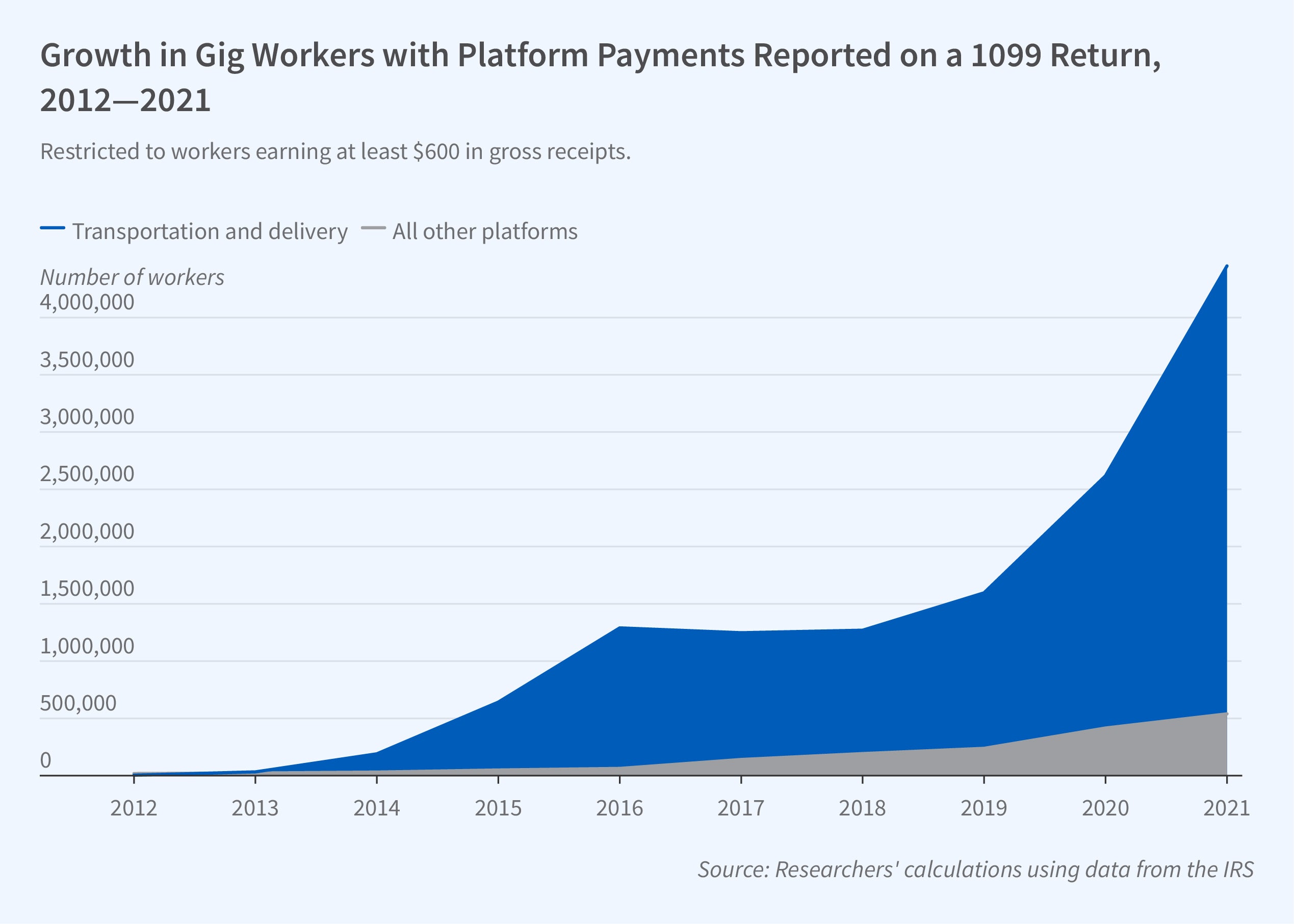
Flexibility is also a real benefit for many participants. Pew survey findings show that workers often value choosing when to work and fitting gigs around family, studies or other jobs. Research summarized by MIT Sloan also suggests that platforms can provide quick income for people who are unemployed or under financial pressure (see Figure 1). A universal employee rule could make some of that low-barrier work less available. 5
There are signs that stricter rules can affect how platforms operate and how much work they offer. Studies of California’s AB5, which tightened rules around contractor status, found changes in worker participation and in the organization of app-based labor. But those studies do not prove that the same result would occur elsewhere. California’s system is unusual, and outcomes can be affected by exemptions, enforcement and wider economic shifts. 6
There are alternatives to making every worker a conventional employee. Portable benefits, individually held accounts and universal social-protection systems could improve coverage while preserving more independence. Yet their success would depend on how they are funded, administered and enforced. Partial systems can also leave uneven coverage and arguments over whether protections are adequate. 8
The bottom line
The evidence strongly supports greater protection for platform workers who are economically dependent on, and materially controlled by, a platform. In those cases, employee status is often justified under the Labor Department’s multi-factor approach, and it addresses well-documented gaps in benefits, security and workplace protection.
But the evidence does not support automatically classifying every app-based worker as an employee. Platform work is too varied, and current research cannot reliably predict how a universal rule would affect jobs, earnings, flexibility, prices or service availability across different places and industries.
The best-supported approach is relationship-specific: classify workers as employees where the facts show real employer-like control and dependence, while assessing genuinely independent businesses separately. The need for stronger protections is clear; the precise effects of any single legal model remain uncertain.
Figures & data

All contributions are reviewed for clarity, balance, and evidence. The strongest insights are elevated into the argument graph — with credit to you.
Help improve this analysis →