Does emphasizing women’s health make the Supreme Court more likely to protect abortion rights?
What's this about?
People disagree about whether talking about women’s health makes the Supreme Court more likely to protect abortion rights. Health facts helped in some past cases, but they do not always decide the result.
What supporters say
- In past cases, health facts helped the Court block rules that lacked real health benefits. (some evidence)
- Medical studies can show that limits on abortion care may harm women instead of helping them. (weak evidence)
What critics say
- The Dobbs ruling shows that health talk does not always predict how the Court will rule. (some evidence)
- The Court has allowed some limits even when doctors disagreed about their health effects. (weak evidence)
How to read this
The number of points on each side does not show who is right; check how strong the evidence is.
The bottom line
Health facts can help protect abortion rights when the Court asks whether rules truly help health. But health talk alone does not reliably decide cases, especially under the Court’s newer approach.
The claim is partly true, but only in certain legal settings. Evidence about women’s health has helped the Supreme Court strike down abortion restrictions in the past, but it does not reliably determine the outcome when the Court uses a different constitutional approach.
The case for
Under the Supreme Court’s former abortion-rights framework, medical evidence could be highly important. The key question was whether a restriction created an “undue burden” on a person seeking an abortion, rather than whether lawmakers simply said it was meant to protect health.
In cases decided under that standard, the Court looked closely at whether restrictions had real medical benefits and whether those benefits outweighed obstacles to care. In *Stenberg*, for example, Nebraska’s ban on a particular abortion procedure was ruled unconstitutional in part because it lacked a health exception. Medical evidence showed the procedure could be safer for some patients. Later, *Whole Woman’s Health* and *June Medical* reinforced the idea that states needed evidence that their rules actually improved health before imposing major burdens on abortion access. Health arguments helped when the Court required states to prove their claims. 1 (some evidence)
Medical research can also give abortion-rights supporters concrete evidence that restrictions may harm, rather than protect, women’s health. The National Academies has found that legal abortion is safe and effective, with serious complications rare. The World Health Organization has warned that unsafe or delayed abortion care can cause substantial illness and death.
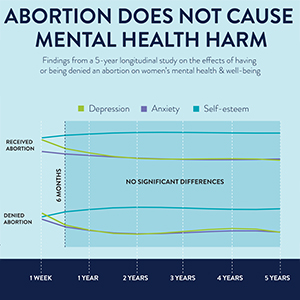
Research from the Turnaway Study found that being denied a wanted abortion did not lead to better mental-health outcomes. Instead, it was linked to greater short-term anxiety and lower self-esteem, as well as worse economic conditions and more difficulty meeting basic needs. These findings can make it harder to argue that restricting access is automatically good for women’s wellbeing. But they do not, by themselves, settle the constitutional question. 2 (weak evidence)
The case against
The clearest problem for the claim is *Dobbs v. Jackson Women’s Health Organization*. In 2022, the Court overturned *Roe v. Wade* and *Planned Parenthood v. Casey*, ruling that the Constitution does not confer a right to abortion and leaving most abortion policy to elected governments.
That decision shows why a health-focused argument is not a stable predictor of Supreme Court outcomes. The *Dobbs* majority treated constitutional text, history and tradition as the controlling issues—not whether abortion restrictions produce better or worse health outcomes. Even strong medical evidence cannot necessarily change the result if the Court chooses a legal test that gives it little weight. 3 (some evidence)
An earlier case, *Gonzales v. Carhart*, points in the same direction. There, the Court upheld a federal abortion restriction despite disagreement among doctors over whether the banned procedure might be preferable for some patients. The majority accepted Congress’s findings and the existence of medical uncertainty, rather than demanding proof that the restriction was medically necessary. The Court can defer to lawmakers even when medical experts disagree. 4 (weak evidence)
There are also limits to the research itself. Studies linking abortion policy to maternal mortality are still developing and vary in their methods, making firm causal conclusions difficult (see Figure 3). The Turnaway Study follows people over time, which is stronger than a simple survey, but it is observational and comes largely from one research program. Medical evidence provides important context; it does not dictate constitutional doctrine.
Most importantly, there is no systematic evidence showing that simply emphasizing women’s health changes Supreme Court votes. The available record shows how justices treated health evidence under different legal rules, not whether a health-based presentation independently caused a different outcome.
The bottom line
The evidence strongly favors a conditional answer, not a blanket one. Emphasizing women’s health made abortion-rights protection more likely during the *Casey*-era undue-burden framework, when the Court demanded proof that restrictions genuinely advanced health. 1
But the evidence does not show that health framing independently predicts protection across Supreme Court abortion cases. *Dobbs* is especially important: it demonstrates that when the Court adopts a constitutional method centered on history and tradition, medical arguments may matter little to the legal result. The case for a conditional effect is well supported by the Court’s decisions; the case that health emphasis alone drives outcomes remains much weaker.
Figures & data
All contributions are reviewed for clarity, balance, and evidence. The strongest insights are elevated into the argument graph — with credit to you.
Help improve this analysis →