DeepSeek-R1-Distill-Qwen-32B is primarily a reasoning model, not a concise everyday assistant
What's this about?
People disagree about whether DeepSeek-R1-Distill-Qwen-32B mainly solves hard problems or works best for daily chats. Its makers built it with deep thinking in mind.
What supporters say
- DeepSeek trained this model on examples that show step-by-step thinking for hard questions.
- Its main tests include tough math, science, and coding tasks.
- The model often gives longer answers because long thinking can help with difficult problems.
- For a short note or simple fact, this extra thinking may use more time and computer power.
What critics say
- A reasoning model does not have to be bad at normal chats.
- The model can help with many kinds of work, not only math or code.
- Users can ask it to give short answers in a clear format.
- We do not have enough proof that it cannot act as a brief daily helper.
The bottom line
The evidence shows that DeepSeek-R1-Distill-Qwen-32B puts hard reasoning first. But that does not mean it cannot give short, useful answers for everyday tasks.
DeepSeek-R1-Distill-Qwen-32B is best described as a model built first for complex reasoning, rather than for short, routine assistant exchanges. But the evidence does not show that it is a poor everyday chatbot—or that it cannot be made concise in practice.
The case for
The strongest evidence concerns the model’s origins. DeepSeek’s R1 family was designed to encourage extended reasoning, using reinforcement learning, and the Qwen-based distilled models were trained on reasoning data generated by DeepSeek-R1. Its model documentation describes it as a DeepSeek-R1 distillation built on Qwen2.5-32B, with prompting and chat formats aimed at eliciting reasoning behavior. That makes reasoning central to the model’s design, rather than an added feature. 1
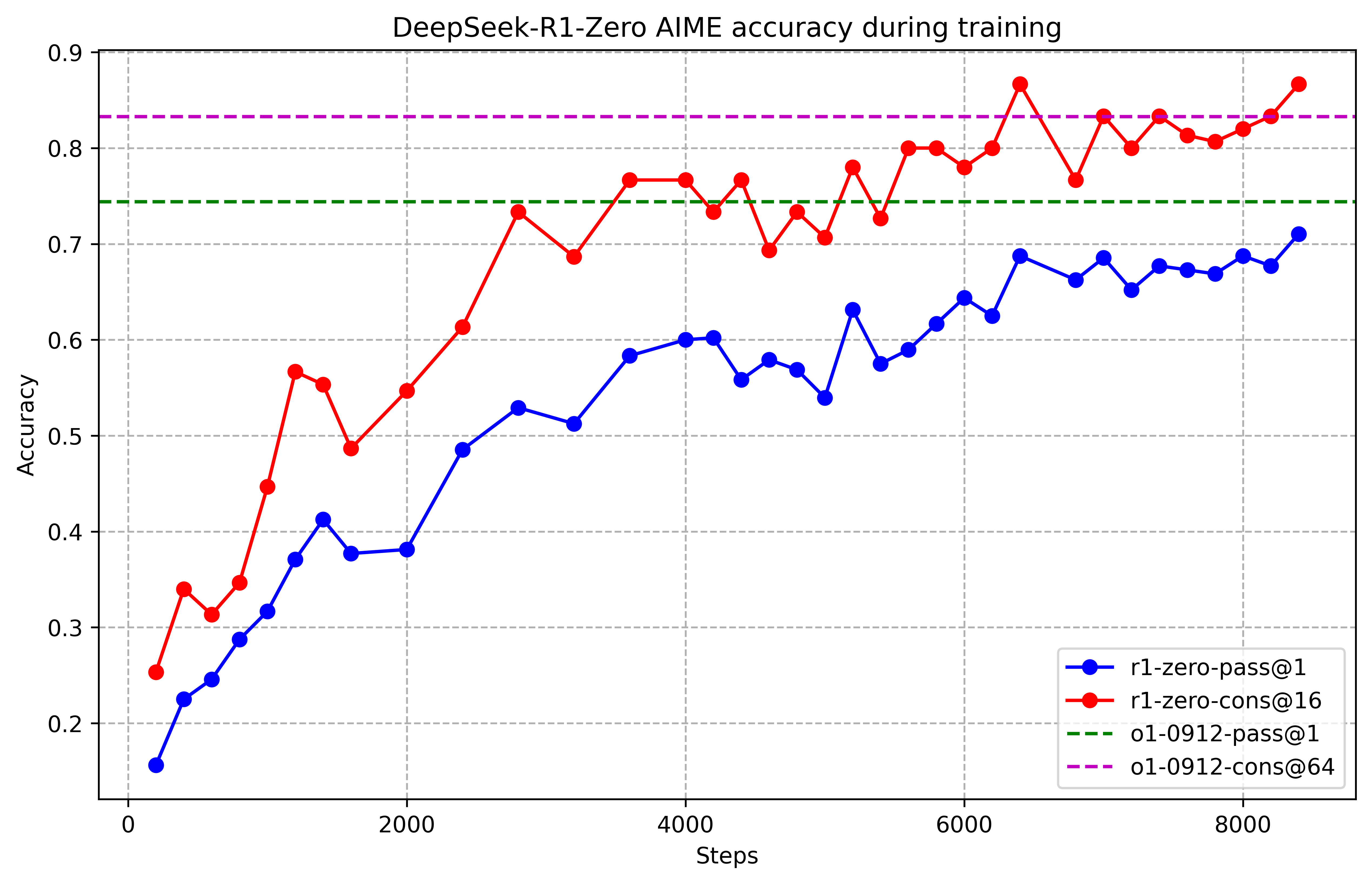
Its headline tests point in the same direction. The published evaluation mix emphasizes hard mathematics, science and coding problems, including AIME, MATH and GPQA. For the 32B distilled Qwen model, the advertised value is its ability to work through difficult questions, not its speed or brevity in ordinary conversation. The technical report also links longer responses with stronger performance on the AIME 2024 reasoning benchmark, suggesting that extended thinking was treated as part of solving demanding tasks (see Figure 1). 1
There is also a plausible practical trade-off. Research on models that use long chains of thought finds that they often produce more tokens, require more computation and behave differently from systems designed mainly to follow direct instructions quickly. That suggests a reasoning-heavy model may be less efficient for simple requests such as drafting a short note or answering a straightforward question. 2
Still, “reasoning model” should not be confused with “narrow specialist.” The model has been assessed across mathematics, coding, scientific reasoning and knowledge-related tasks. It can be useful in more than one domain; its defining feature is the type of work it was optimized to do. 3
The case against
A reasoning-focused training program does not prove that the model performs badly in everyday chat. DeepSeek’s materials also point to broad language and knowledge abilities, but they do not provide controlled comparisons of everyday qualities such as answer length, tone, response time, reliability or user satisfaction. In other words, the evidence strongly shows what the model was built to prioritize, but not whether it is worse than conventional assistants at routine conversation. 4
That missing evidence matters. There is no independent, controlled study comparing DeepSeek-R1-Distill-Qwen-32B with instruction-tuned alternatives on common assistant tasks, under similar settings. Available comparisons with Qwen2.5-32B-Instruct suggest that the two models may have different strengths depending on the task, but their methods are not transparent enough to settle the question of everyday use.
What users see can also depend heavily on how a model is deployed. Prompts, system instructions, stopping rules, token limits and interface design can reduce or hide lengthy reasoning. A checkpoint may be reasoning-oriented underneath while still producing short answers in a consumer product. Training does not entirely determine visible verbosity. 5
Related concerns—such as safety, refusal behavior and conversational reliability—should also be kept separate from reasoning ability. Research has identified limits in safety and refusal performance in the broader DeepSeek-R1 family, while work on long-chain-of-thought systems notes differences in output length and behavior. But neither finding proves that this particular 32B model is worse than every general-purpose assistant on those measures.
The bottom line
The evidence supports the claim in its narrower sense: DeepSeek-R1-Distill-Qwen-32B is primarily a reasoning model. Its training lineage, reasoning-trace distillation and benchmark focus all point clearly in that direction, with high confidence. 1
But it would go too far to say that it is generally a bad or unusable concise everyday assistant. The available record does not directly measure its routine chat performance against relevant instruction-tuned models, and deployment choices can substantially change how verbose it appears. The best conclusion is that DeepSeek prioritized reasoning over maximizing concise routine interaction—not that it necessarily loses every everyday-assistant comparison.
Figures & data
All contributions are reviewed for clarity, balance, and evidence. The strongest insights are elevated into the argument graph — with credit to you.
Help improve this analysis →