Ranked choice voting produces better outcomes than plurality voting

Updated 2026-07-31 5 supporting · 5 opposing arguments
Aldo's Synthesis high
Based on the strength of the Arguments below
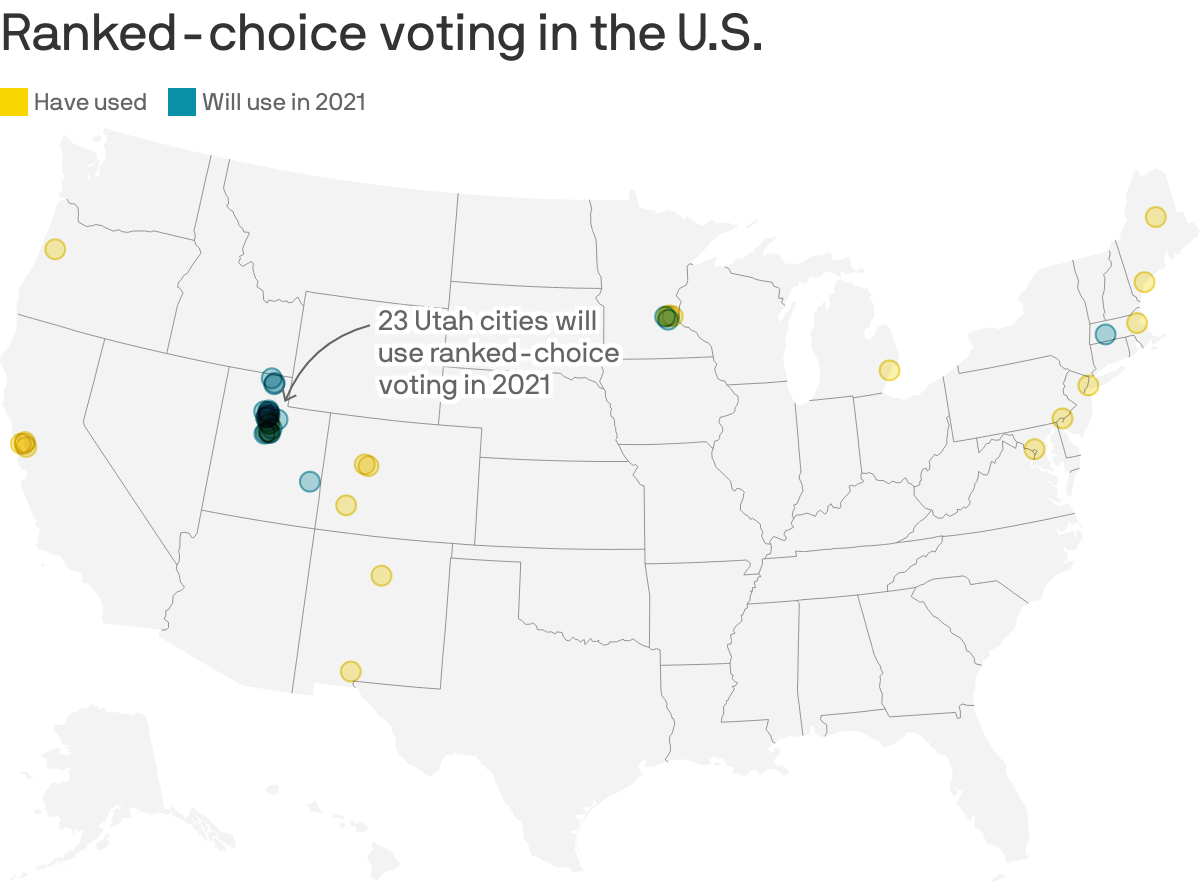
Whether ranked-choice voting produces better outcomes than plurality voting turns on several distinct criteria: representation of preferences, participation, campaign quality, administrative performance, and legitimacy. The comparison therefore cannot be resolved merely by asking whether ranked ballots are more expressive; it must also consider which winner-selection principle is preferred, what electoral arrangement RCV replaces, and whether implementation distributes burdens fairly. The central policy question is whether RCV's capacity to preserve backup preferences and consolidate rounds generally outweighs its risks of ballot exhaustion, unequal error, counterintuitive outcomes, and added administrative demands. RCV's strongest comparative advantage is that it records backup preferences and transfers votes after eliminations, reducing the spoiler role that similar candidates can play under plurality voting. Under plurality, voters who prefer a less competitive candidate may have to choose between expressing that preference and influencing the contest among leading alternatives; RCV permits both choices on one ballot by transferring support when the first choice is eliminated. That mechanism improves the ballot's ability to register contingent preferences and makes vote splitting less consequential, although it does not by itself guarantee selection of the candidate with the broadest head-to-head support. RCV also offers a comparatively clear institutional benefit when it replaces a separate runoff, because an instant runoff can combine the initial choice and later-round decision in one election. This structure can eliminate a second trip to the polls, but its practical advantage depends on local rules, equipment, certification procedures, and the kind of runoff or nomination process being replaced. The benefit is consequently more defensible as a comparison with two-round arrangements than as proof that RCV is administratively superior to every one-round plurality election. The claim that ranked ballots are inherently unusable is contradicted by large-scale ballot-record research finding that most voters successfully cast usable RCV ballots. That research distinguishes harmless skips or duplicate rankings from mistakes that actually invalidate a vote, preventing raw irregularity counts from overstating disenfranchisement. Successful ballot use does not eliminate distributional concerns, but it establishes that additional ranking is generally administrable rather than intrinsically prohibitive. RCV may further improve campaign incentives because candidates can benefit from becoming the second or third choice of rival candidates' supporters, and comparative survey evidence found lower perceived negativity in preferential-voting jurisdictions. Survey-based research also associates RCV elections with greater candidate contact and participation among younger voters, supporting the possibility that broader outreach and a more expressive ballot can encourage engagement. These observational findings support plausible campaign and mobilization benefits, but they do not establish that the voting rule alone caused them. Finally, institutional reviews and election-official research indicate that RCV can be administered successfully across real jurisdictions, even though doing so requires preparation and resources (see Figure 1). Operational feasibility strengthens the case that RCV is a workable alternative to plurality, although feasibility alone does not prove superior electoral outcomes. The strongest challenge to RCV's legitimacy claim is ballot exhaustion: the eventual winner may hold a majority only of ballots still active in the decisive round, not of all ballots originally cast. A study of four local RCV elections found that substantial shares of ballots ceased to count before the decisive round because voters ranked too few candidates or did not rank either finalist. RCV therefore supports a precise claim of majority among continuing ballots, but a broader assertion that every winner commands majority support among all participating voters can be misleading. RCV's additional ballot task can also create unequal risks of confusion, incomplete ranking, and invalid voting across demographic groups. San Francisco studies identified demographic disparities in ranking patterns and overvotes, including higher precinct-level overvote rates in communities with larger African American, Latino, elderly, less-educated, and low-income populations. Separate peer-reviewed research reports that understanding of RCV is unevenly distributed and that confusion can reduce effective use of rankings and political participation. These findings do not show that most voters fail, but they establish an equity concern that aggregate ballot-validity rates can obscure. Instant-runoff RCV can also eliminate a candidate who would defeat every rival head-to-head, so transferred preferences do not necessarily identify the broadest compromise winner. Analysis of cast-vote records from Alaska's 2022 special U.S. House election concluded that Mary Peltola won under RCV even though reconstructed preferences indicated that Nick Begich would have defeated each opponent in a pairwise contest. The case does not uniquely vindicate plurality, which likewise does not guarantee the pairwise winner, but it refutes any general claim that RCV necessarily selects the candidate with widest comparative acceptability. RCV additionally has a counterintuitive mathematical vulnerability: in some configurations, ranking a candidate higher can cause that candidate to lose. The cited mathematical analyses establish the possibility of monotonicity failure rather than its frequency in actual elections, so this objection limits claims of intuitive preference translation more than it demonstrates widespread practical harm. Administration and public reporting are more demanding under RCV than under ordinary plurality tabulation because jurisdictions must address compatible equipment, ballot design, testing, voter education, transfer rules, audits, recounts, certification, and explanation of results. Administrator-focused evidence further documents burdens involving ballot handling, tabulation, communication, and delayed results, while finding that effects on cost and reporting speed vary with state law and existing systems. Any savings from eliminating a separate runoff must therefore be weighed against the transition and continuing costs of administering a more complex tabulation rule. The effect of RCV on participation is conditional rather than generally positive: some research reports mobilization associations, while comparative mayoral analysis finds no consistent turnout increase and possible declines in some contexts. The mayoral evidence is itself difficult to interpret causally because adoption may coincide with other institutional changes and city characteristics. RCV may consequently compare favorably with a separate low-participation runoff yet be neutral or unfavorable relative to a single salient plurality election; the baseline institution is indispensable to the turnout judgment. Campaign civility is likewise a plausible but unsettled benefit: earlier comparative survey evidence found less perceived negativity under preferential voting, whereas a later peer-reviewed reassessment found that the conclusion depends on the cases and measures used. The evidence supports an incentive for candidates to seek later-choice support, but not a demonstrated general reduction in negative campaigning. Implementation quality is a major boundary condition because evidence that most voters cast usable ballots coexists with evidence of unequal confusion and error, while administrator studies identify consequential variation in preparation and capacity. Ballot layout, permitted ranking depth, voting equipment, education, and tabulation capacity affect rejection risk and administrative performance, so results from one jurisdiction need not transfer unchanged to another. Well-designed implementation can mitigate RCV's cognitive and administrative costs, but the evidence does not support treating those costs as either inevitable or negligible. The judgment also depends on the chosen definition of a better winner: RCV prioritizes sequential elimination and transferred rankings, plurality prioritizes first choices, and a Condorcet standard prioritizes head-to-head support. RCV reduces plurality's vote-splitting problem, yet exhaustion and Condorcet failure show that it exchanges rather than eliminates all winner-selection pathologies. The principal evidentiary limitation is not the absence of either side, but the difficulty of isolating voting-rule effects from election type, jurisdictional context, implementation choices, and contemporaneous institutional changes. The bundle does not supply a single common metric that aggregates preference representation, turnout, civility, equity, cost, reporting speed, and legitimacy, so the overall judgment necessarily depends partly on normative weighting. Evidence concerning turnout and civility remains causally limited or conflicting, while evidence about rare mathematical failures identifies possibility more clearly than prevalence. The supplied structural classification also flags unresolved conflict-of-interest classifications, which weakens confidence in source independence even though the substantive evidence spans peer-reviewed analyses, data studies, and institutional reports. More credible causal comparisons across matched jurisdictions, longer-term studies of adaptation, subgroup analyses under different ballot and equipment designs, and standardized measurements of campaign conduct and legitimacy would most directly narrow the remaining uncertainty. On balance, the evidence supports a qualified rather than general verdict: RCV offers real advantages over plurality in preserving backup preferences, reducing spoiler pressure, and replacing separate runoffs, but it has not been shown to improve participation, campaign quality, representation, and legitimacy across contexts. Confidence in that conditional assessment is high because multiple source types converge on both RCV's workable expressive benefits and its implementation-dependent costs, while also documenting exhaustion, equity risks, and possible winner-selection failures. The dominant substantive uncertainty is contextual heterogeneity—especially what system RCV replaces and how well it is implemented—supplemented by unresolved conflict-of-interest classifications in the source bundle.

Supporting Arguments

P1RCV reduces vote splitting and preserves backup preferences
Plurality can allow two similar candidates to divide support, whereas RCV transfers ballots when a voter's first choice is eliminated. This makes a spoiler outcome less likely and lets voters support a preferred candidate without entirely sacrificing influence over the contest between leading alternatives, although it does not guarantee the pairwise-majority winner.
73/100 · Logical Inference
P2Candidates may have incentives to campaign more broadly
Because candidates can benefit from being ranked second or third by their rivals' supporters, RCV provides an incentive to seek support beyond a narrow base. Comparative survey research found less perceived negativity in RCV cities, though later work shows that the civility effect is sensitive to measurement and should not be treated as settled.
73/100 · Direct Evidence
P3RCV can replace a separate runoff election
An instant runoff can identify a winner from one trip to the polls, avoiding the expense and typically lower participation of a second election. Whether this is an improvement depends on the comparison: replacing a separate runoff is a clearer potential benefit than replacing a simple one-round plurality contest.
68/100 · Logical Inference
P4Most voters cast usable ranked ballots
Large-scale ballot-record evidence indicates that most voters successfully use RCV and that many apparent irregularities do not invalidate a ballot. This counters claims that ranked ballots are inherently unusable, while still leaving room for targeted education and better ballot design to reduce unequal error rates.
64/100 · Direct Evidence
P5RCV may encourage mobilization in some elections
Recent research reports positive turnout or mobilization effects under some conditions, and survey evidence associates RCV with candidate contact and youth participation. The evidence does not establish a universal turnout increase, but it supports the possibility that more expressive ballots and broader outreach can improve engagement.
49/100 · Direct Evidence

Opposing Arguments

C1Ballot exhaustion weakens the majority claim
When voters rank too few candidates or none of the eventual finalists, their ballots stop counting in later rounds. Therefore, an RCV winner can have a majority of continuing ballots without support from a majority of all participating voters, limiting claims that RCV always produces a true majority winner.
64/100 · Direct Evidence
C2Complexity can create unequal voting errors
Studies from San Francisco and broader ballot-record research identify demographic disparities in overvotes, incomplete rankings, and rejected ballots. These disparities are not inevitable—equipment, instructions, ranking limits, and education matter—but they create an equity risk beyond the simpler task of selecting one plurality candidate.
89/100 · Direct Evidence
C3Instant-runoff RCV can reject the consensus candidate
RCV eliminates candidates based on first-choice totals rather than asking who can defeat every rival head-to-head. Alaska's 2022 special election provides an empirical case in which the reported pairwise winner was eliminated before the final round, showing that RCV can miss a broadly acceptable compromise candidate.
58/100 · Data Analysis
C4RCV has counterintuitive mathematical vulnerabilities
Instant-runoff voting can violate monotonicity, meaning additional or higher rankings can theoretically hurt a candidate. Such configurations may be uncommon and voters generally cannot exploit them predictably, but the result undercuts claims that RCV always translates preference improvements intuitively.
80/100 · Logical Inference
C5Administration and reporting can become harder
RCV requires compatible tabulation systems, more testing and education, clear rules for ranking errors, and procedures for transferring and auditing ballots. Centralized tabulation or delayed receipt of ballots can also postpone final results, so administrative gains from eliminating runoffs must be weighed against added complexity.
76/100 · Direct Evidence

All contributions are reviewed for clarity, balance, and evidence. The strongest insights are elevated into the argument graph — with credit to you.

Help improve this analysis on ProConWiki →
𝕏 Share Facebook LinkedIn