Companies with stronger sustainability performance achieve superior long-term financial returns
Bottom line (updated 2026-11-14): The evidence favors a narrower idea: strong care for important issues may help a company’s health and earnings. But broad ESG scores do not reliably lead to higher stock returns, so the full claim goes too far.
What's this about?
People disagree about whether companies that care more for Earth and people earn more money over many years.
The evidence supports a smaller claim, not a sure rule for every company.
What supporters say
- Good care for important Earth and people issues can lower costs, risks, fines, and waste.
- Money spent on these goals may help more in the long run than in the short run.
- Lower risks from these issues may help companies borrow money more cheaply.
What critics say
- ESG ratings (scores about Earth, people, and company rules) often measure different things.
- Some risky industries earn higher returns because investors demand more money for taking risks.
- Funds built around ESG scores do not beat other funds in a steady way.
How to read this
The number of points on each side does not show who is right; strong proof matters more than a longer list.
The bottom line
The evidence favors a narrower idea: strong care for important issues may help a company’s health and earnings.
But broad ESG scores do not reliably lead to higher stock returns, so the full claim goes too far.
The claim is that companies with stronger sustainability records deliver better financial results over the long term. The evidence supports a narrower version of that idea, but does not show that broad ESG ratings or labels reliably produce higher returns.
The case for
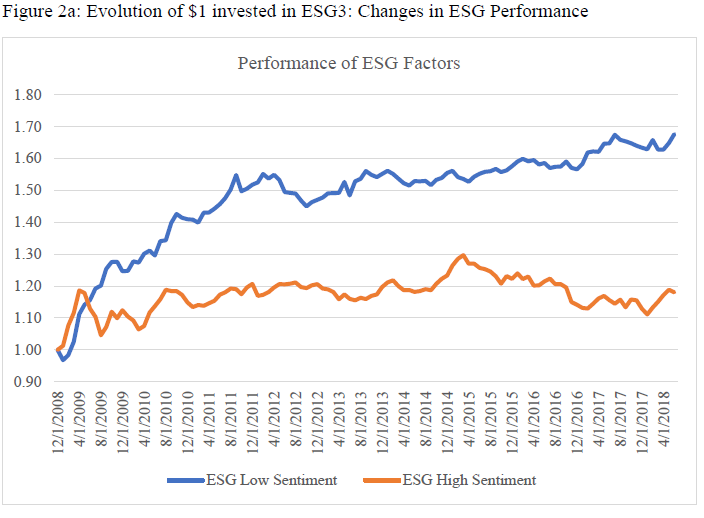
The strongest support is for sustainability practices that address financially important issues in a company’s industry. Research by Khan, Serafeim and Yoon found that companies performing well on material sustainability issues tended to outperform those performing poorly on them, while performance on less relevant issues showed no similar relationship (see Figure 1). The likely explanation is practical: good management of material environmental and social risks can reduce operational, legal, regulatory and transition costs, while improving efficiency and relationships with employees, customers and other stakeholders. 1
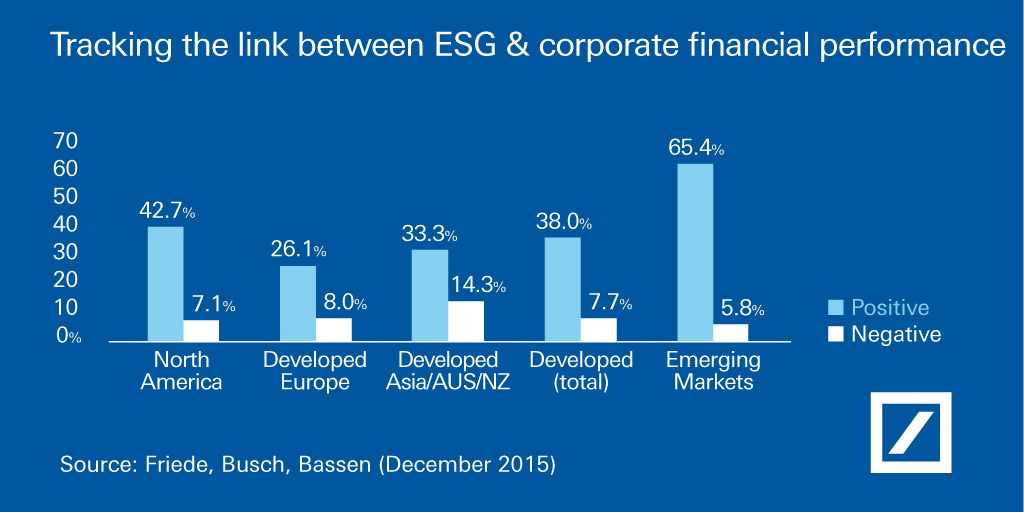
Broader research is also more encouraging at the company level than in investment portfolios. A review of more than 2,000 studies found that most reported non-negative links between ESG and corporate financial performance, although results for portfolios were more mixed (see Figure 3). That distinction matters: a company may become more resilient or profitable without its stock reliably beating a benchmark. 1
Benefits may also take time to appear. Sustainability investments can involve short-term costs but later improve resilience, innovation, efficiency, employee retention and brand value. NYU Stern’s review found that positive relationships were more visible over longer periods. MSCI has also reported links between stronger ESG ratings and lower borrowing and equity-financing costs, although those links could reflect company size, industry, profitability, risk or disclosure quality rather than sustainability itself. 23
The case against
The evidence does not establish a consistent, universal ESG return premium. Morningstar found no dependable performance advantage for ESG funds after adjusting for their exposure to factors such as growth, quality and sector. International studies have produced different results depending on the country, screening method, benchmark and time period. Apparent outperformance may therefore come from portfolio construction, geography, valuation or industry choices rather than sustainability performance itself. 4
Some evidence points in the opposite direction. A study of about 14,400 companies across 77 countries found higher stock returns among firms facing greater carbon-transition risk. Research on alcohol, tobacco and gambling companies also found higher returns than for comparable businesses, partly because social norms limited institutional ownership. These findings do not prove that unsustainable companies are inherently better investments, but they contradict the idea that stronger sustainability must always mean higher raw returns. 5
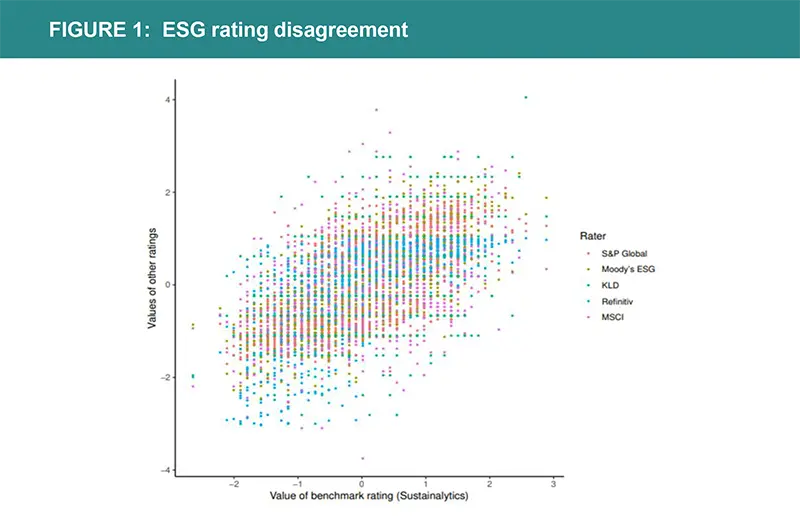
The most serious problem is measurement. Six major ESG rating agencies often disagree substantially because they use different definitions, indicators, weightings and methods for handling data (see Figure 2). An ESG score may therefore measure disclosure, risk exposure, management quality or something else, rather than a single, agreed measure of sustainability. Results can also change depending on the model, sample, controls and definition of “material” issues. 6
That uncertainty makes causation difficult to establish. Profitable, large or well-managed companies may simply have more money to spend on sustainability programs and reporting. ESG-labelled funds may also not follow their advertised processes: the Securities and Exchange Commission fined one asset manager after finding that some funds claimed to consider ESG factors without consistently doing so.
The bottom line
The evidence moderately favours a qualified positive relationship, not the broad claim as stated. Financially material sustainability improvements may strengthen a company’s long-term economics, particularly by reducing risks and improving efficiency. But the evidence is much weaker that broad ESG scores, sustainability labels or ESG portfolios consistently deliver superior long-term shareholder returns.
The central uncertainty is whether sustainability itself causes better performance. Rating disagreement, misleading labels, reverse causation and differences in sectors and investment strategies all make that difficult to prove. The claim is therefore best accepted only after narrowing it: targeted sustainability performance can support stronger long-term company results, but stronger sustainability in the abstract does not reliably guarantee higher financial returns.
Figures & data
All contributions are reviewed for clarity, balance, and evidence. The strongest insights are elevated into the argument graph — with credit to you.
Help improve this analysis →