Arctic resource competition will lead to geopolitical tensions and conflicts
What's this about?
People disagree about whether new Arctic oil, gas, and sea routes will cause more fights between nations. Melting ice makes these things easier to reach.
What supporters say
- The Arctic may hold huge amounts of oil and gas, so nations want control over them.
- These oil and gas amounts remain guesses, but they still make leaders pay close attention.
- More ships may use Arctic sea paths, which can cause more close calls and disputes.
- Russia’s war in Ukraine has raised fear and mistrust between Russia and Western nations.
What critics say
- Oil and gas do not force nations to start wars with each other.
- The Arctic oil and gas stores have not all been found or proven usable.
- Many problems can grow from poor ties between big powers, not only from resources.
- Nations may still use talks, rules, and deals to handle sea borders and ship travel.
The bottom line
Arctic resources will likely add stress to an already tense region. But the facts do not show that resource rivalry will surely lead to war.
Arctic resource competition is likely to add to geopolitical strain as melting ice opens access to oil, gas and shipping routes. But the evidence does not show that a rush for resources will inevitably lead to war between Arctic states.
The case for
The Arctic contains large estimated stores of energy, giving governments a clear reason to compete over access and control. The U.S. Geological Survey estimates there may be about 90 billion barrels of undiscovered oil and 1,669 trillion cubic feet of undiscovered natural gas north of the Arctic Circle. These are not proven reserves or guaranteed future production, but they create strategic interest in maritime jurisdiction, infrastructure and transport routes 1.
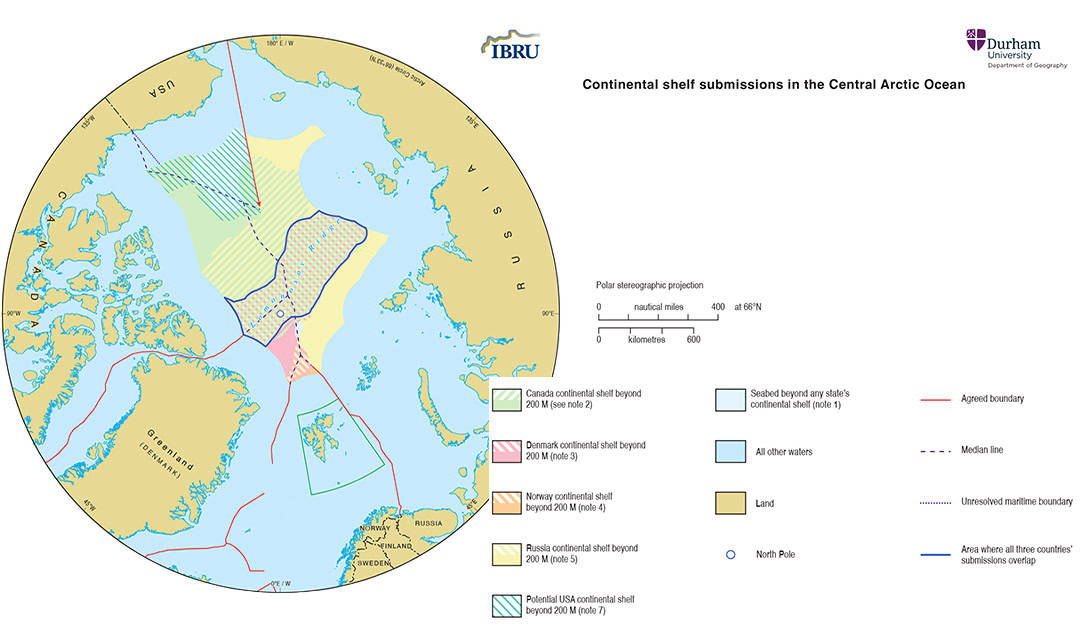
As ice conditions change, more activity at sea could also bring more chances for confrontation. Shipping along routes such as Russia’s Northern Sea Route has changed, while greater traffic creates practical risks: disagreements over authority, closer military monitoring, accidents and coercive encounters. Claims over seabed territory and maritime boundaries provide the setting where questions of sovereignty, resources and access can overlap (see Figure 2) 2.
The wider political climate has made those risks more immediate. Russia’s invasion of Ukraine disrupted Arctic cooperation, isolated Moscow from many regional forums and deepened security concerns between Russia and Western states. The U.S. Defense Department now describes the Arctic as an arena of strategic competition, while Russia’s Arctic policy closely connects economic development to sovereignty, national identity and security 3.
Research on natural resources and conflict offers a further warning, though a qualified one. Resources can increase the risk of violence under certain political and institutional conditions. In the Arctic, they are best seen as a risk multiplier: one factor that can worsen an already difficult relationship among major powers, rather than an independent trigger for conflict 4.
The case against
The Arctic also has a substantial record of settling disputes without military force. Norway and Russia ended their long-running Barents Sea boundary dispute with a 2010 treaty that divided a potentially resource-rich area and included provisions for cooperation. That case shows that even valuable territory can be managed through negotiation rather than confrontation 5.
Regional institutions have also helped Arctic countries handle shared dangers. Arctic Council agreements cover search and rescue, oil-pollution preparedness and scientific cooperation. The Central Arctic Ocean fisheries agreement placed precautionary limits on unregulated fishing in international waters until enough information and management systems are in place. Such arrangements reflect strong common interests in safety, environmental protection and predictable rules 6.
A rapid “scramble” for Arctic oil and gas is far from certain. Extraction remains expensive and technically difficult because of harsh weather, limited infrastructure, environmental dangers, regulatory hurdles and logistical problems. These barriers make headline estimates of Arctic wealth less immediate than they may appear, and weaken the case that states will soon resort to coercion for commercial gain 7.
More broadly, the link between resources and war is not simple. Studies find that outcomes vary by the kind of resource involved, the strength of political institutions and state behavior. Much of the research concerns civil wars or weaker states, not disputes among advanced Arctic countries, so it cannot serve as direct proof that Arctic resources will cause an interstate war 8.
The bottom line
The strongest conclusion is that Arctic resource competition will probably deepen geopolitical tensions and could contribute to localized incidents, particularly as Russia-West relations remain strained. It is much less likely, on the available evidence, to cause a deliberate, large-scale war between Arctic states.
Resources and newly accessible routes matter, but they are not the main explanation for the present breakdown in regional cooperation. Russia’s war in Ukraine and the resulting strategic split between Russia and the West have been more decisive. Climate change and resource access are amplifying those existing tensions, not creating them from nothing.
There is high confidence in this more limited forecast because the evidence points in both directions: genuine strategic pressure on one side, and legal, institutional and commercial restraints on the other. The key uncertainty is whether the legal processes, technical cooperation and communication channels that have contained rivalry in the past can keep operating—or whether wider great-power tensions will erode them further.
Figures & data

All contributions are reviewed for clarity, balance, and evidence. The strongest insights are elevated into the argument graph — with credit to you.
Help improve this analysis →