Americans can support free-trade agreements while supporting protective tariffs
Bottom line (updated 2026-11-12): People can hold both views, but we are not sure how many Americans truly do. The proof is stronger for changing views through job-focused messages than for a large group holding both views over time.
What's this about?
People disagree about whether Americans can favor free-trade deals and tariffs at the same time.
Free trade can mean lower prices, while tariffs can aim to save jobs.
What supporters say
- Messages about saving jobs can change how people feel about trade plans.
- Americans may favor open trade in general but support pressure against one country or field.
- People may want free trade for low prices and tariffs for worker safety.
What critics say
- Party loyalty may explain why some people seem to favor both free trade and tariffs.
- Most polls do not ask the same people about both free-trade deals and tariffs.
How to read this
The number of points on each side does not show which side is right; strong proof matters more.
The bottom line
People can hold both views, but we are not sure how many Americans truly do.
The proof is stronger for changing views through job-focused messages than for a large group holding both views over time.
Americans may be able to support free-trade agreements while also backing tariffs meant to protect domestic workers or industries. But the evidence is stronger for the idea that people respond to different policy frames than for the claim that a large, stable share of Americans consistently holds both views.
The case for
The strongest argument is that people may judge trade policies according to different interests. As consumers, they may want lower prices and access to foreign goods. As workers, they may want protection from job losses. Research suggests these roles can coexist, making it possible to support broad trade agreements while accepting tariffs aimed at a particular industry or labor-market problem 1.
Survey experiments also show that the way trade is presented changes public opinion. Anti-trade information reduced support even when compensation for workers was mentioned. By contrast, pro-trade messages gained support when they emphasized job creation. This suggests that a tariff described as preserving domestic employment could attract support without requiring people to reject trade agreements generally 2.
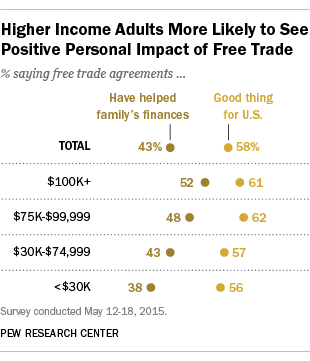
Public opinion surveys show a pattern consistent with this explanation, although they do not prove that the same respondents hold both views. Gallup found that 70% of adults viewed foreign trade positively, while the Chicago Council found majority support for pursuing global free trade. Pew separately reported that 43% believed free-trade agreements had helped their families, even as concerns about U.S. job losses remained (see Figure 1).
Americans may also distinguish between trade in general and pressure aimed at a specific country or industry. Pew found substantial support for taking a tougher economic stance toward China, alongside mixed views about tariffs on Chinese goods. That suggests tariff support can depend on the target and on perceived national or industrial interests, rather than reflecting a general rejection of international exchange 3.
The claim does not require people to believe tariffs are economically successful. Some Americans may support tariffs because they see them as fair, protective or a sign of national solidarity, even while expecting higher prices or broader economic harm. A 2025 survey synthesis found that some respondents supported tariffs while believing they would hurt the economy. Council on Foreign Relations polling found that 41% identified higher prices as the main expected effect.
The case against
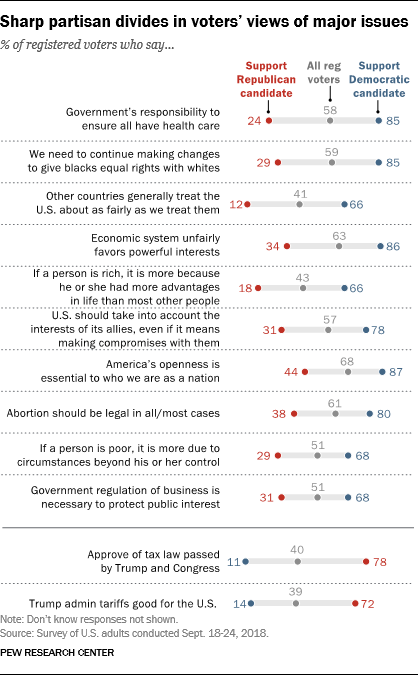
The central problem is that the available evidence rarely asks about both positions in the same survey of the same people. Pew found that 56% viewed free-trade agreements as generally good for the United States, while a separate survey found that 72% of Republican voters, compared with 14% of Democratic voters, viewed increased tariffs as good for the country (see Figure 2). Those results show that both attitudes exist, but they do not show how many individuals combine them 4.
Partisanship offers another explanation. Tariff support is sharply divided by party, and a Chicago Booth Review survey found average support of 2.1 on a seven-point scale among Democrats and 5 among Republicans. What looks like a carefully balanced view—supporting trade but favoring protection in selected cases—could instead reflect political identity or changing political circumstances 5.
There is also a difference between finding a tariff politically understandable and finding it economically effective. Chicago Booth Review summarized evidence that retaliatory tariffs and other trade measures can impose costs on households and exporters. Its discussion of the 2002 steel tariffs concluded that protecting a narrow steel industry put more American jobs at risk elsewhere. A person can therefore support a tariff as protection without the policy actually delivering the promised protection.
The bottom line
The evidence leans toward the claim, but only weakly. It supports the idea that Americans can react differently to broad trade agreements and tariffs framed as targeted protection. The strongest support comes from research on consumer and worker interests, employment framing and policy targets.
But the evidence does not establish how common or lasting this combination is. Most surveys measure support for trade and tariffs separately, leaving open whether the apparent overlap reflects the same individuals or simply different partisan groups. The claim is therefore plausible as a description of conditional attitudes, not strong evidence that Americans widely and consistently support both free trade and protectionist tariffs.
Figures & data
All contributions are reviewed for clarity, balance, and evidence. The strongest insights are elevated into the argument graph — with credit to you.
Help improve this analysis →