Allowing transgender women to compete in women’s sports undermines fair competition
Bottom line (updated 2026-10-22): The evidence supports a concern in some sports, especially those based on strength, speed, power, size, or contact. But the evidence does not support one rule for every sport, event, or level of play.
What's this about?
People disagree about whether trans women should compete in women’s sports.
The key question asks if male puberty can leave body changes after hormone treatment.
What supporters say
- Some effects from male puberty may remain even after treatment lowers testosterone.
- Sports that reward strength, speed, power, size, reach, or body contact may feel those effects more.
- Some studies found fitness gaps between trans women and women after more than one year of treatment.
What critics say
- Research does not show that trans women have one clear advantage in every sport.
- Hormone treatment lowers muscle size, strength, blood levels, and other body traits linked to sport.
- What counts as fair can change by sport and by the level of play.
How to read this
The number of points on each side does not show which side wins; the strength of the proof matters more.
The bottom line
The evidence supports a concern in some sports, especially those based on strength, speed, power, size, or contact.
But the evidence does not support one rule for every sport, event, or level of play.
The debate over transgender women competing in women’s sports turns on a difficult question: whether physical differences linked to male puberty can remain important after hormone therapy. The evidence points to a sport-specific concern, not a universal rule that applies equally to every event and level of competition.
The case for
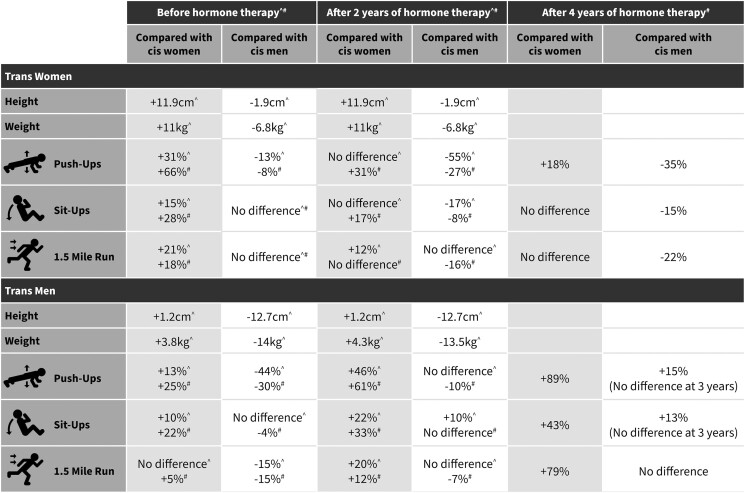
The strongest argument is that some effects of male puberty may persist after testosterone is suppressed. Adult males are typically stronger, faster and more powerful than females with similar training, according to an American College of Sports Medicine consensus statement. Hormone therapy reduces lean body mass, muscle strength, muscle area, hemoglobin and hematocrit, but some measures may remain above cisgender female averages for several years 1 (see Figure 1).
This matters most in sports that directly reward strength, speed, power, size, reach or the ability to withstand contact. A review argues that skeletal, muscular and cardiovascular effects associated with male puberty may not disappear completely after hormone treatment. World Athletics, for example, treats prior male puberty as relevant when setting eligibility rules for elite track-and-field competitions.
Some studies also report performance differences after transition. In one study of transgender military personnel, differences between transgender women and cisgender women persisted after more than 12 months of hormone therapy (see Figure 2). The study measured military fitness rather than elite sports performance, so it cannot show how large any advantage would be in a particular event. Still, it offers more direct evidence of possible residual differences than physiology alone 3.
The concern is therefore especially plausible in events where even a modest physical difference can affect results. Some sports may be more sensitive than others to traits retained from male puberty, though the evidence does not show that this applies equally across all disciplines 2.
The case against
The strongest challenge is that research has not established a universal competitive advantage for transgender women in women’s sports. An earlier systematic review found no direct or consistent evidence of an advantage at any stage of transition, while warning that the available studies were few and often limited in quality. More recent reviews describe the evidence as sparse, varied and difficult to apply across different sports 4.
Hormone therapy also changes several traits that affect performance. Research has documented reductions in muscle mass, strength, muscle area, hemoglobin and hematocrit. One observational analysis found slower running times after hormone therapy, although it did not determine whether a remaining advantage existed 5. Small laboratory studies and retrospective studies cannot, by themselves, establish what happens in elite competition.
There is also a gap between the evidence available and the question policymakers need to answer. Body-composition measurements, military fitness tests and laboratory results do not automatically show how transgender athletes would rank in a specific elite event. At the same time, the lack of consistent evidence does not prove that no relevant advantage exists anywhere, particularly when studies are small or measure outcomes unlike those in competition.
For that reason, the IOC framework and sports-medicine reviews have rejected a single presumption for every setting. They support rules that consider the sport, level of competition, age, transition history, available evidence and proportionality, while also protecting athletes from discrimination 6. Large, long-term, sport-specific studies comparing meaningful competition results remain scarce.
The bottom line
The evidence does not support the claim as a universal proposition that allowing transgender women to compete in women’s sports necessarily undermines fair competition. It does support a qualified concern: restrictions are more plausible in some elite, strength- and power-dependent events than in women’s sports generally.
Confidence is high that sex-linked physical differences and hormone-related changes are real. Confidence is lower about how large any remaining difference is, how long it persists and whether it materially affects results in a particular sport. Overall, the evidence favours a sport-specific and proportional approach, rather than a blanket conclusion for or against eligibility.
Figures & data

All contributions are reviewed for clarity, balance, and evidence. The strongest insights are elevated into the argument graph — with credit to you.
Help improve this analysis →