Americans are becoming increasingly politically divided over whether the United States should support Israel
Bottom line (updated 2026-11-25): Americans seem more divided by party about what U.S. support for Israel should mean. Still, we are not sure this shows a clear end to overall support for Israel.
What's this about?
People disagree about whether Americans are growing more split over U.S. support for Israel.
Surveys show a bigger gap between the two main U.S. parties, but overall support has not clearly collapsed.
What supporters say
- Democrats show more support for Palestinians, while Republicans still show strong support for Israel.
- Americans disagree about the kind of U.S. help they want for Israel and people in Gaza.
- This split also appears among experts who study world affairs, not just among everyday voters.
- The gap began growing around 2019, before the war that began in 2023.
What critics say
- The old agreement about Israel did not last very long, so today’s split may seem bigger than it is.
- Many Americans still support Israel, even though support has fallen in some groups.
How to read this
The number of points on each side does not show which side is right; stronger proof matters more.
The bottom line
Americans seem more divided by party about what U.S. support for Israel should mean.
Still, we are not sure this shows a clear end to overall support for Israel.
The evidence suggests that Americans are becoming more divided along party lines over what support for Israel should look like. But this does not amount to a clear collapse in overall support for Israel, and the conclusion remains tentative because different surveys measure different attitudes.
The case for
The clearest sign of growing division is the widening gap between Democrats and Republicans over whom Americans sympathize with in the Israeli-Palestinian conflict. Gallup’s long-running polling shows Democrats moving toward greater sympathy for Palestinians, while Republicans remain strongly sympathetic toward Israel. More recent declines in overall sympathy for Israel have been driven mainly by Democrats, while Republicans continue to express overwhelmingly favorable views of Israel. 1 (see Figure 1)
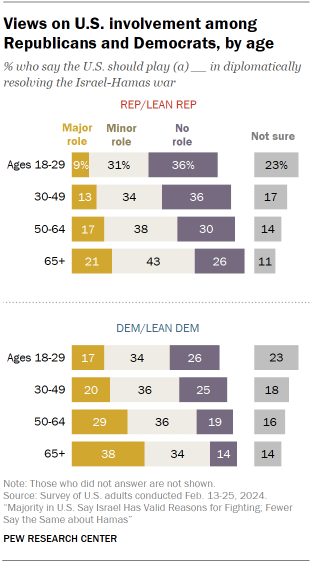
The disagreement is also about policy, not just emotional identification with one side. Americans do not share a single view of what the United States should do. Pew found that 22% supported aid to both Israel and Gaza, about 30% favored only humanitarian aid for Palestinians, 14% favored only military aid for Israel, and 36% favored neither. Chicago Council research likewise found sharp differences by party, age and race over the proper U.S. role. 2 (see Figure 2)
This polarization reaches beyond the general public. A 2024 survey of 471 foreign-policy opinion leaders by the Chicago Council and the University of Texas found strong partisan divisions over policy toward Israel and Gaza. Those divisions broadly resembled the disagreements found among ordinary Americans. 3
The pattern also appears to have begun before the current war. Gallup’s long-term review found that the advantage Israel held in American sympathies began narrowing around 2019, several years before the October 2023 attack. That suggests the change cannot be explained entirely by reactions to the war that followed.
The case against
There is still substantial support for Israel in the United States. One Chicago Council poll found that 60% favored continuing U.S. military support until Israeli hostages were freed. Pew also found that Americans were more likely to view Israel’s reasons for fighting Hamas as valid than Hamas’s reasons for fighting, although those judgments varied sharply by party, age and ideology. 4
The previous bipartisan consensus was also relatively recent, rather than an unbroken feature of American politics. Before the October 2023 war, 74% of Americans described U.S.-Israel relations as good, with Democrats and Republicans expressing similar views. That history cautions against portraying today’s disagreements as a complete and permanent break with the past. 5
The surveys do not all measure the same thing. Favorability toward Israel, sympathy for Israelis, support for military aid, support for humanitarian assistance and views of the overall relationship are separate attitudes. Results can differ depending on the question, the wording and the timing. It remains uncertain how much of the current change reflects a lasting political realignment and how much reflects short-term reactions to wartime events.
The bottom line
The evidence leans toward the claim, but only with low confidence. The strongest evidence shows a real and increasingly visible partisan gap in sympathy toward Israelis and Palestinians, as well as disagreement over military and humanitarian policy. That evidence is stronger than the case that nothing important has changed.
Still, the conclusion should be stated narrowly. Americans have not clearly divided into two evenly matched camps, and broad support for Israel—including support for military assistance—remains substantial. The evidence supports growing partisan divergence over the form and purpose of U.S. support, not a proven, across-the-board collapse in support for Israel. Survey differences and the possibility of event-driven swings leave open whether this is a durable realignment or a change that varies by issue and moment.
Pros — Supporting Arguments
Cons — Opposing Arguments
Figures & data

All contributions are reviewed for clarity, balance, and evidence. The strongest insights are elevated into the argument graph — with credit to you.
Help improve this analysis →