AI infrastructure investment is contributing materially to higher global borrowing costs
Bottom line (updated 2026-10-30): AI spending likely adds some upward pressure to long-term loan costs. But the facts do not yet show that AI caused a large part of higher world rates.
What's this about?
People disagree about whether the AI building boom helps raise the cost of loans worldwide.
The facts show a real link, but they do not prove that AI caused much of the rise.
What supporters say
- AI firms sell many long-term bonds to pay for data centers, which adds more debt for buyers to absorb.
- Funds and firms can hide some AI debt off their main books, spreading loan pressure to firms outside AI.
- AI building now needs so much money that it can affect big money markets, not just a few firms.
What critics say
- Large banks, funds, and other buyers may absorb the new AI debt without much change in loan rates.
- World loan rates also move because of many other big forces, such as inflation, state debt, and central bank choices.
How to read this
The number of points on each side does not show who is right; the strength of each point matters more.
The bottom line
AI spending likely adds some upward pressure to long-term loan costs.
But the facts do not yet show that AI caused a large part of higher world rates.
The claim is that the rapid build-out of artificial-intelligence infrastructure is helping push up borrowing costs around the world. The evidence shows a real financing channel, but it does not yet prove that AI has caused a large share of the rise in global interest rates.
The case for
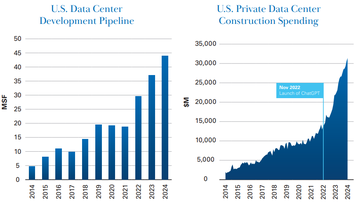
AI infrastructure has become a large, debt-heavy investment cycle. Federal Reserve researchers say spending on data-center structures roughly quadrupled between 2021 and 2025, while more than $1 trillion in future projects has been announced. The Bank for International Settlements, or BIS, also describes the wider AI boom as a major and increasingly debt-financed surge. That scale makes AI financing large enough to matter in capital markets, rather than a minor source of demand for money. But size alone does not show how much it has raised interest rates (see Figure 3). 2
The clearest link to borrowing costs is the sharp increase in long-term debt issued by major technology companies, known as hyperscalers, and related financing vehicles. BIS and CEPR research says hyperscaler bond issuance topped $100 billion in 2025—about five times the yearly average in 2023 and 2024—with much of it issued for the long term. A sudden increase in long-term bond supply can force borrowers to offer higher yields as they compete for investment from pension funds, insurers and other institutions. That provides a credible route from AI construction to higher corporate borrowing costs. 1
The pressure may also spread beyond the companies building data centers. Private-credit funds and special-purpose vehicles can function much like debt while keeping borrowing away from a company’s main balance sheet. BIS analysis says these structures can connect data-center financing to non-bank lenders and to businesses with no direct link to AI. European Central Bank analysts have similarly warned that a large U.S. technology-financing wave could spill into euro-area borrowing costs. Market movements are consistent with some spillover to other corporate borrowers, although they do not prove how much AI was responsible. 3
The case against
The main problem is attribution. Global yields are also shaped by monetary policy, government borrowing, inflation, economic growth and geopolitical risks. The BIS discusses AI’s possible effects on demand, inflation and central-bank policy, but does not isolate its impact on borrowing costs. Russell Investments points to several non-AI reasons for higher yields, and an IMF financial-stability review does not identify AI infrastructure investment as a demonstrated cause of higher global borrowing costs. AI borrowing and high yields occurring at the same time is not enough to establish a material global effect (see Figure 2). 4
Investment spending also does not necessarily raise economy-wide interest rates in proportion to the amount borrowed. Some AI projects may be funded through stock markets, company cash flows or strong investor demand rather than through additional borrowing that significantly strains credit markets. The available studies make this case only provisionally, and some are working papers rather than settled research. This argument is strongest against the word “materially” if it means a large, economy-wide increase—not against the narrower idea that AI financing has affected some credit-market prices. 5
The evidence is also concentrated in U.S. investment-grade corporate bonds and long-term financing. Proposed effects on European and global borrowing costs remain largely analytical projections, not quantified estimates covering government debt, household loans and all major credit markets. Over a longer period, AI’s effects could even move in the opposite direction: greater productivity might raise output and reduce pressure on interest rates. So far, however, clear economy-wide productivity gains from AI have not appeared.
The bottom line
The evidence favours the existence of an AI-related financing pressure, especially in long-term corporate and credit markets. It supports the idea that the AI investment boom is large, debt-intensive and capable of affecting borrowing conditions.
But the evidence is even overall, with low confidence in the claim at its full global scope. No study has yet shown how much of the increase in worldwide borrowing costs is caused by AI infrastructure rather than by monetary policy, fiscal pressures, inflation, growth or geopolitical risk. The financing mechanism is credible; its size, reach and persistence are not yet established.
Figures & data


All contributions are reviewed for clarity, balance, and evidence. The strongest insights are elevated into the argument graph — with credit to you.
Help improve this analysis →