Weakening federal voting-rights protections can mobilize opposition and weaken a dominant party’s long-term electoral advantage
Bottom line (updated 2026-11-08): The evidence shows this could happen, but it does not show that it usually will. Weaker protections might spark a strong reply and reduce a party’s long-term edge, yet that path remains unsure.
What's this about?
People disagree about whether weaker voting-rights rules could hurt a leading party later. The question asks if fewer protections might also spark strong pushback.
What supporters say
- Some voting limits can lower turnout among groups that often back the leading party’s rivals.
- Less federal checking may cause anger that hurts the leading party.
- Weaker rules may lead groups to start sign-up drives, court fights, protests, and turnout efforts.
What critics say
- Most election-law changes may affect turnout too little to change which party controls the government.
- Some limits may keep the leading party’s edge by making it harder for rival voters to take part.
How to read this
The number of points on each side does not show which side is right; look at how strong the proof is behind each one.
The bottom line
The evidence shows this could happen, but it does not show that it usually will. Weaker protections might spark a strong reply and reduce a party’s long-term edge, yet that path remains unsure.
The claim is that weakening federal voting-rights protections could do more than reduce participation: it might also provoke opposition and eventually erode a dominant party’s long-term electoral advantage. The evidence supports that possibility, but only as a conditional and uncertain pathway, not as a predictable result.
The case for
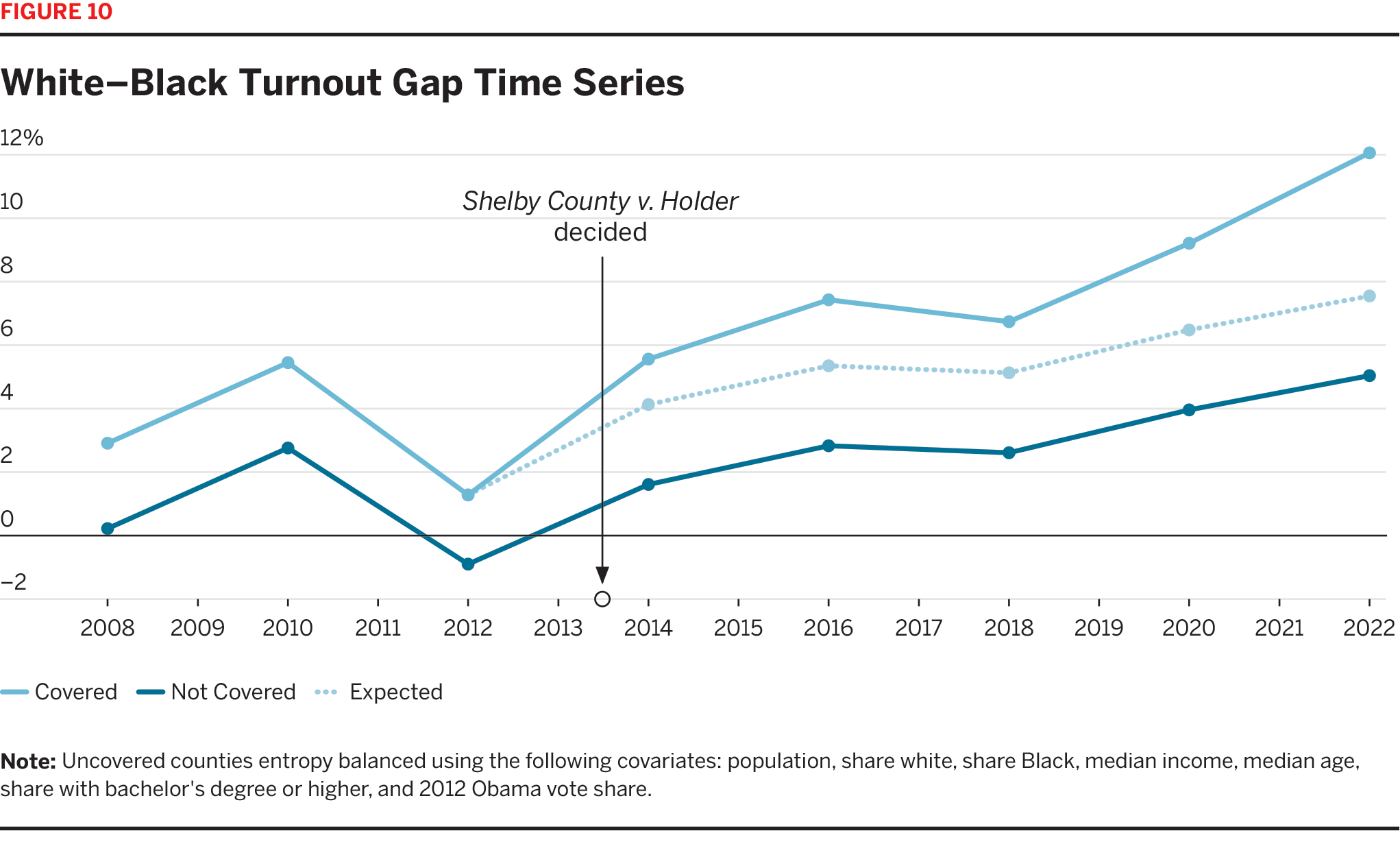
There is strong evidence that some voting restrictions reduce participation among groups that often support the dominant party’s opponents. Studies of *Shelby County v. Holder*, which struck down the formula used for federal preclearance of election changes, found unequal effects on Black and Hispanic ballot access or turnout. Research on strict identification rules and federal oversight has also found participation effects concentrated among some demographic groups. Longer-term research suggests that federal protections can produce lasting increases in minority turnout, making it plausible that removing them could affect political engagement beyond one election. 1 (see Figure 3)
Restrictions can also become a visible political grievance. Opposition groups may respond with voter-registration drives, lawsuits, protests and turnout campaigns. Historical research on Voting Rights Act enforcement found not only greater Black political empowerment but also increased white political mobilization, showing that voting-rights changes can generate organized reactions rather than simple withdrawal. 2 Evidence that competitiveness and campaign activity influence turnout further supports the idea that organization could magnify the political consequences of a restriction, though it does not prove that weakening federal protection generally causes such a response. (see Figure 1)
Federal enforcement can affect representation as well as turnout. Section 2 lawsuits have challenged vote dilution and discriminatory election systems, and one analysis of successful cases found increased Black participation and a smaller racial turnout gap. Together, these findings make the backlash mechanism credible: weakening protections may expose a dominant party to opposition when affected communities and allied organizations view voting access as a major political issue. Reduced federal oversight may therefore create opportunities for backlash, particularly where the affected population is large and politically important. 3
The case against
The strongest objection is that most election-law effects may be too small to change party control. A review of election-rule research found that such policies often affect only a small share of voters, produce limited turnout changes, or reach voters whose partisan preferences are divided. The resulting effects on election outcomes are therefore often small or unreliable. 5
Recent research on strict voter-identification laws has found no consistent overall turnout effect. Some groups appear to be affected in some settings, but those effects vary and may cancel out in the aggregate. The Government Accountability Office likewise found mixed results across studies and jurisdictions, although some comparisons reported larger turnout declines after stricter identification rules, especially among certain demographic groups.
Even when restrictions burden voters aligned with the opposition, the immediate result may be to preserve or increase the dominant party’s advantage—not weaken it. Estimates are also difficult because administrative records and surveys measure identification-law effects imperfectly. Individual studies therefore cannot settle whether restrictions produce a partisan advantage or trigger a backlash. 4
Mobilization does not automatically produce electoral victory. Its impact depends on party preferences, district boundaries, litigation, election competitiveness and counter-mobilization. Historical voting-rights changes mobilized more than one side, so the final partisan effect depends on which response is larger and lasts longer. Studies of *Shelby County* and federal enforcement show effects on turnout or representation, but they do not directly demonstrate that opposition mobilization causes a lasting reversal of party control. (see Figure 2)
The bottom line
The evidence moderately supports the claim as a plausible, conditional mechanism, but it does not show that weakening voting-rights protections generally or predictably damages a dominant party’s long-term advantage.
Confidence is high that voting-rights changes can affect participation and provoke political responses. Confidence is much lower about the direction and durability of their partisan effects. The key question is whether opposition mobilization will outweigh lost participation and counter-mobilization. That is most likely when restrictions are visible, clearly linked to the dominant party, imposed on an electorally important population, and met by organizations capable of turning grievance into votes.
Figures & data

All contributions are reviewed for clarity, balance, and evidence. The strongest insights are elevated into the argument graph — with credit to you.
Help improve this analysis →