Water scarcity will cause more conflicts than oil ever did

Updated 2026-07-29 4 supporting · 4 opposing arguments
Aldo's Synthesis high
Based on the strength of the Arguments below
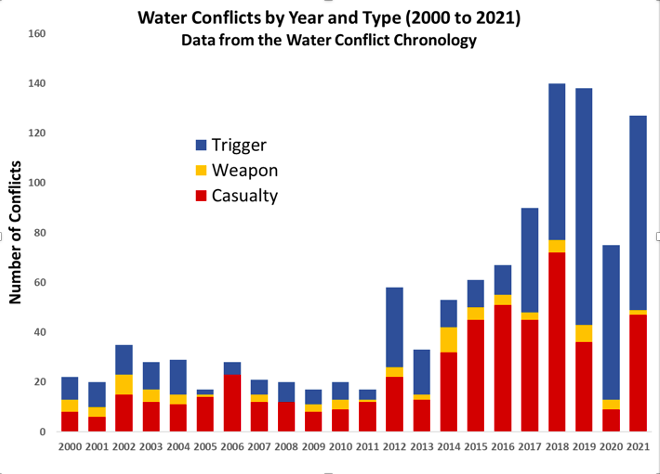
The claim asks whether future water scarcity will cause a greater number of conflicts than petroleum has caused historically, requiring a comparison between a forecast and a historical record. The comparison turns on three questions: what qualifies as conflict, when a resource counts as a cause rather than a background condition, and whether water and oil events are measured using the same unit, severity threshold, and time horizon. The evidence can therefore establish mechanisms, historical patterns, and conditional risks more securely than it can validate the claim's precise numerical comparison. The strongest case for the claim is that intensifying and geographically widespread water insecurity will expose many communities and shared basins to a destabilizing pressure that affects essential services, livelihoods, and interstate relations simultaneously (see Figure 1). The UN water assessment documents growing insecurity and identifies unequal access, deteriorating services, displacement, and climate shocks as pathways through which water conditions can undermine peace. That case is not limited to direct competition over rivers or aquifers: water-related shocks can reduce income in rainfall-dependent economies, damage livelihoods, contribute to displacement, and intensify grievances that feed existing political disputes. Fine-grained research and the IPCC assessment support the existence of water-related conflict pathways while locating their effects in particular seasons, places, conflict types, and socioeconomic settings. A second supporting consideration is the sharp recent rise in recorded incidents in which water appears as a trigger, weapon, or casualty of conflict (see Figure 3). The chronology demonstrates that water is increasingly implicated in recorded violence, although broader coverage and the inclusion of attacks on water infrastructure prevent treating the trend as a clean measure of conflicts caused by scarcity. Historical event research nevertheless finds cooperation more common than acute water conflict, while the natural-resource literature finds a consistent association between oil dependence and civil-war onset, so the observed water trend does not by itself establish that water will overtake oil. The pro case is strongest where hydrological change outpaces institutions: many shared basins lack fully operational cooperative arrangements even though extensive treaties and joint institutions already exist. Governance gaps leave populations exposed to worsening stress and unilateral projects, making conflict more plausible when states cannot negotiate allocations, exchange information, or manage distributive losses. Forward-looking basin risk should thus be interpreted conditionally—through the interaction of stress and institutional capacity—rather than as a projection that scarcity mechanically produces violence (see Figure 2). The strongest challenge is historical: cooperative international water interactions substantially outnumbered acute conflicts in the examined event record, which identified no interstate wars caused solely by water. In that research, rapid physical or institutional change—especially where treaties could not absorb it—predicted tension better than scarcity alone. Global records and institutional assessments likewise show that water relations include negotiations, agreements, and peacebuilding alongside coercion and violence, supporting a model in which shared dependence can create incentives for governance rather than war. More broadly, the synthesis literature rejects scarcity as an automatic or sufficient predictor of violence. Water availability and access can affect violence, but livelihood exposure, inequality, social divisions, governance, adaptation, and prior conflict shape whether stress culminates in instability or is managed without force. Consequently, counting every conflict in a water-stressed setting as caused by scarcity would conflate a contributing risk factor with a singular cause. Methodological disputes further weaken a simple extrapolation from rainfall or drought trends to a global count of future conflicts. A reanalysis found an influential rainfall-growth-conflict estimate not robust to alternative measures and specifications. Later fine-grained analysis found rainfall effects that vary by conflict type, season, location, and socioeconomic context, which is evidence for heterogeneous mechanisms rather than a universal scarcity-to-war relationship. Water must also surpass a substantial petroleum baseline: oil research identifies pathways involving territorial claims, interstate disputes, separatist rebellion, authoritarian institutions, corruption, and the distribution of prospective rents. The oil effect is itself conditional: geography, claimability, institutions, discovery location, pre-existing instability, and rent distribution influence whether petroleum generates conflict. Restricting the oil comparator to wars openly described as fights for petroleum would omit indirect institutional, separatist, rent-based, and territorial pathways recognized in that literature. The best-supported interpretation is that water scarcity acts as a threat multiplier whose effects depend on exposure, social divisions, governance, adaptation, and existing conflict, rather than as an independent and deterministic cause of war. Under this model, scarcity can contribute to livelihood loss, migration, instability, or communal violence in vulnerable settings, while effective management can redirect the same pressure toward adaptation and peacebuilding. The claim is therefore more plausible for particular vulnerable regions and for a broad category of conflictual interactions than as a categorical forecast of future wars worldwide. Institutions condition both sides of the comparison: shared waters often generate treaties and joint bodies, whereas claimable oil discoveries can encourage territorial demands and interstate conflict. Accordingly, neither physical scarcity nor resource abundance alone determines outcomes; institutional capacity and the political feasibility of appropriating gains or imposing losses are central boundary conditions. The answer also changes with the attribution rule: water records can include diplomatic disputes, water used as a weapon, and damaged infrastructure, while oil research includes civil-war, institutional, separatist, and interstate pathways that may not be labeled wars for oil. A broad event definition could enlarge the water numerator, whereas a broad causal definition could enlarge the petroleum baseline; without symmetrical coding, a numerical ranking would reflect classification choices as much as resource effects. The principal gap is the absence of a harmonized comparison that applies one definition of conflict, one causal-attribution rule, one severity threshold, and one time horizon to future water events and historical oil events. The bundle contains mechanisms, reviews, event datasets, institutional assessments, and historical associations, but no directly comparable estimate of the two totals specified by the claim. Recorded trends are additionally vulnerable to changes in media coverage, event coding, and the inclusion of water as a trigger, weapon, or casualty, while indirect oil pathways create a different attribution problem. The future side of the comparison is also structurally uncertain because exposure does not determine how adaptation, institutions, population patterns, infrastructure, and political choices will evolve. Methodological disagreement over rainfall-based causal estimates further limits extrapolation from observed shocks to worldwide future counts. The unresolved conflict-of-interest classifications identified in the structural assessment remain an additional, though less substantive, uncertainty in evaluating the assembled sources. On the current evidence, the categorical claim is not established: future water scarcity is credibly a growing and sometimes serious conflict multiplier, but the record does not show that it will cause more conflicts than petroleum has caused historically. Confidence is high in the narrower judgment that scarcity is conditional rather than deterministic and that oil's comparison baseline includes substantial direct and indirect conflict pathways. The dominant uncertainty is not whether water stress can contribute to conflict, but whether future water events and historical petroleum events can be counted and causally attributed on a common basis; until that problem is resolved, the proposed ranking remains indeterminate.

Supporting Arguments

P1Climate change is expanding exposure to destabilizing water stress
Water insecurity is expected to affect more people as climate change alters droughts, precipitation, snowpack, and supply reliability. Because water is indispensable to households, agriculture, energy, and ecosystems, simultaneous shocks can amplify livelihood loss, displacement, and political grievances across many regions, creating more opportunities for conflict even when scarcity is not the sole cause.
74/100 · Logical Inference
P2Observed water-related conflict incidents have risen sharply
The Water Conflict Chronology records a strong recent increase in incidents where water was a trigger, weapon, or casualty, and newer global datasets likewise document conflictual water interactions. If worsening scarcity combines with population growth and inadequate governance, that upward trend could continue, though these records do not establish scarcity as the cause of every incident.
50/100 · Data Analysis
P3Rainfall shocks can translate into violence through economic loss
Research in rainfall-dependent economies finds pathways from adverse precipitation and economic shocks to increased civil-conflict risk. This supports the claim where agriculture and pastoral livelihoods are exposed, although later reanalysis and fine-grained studies show that the relationship varies substantially by specification and context.
62/100 · Direct Evidence
P4Weak water institutions leave dangerous governance gaps
Many transboundary waters still lack fully operational cooperative arrangements, while changing supply and new infrastructure can shift costs across borders. Scarcity may be especially destabilizing when states cannot negotiate allocations, share data, or compensate affected communities, suggesting future conflict depends partly on whether governance keeps pace with hydrological change.
75/100 · Logical Inference

Opposing Arguments

C1Water cooperation is historically more common than water war
Historical event research finds cooperative water interactions substantially outnumber acute conflicts and identifies no interstate wars caused solely by water in the examined period. Shared dependence can create incentives for treaties, information exchange, and joint infrastructure, so greater scarcity need not produce more warfare.
67/100 · Direct Evidence
C2Scarcity alone is a poor predictor of conflict
Systematic reviews and the IPCC conclude that water stress usually interacts with inequality, exclusion, state capacity, livelihood dependence, and existing violence. A deterministic count attributing future conflicts to water would therefore confuse a contributing risk factor with a singular cause.
100/100 · Expert Opinion
C3Prominent scarcity-conflict estimates are not fully robust
The influential rainfall-shock evidence was challenged by a reanalysis using alternative rainfall measures and empirical specifications. More recent localized research also finds heterogeneous effects, weakening any simple extrapolation from drought trends to a global number of future wars.
77/100 · Direct Evidence
C4Oil already has a large and well-documented conflict legacy
Research links petroleum dependence and geographically claimable discoveries to civil-war onset, separatism, territorial claims, and interstate disputes. Because oil also affects conflict through rents, authoritarian institutions, and state financing, counting only wars openly labeled as being 'for oil' would understate the historical comparison water must exceed.
78/100 · Direct Evidence

All contributions are reviewed for clarity, balance, and evidence. The strongest insights are elevated into the argument graph — with credit to you.

Help improve this analysis on ProConWiki →
𝕏 Share Facebook LinkedIn