Voters’ assessments of the economy influence midterm choices more than their views on foreign policy or the president’s performance
Bottom line (updated 2026-10-16): The economy often matters in midterm votes, but it does not always matter most. The claim goes too far because the president, war, and other big issues can matter as much or more.
What's this about?
People disagree about whether the economy shapes midterm votes more than foreign policy or views of the president.
What supporters say
- In 2022, many voters named high prices, jobs, and the economy as top worries.
- When the economy does well, voters often back the president’s party more.
- When the economy goes badly, voters often punish the president’s party.
- Voters who dislike the economy may also dislike the president and the party in power.
What critics say
- Big issues, such as abortion or threats to democracy, can push money worries aside.
- Some studies show that views of the president matter as much as, or more than, the economy.
- In 2006, anger at President Bush and the Iraq war strongly shaped many votes.
- A foreign crisis can change what the election means to voters.
How to read this
The number of points on each side does not show who is right; the strength of the proof matters more.
The bottom line
The economy often matters in midterm votes, but it does not always matter most.
The claim goes too far because the president, war, and other big issues can matter as much or more.
The claim is that voters’ views of the economy usually shape midterm choices more than foreign policy or opinions of the president. The evidence supports an important economic role, but it does not show that the economy always matters most.
The case for
Economic conditions have a recurring connection to midterm voting. When the economy is doing well, voters generally give more support to the president’s party; when conditions are poor, they tend to punish it. Historical studies also find that the broader economic climate is a regular part of the setting in which midterm elections take shape. 1
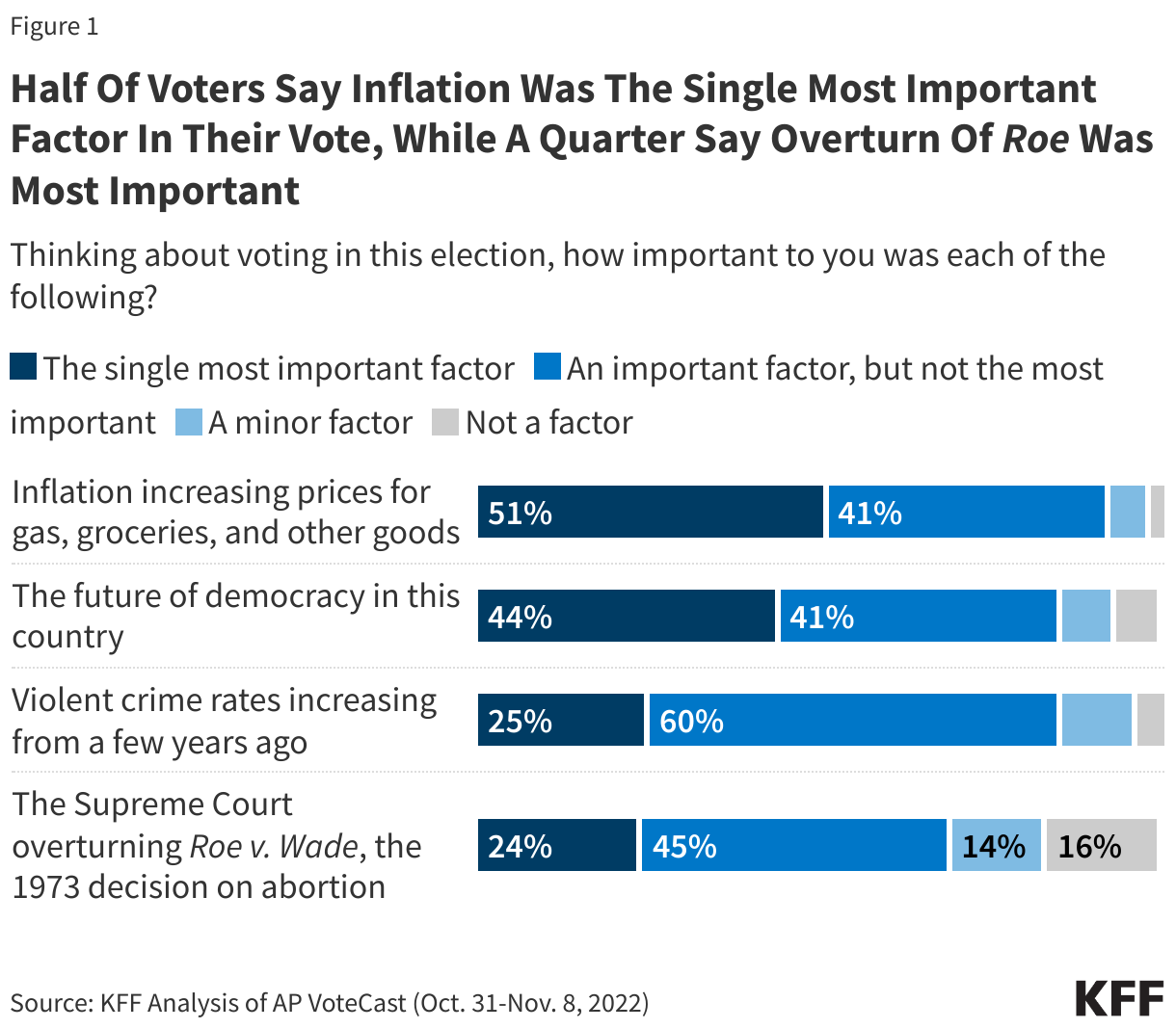
Economic concerns were especially visible in 2022. Surveys placed inflation, rising prices, jobs and the economy among voters’ leading worries, alongside abortion and threats to democracy (see Figure 1). That supports the idea that economic issues are a durable part of midterm politics. But surveys showing what voters say matters most do not prove how much each concern independently changed their vote. 2
Economic judgments may also work through views of the president. Voters who think the economy is poor may become more negative toward the administration and its party. In that sense, economic voting can be one way voters hold the governing party accountable. But this overlap also makes it difficult to separate the effect of the economy from the effect of presidential performance. 3
The case against
The strongest challenge is that presidential approval can be as important as, or more important than, economic conditions. Some election models find that both matter, while other analyses find a clearer link between approval ratings and midterm losses than between economic performance and the vote. 4
The 2006 midterm offers a direct counterexample to any fixed economic ranking. Studies found unusually large effects from voters’ views of President George W. Bush and from the decision to invade Iraq on individual congressional choices. The election was not simply an economic referendum; it was heavily shaped by the war and the administration. 5
Foreign-policy crises can change what a midterm election is about. Research on 2002 argues that the September 11 attacks reshaped an election that had otherwise been partly framed around the administration and the economy. Such events can turn foreign policy into the central test of the governing party. 6
The 2022 election shows how a major domestic issue can also displace economic voting. Despite economic dissatisfaction and low approval of President Biden, Republicans did not win the expected large “wave.” A nationally representative post-election study found that abortion rights played a pivotal role. Inflation still mattered, but its importance coexisted with—and may have been overtaken by—a powerful non-economic issue. 7
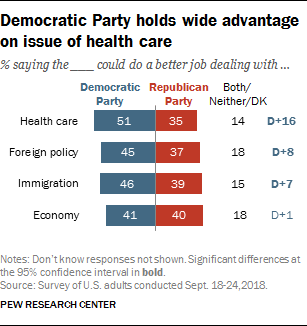
Comparisons are also difficult because the measures are not identical. Some studies examine actual vote choices, others look at overall election results, and surveys record stated concerns or which party voters trust on an issue. Partisan identity may shape both economic opinions and presidential approval, while major events can influence several judgments at once. Voters’ views of which party could handle the economy also differ from their views on health care, foreign policy and immigration (see Figure 2).
The bottom line
The evidence favors a conditional version of the claim, but only moderately. Economic conditions and concerns are a persistent baseline influence on midterm voting, and that general pattern is well supported. However, the evidence does not show that economic assessments always have a larger effect than presidential approval or foreign policy.
In particular elections, presidential evaluations, wars, terrorist attacks or highly salient domestic issues can equal or surpass economic concerns. Because these factors overlap and are often measured in different ways, there is no single, election-proof ranking. The strongest conclusion is therefore that economic voting is durable, not universally dominant.
Figures & data
All contributions are reviewed for clarity, balance, and evidence. The strongest insights are elevated into the argument graph — with credit to you.
Help improve this analysis →