Transferring wartime operational control to South Korea would strengthen the alliance’s deterrence and wartime response
Bottom line (updated 2026-10-16): The evidence does not prove that the change would improve defense or stop an attack. Both sides have reasonable points, but success would depend more on the plan than on who holds command.
What's this about?
People disagree about whether South Korea should lead its own forces during a war.
The change might help, but its success would depend on how leaders carry it out.
What supporters say
- A Korea-led command could give South Korea more duty and make the alliance seem fairer.
- A step-by-step change could keep the two nations’ joint defense strong.
- Local leaders might make faster choices because they know the land and risks best.
What critics say
- South Korea still needs key United States tools, such as spy planes and air power.
- The change might make enemies doubt how strongly the United States would stand with South Korea.
- Two linked command groups might struggle to act as one during a fast crisis.
How to read this
The number of points on each side does not show who is right; stronger proof matters more.
The bottom line
The evidence does not prove that the change would improve defense or stop an attack.
Both sides have reasonable points, but success would depend more on the plan than on who holds command.
The claim is that giving South Korea wartime operational control of its own forces would make the U.S.-South Korean alliance more credible and effective. The available evidence makes that possible, but not proven: the outcome would depend more on how the transfer is carried out than on who formally holds command.
The case for
A Korea-led command could give South Korea greater responsibility for defending its own territory and make the alliance appear more politically legitimate. Aligning wartime authority with South Korea’s sovereignty may strengthen public support and encourage greater national ownership of defense planning. But this is mainly a political and institutional argument. There is no clear evidence that a South Korean commander would deter or fight more effectively than the current arrangement. 1
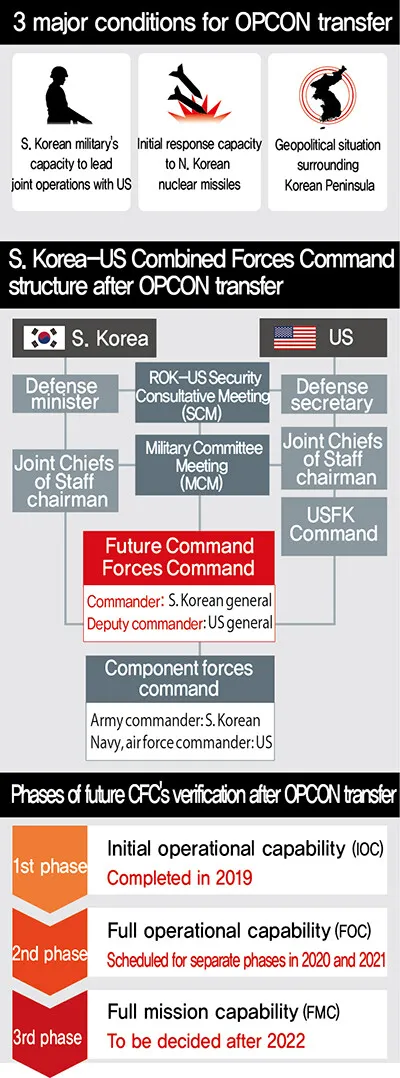
A conditions-based transfer could preserve the alliance’s combined military strength while delivering those political benefits. The transition plan uses staged assessments, ending in a test of whether South Korea can perform the required wartime missions. Combined exercises also examine coordination among South Korean, U.S., United Nations and civilian institutions. These assessments are intended to ensure that authority changes only after South Korea demonstrates the necessary capabilities (see Figure 2). 2
Local control could also make decision-making more responsive because the authority directing South Korean forces would be closer to the territory and political stakes of a conflict. South Korea has a direct interest in maintaining readiness and preparing for war. Still, this remains a reasonable expectation rather than a demonstrated advantage: the evidence does not compare response times or battlefield results under the two command systems. 3
The case against
Changing the formal commander could create friction if it weakens unity of command. In a fast-moving crisis, separate authorities connected through coordination procedures might produce slower or less coherent decisions than a single command structure. The risk would be greatest if integrated planning, communications and decision rules were not fully preserved. 4
South Korea may also hold formal authority without possessing every capability needed to use it effectively. RAND has identified continuing dependence on important U.S. intelligence, surveillance and reconnaissance capabilities as a readiness concern. The Asan Institute has likewise argued that the transition must account for South Korean capabilities and changes in North Korea’s nuclear and missile threats. 5
There is also a signaling risk. North Korea or the American public could interpret the transfer as evidence of reduced U.S. commitment, even if the change only concerns control of conventional forces. That could weaken deterrence if uncertainty grows about whether the United States would continue to provide broader support, including strategic and nuclear capabilities. Transfer therefore could coexist with strong U.S. extended deterrence, but only if both governments clearly preserve and communicate that commitment. 6
The bottom line
The evidence makes the claim conditionally plausible but not established, with low confidence. It favors neither command arrangement as inherently superior. Instead, RAND, Brookings, the Council on Foreign Relations, the Congressional Research Service and the Asan Institute emphasize capability benchmarks, security conditions, continued integration and clear U.S. commitments.
The strongest evidence concerns the design of the transition, its political rationale and the risks that must be managed. Exercises and assessments show preparation and institutional adaptation, but they cannot fully reproduce wartime uncertainty, communications failures or political pressure. There is no comparative wartime evidence showing that a Korea-led command would improve deterrence, decision speed or combat performance.
The transfer would strengthen the alliance only if South Korea meets verified capability standards, integrated command and planning survive, and U.S. extended deterrence remains unmistakable. Formal ownership alone does not establish a military advantage.
Figures & data
All contributions are reviewed for clarity, balance, and evidence. The strongest insights are elevated into the argument graph — with credit to you.
Help improve this analysis →