Supreme Court decisions on mail ballot regulations give an electoral advantage to the Republican Party
Bottom line (updated 2026-08-28): Some tough mail ballot rules may help GOP candidates in certain states and races. But strong proof does not show a steady GOP gain across the whole country.
What's this about?
People disagree about whether Supreme Court rulings on mail ballots help the GOP (Republican Party).
The key question is whether these rulings help GOP candidates across the whole country.
What supporters say
- Tough rules may hurt Democrat voters more when they use mail ballots more often.
- In some states, court rulings may limit voting and help GOP candidates in close races.
What critics say
- Studies show that mail voting usually does not change each party’s share of votes.
- The claim may treat a few state cases as proof of a countrywide trend.
How to read this
The number of points on each side does not show who is right; stronger proof matters more.
The bottom line
Some tough mail ballot rules may help GOP candidates in certain states and races.
But strong proof does not show a steady GOP gain across the whole country.
The claim is that Supreme Court decisions governing mail ballots generally give Republican candidates an electoral edge. The evidence supports a narrower conclusion: some restrictive rulings may help Republicans in particular states and elections, but there is no strong proof of a consistent national effect.
The case for
The strongest argument is state-specific and conditional. If Democratic voters use mail ballots more often than Republicans in a given election, rules that make those ballots harder to submit or count could place a heavier burden on Democratic voters. Restrictions involving deadlines, signatures, witnesses, ballot curing or counting procedures could therefore help Republican candidates in close contests. 1
Research also suggests that experience matters. Voters who have used mail ballots before are less likely to have those ballots rejected. That makes administrative rules important: a shorter deadline or stricter signature requirement may have a greater effect on voters who are unfamiliar with the process. The 2020 litigation record shows that courts repeatedly dealt with these issues, including absentee-ballot deadlines, witness requirements, signature rules, curing procedures and the counting of disputed ballots (see Figure 3).
These cases make the proposed mechanism plausible. Litigation materials document extensive judicial intervention, while analysis of Texas cases describes decisions that restricted or complicated voting access for some voters. In a state where Democrats rely more heavily on mail voting, and where the race is close, such a ruling could produce a Republican gain. But the available sources do not calculate how many Republican votes were gained because of Supreme Court decisions. 2
The case against
The main problem is that evidence about mail voting’s broader partisan effects does not show a predictable Republican advantage. Peer-reviewed studies of universal mail voting in several states, along with research on Colorado’s mandatory mail-voting system, found higher participation but little or no lasting change in partisan turnout or vote share (see Figure 1). These studies do not directly test Supreme Court rulings, but they weaken the idea that changing mail-ballot rules normally benefits one party.
The legal disputes also vary widely. Cases involved different rules, states, election dates and groups of voters. Treating them as one national policy risks turning a collection of unrelated decisions into an unsupported general claim. A ruling affecting disputed ballots in a close Pennsylvania election, for example, may have been important in that contest without proving that the Court’s mail-ballot decisions generally help Republicans. 4
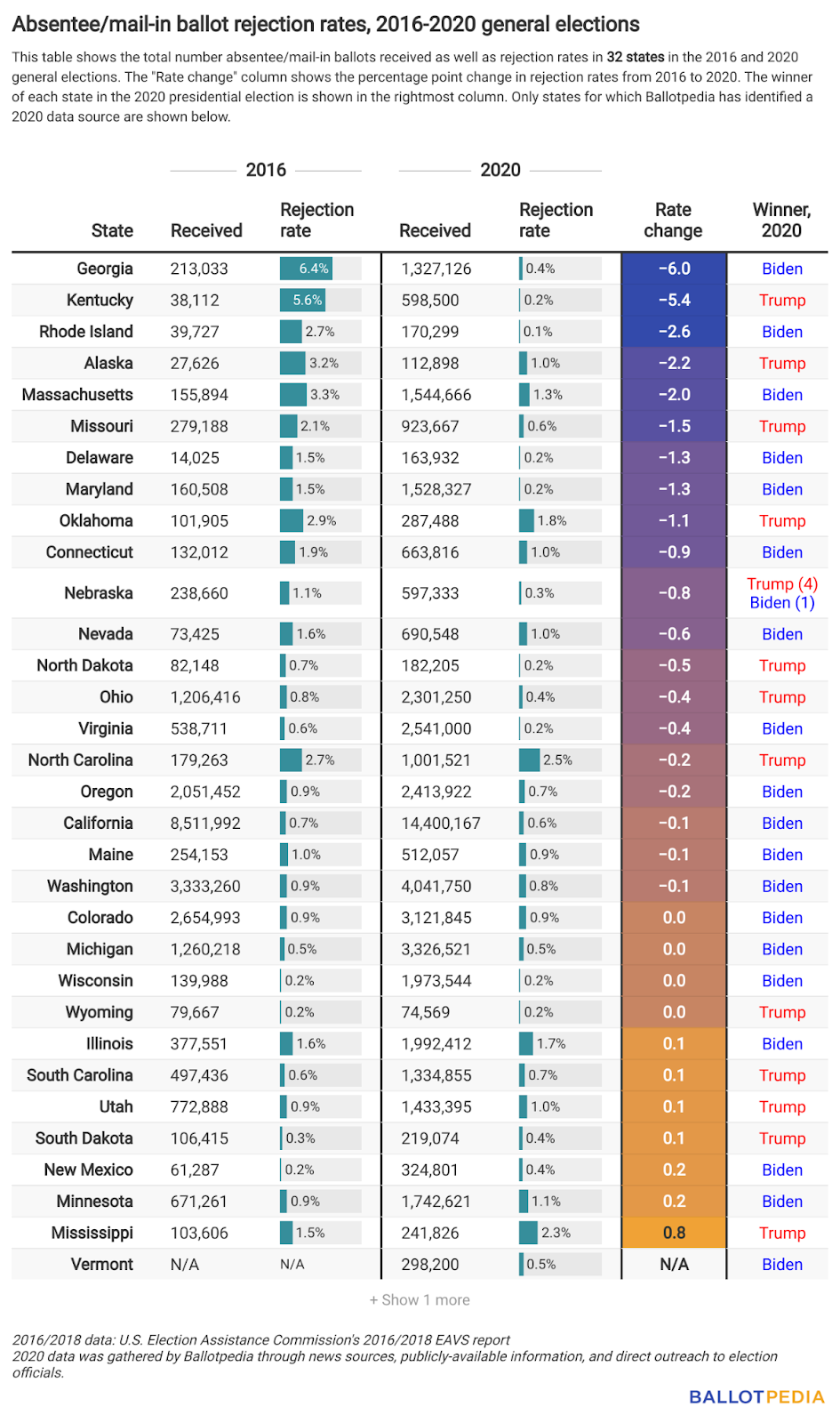
The impact of any ruling can also depend on voter experience, state procedures and how election officials apply the rule. Ballot-rejection research finds that familiarity with mail voting affects whether a ballot is successfully submitted, while rejection rates and differences among voter groups vary substantially across states (see Figure 2). A formal restriction might hurt Democratic voters in one jurisdiction, have little effect in another, or even produce a different partisan result. 3
The central gap is causal evidence. Legal opinions and litigation trackers show what rules changed and identify possible effects. Research on rejected ballots explains how those rules could matter. But there is no pooled, election-by-election estimate showing how many votes each party gained or lost because of Supreme Court mail-ballot decisions.
The bottom line
The evidence does not substantiate the claim that Supreme Court decisions on mail ballots generally advantage Republicans. Confidence in that assessment is moderate.
The evidence more strongly supports a narrower point: particular restrictive rulings can benefit Republicans when they reduce valid or timely ballots disproportionately among Democratic voters, especially in states where Democrats use mail voting more often and elections are close. But those effects are conditional and jurisdiction-specific. The legal record is substantial, while the evidence linking Supreme Court decisions to an overall partisan electoral result remains limited.
Pros — Supporting Arguments
Cons — Opposing Arguments
Figures & data

All contributions are reviewed for clarity, balance, and evidence. The strongest insights are elevated into the argument graph — with credit to you.
Help improve this analysis →