Stronger international climate agreements would significantly cut global greenhouse-gas emissions
Bottom line (updated 2026-11-24): Stronger deals could help nations cut pollution, but the effect is possible, not sure. Current proof shows that past deals have not yet caused large world-wide cuts.
What's this about?
People disagree about whether stronger world climate deals can greatly cut heat-trapping gas pollution. The key question is whether these deals can make nations act.
What supporters say
- Stronger world teamwork could stop free-riding, when nations enjoy clean air while others pay to cut pollution.
- Money, tools, and skills from other nations could make clean energy changes easier at home.
- Past deals may have helped some nations cut more pollution than they would have without those deals.
What critics say
- Many deals do not force nations to keep their promises, so weak action can limit their effect.
- Current promises still fall far short of the cuts needed to slow warming.
- World pollution from heat-trapping gases has kept rising, despite past deals and promises.
How to read this
The number of points on each side does not show who is right; strong proof matters more than a long list.
The bottom line
Stronger deals could help nations cut pollution, but the effect is possible, not sure. Current proof shows that past deals have not yet caused large world-wide cuts.
The claim is that stronger international climate agreements could significantly reduce global greenhouse-gas emissions, even when countries disagree over costs, enforcement and development priorities. The evidence points to a possible but far from guaranteed effect.
The case for
International agreements can produce reductions beyond what might have happened without them. A peer-reviewed study estimated that countries ratifying the Kyoto Protocol emitted about 7% less than a modeled no-Kyoto scenario, suggesting that treaty commitments can influence real-world outcomes rather than simply reflect policies governments had already planned. 1 But Kyoto covered fewer countries and used different rules from the Paris Agreement, so the result cannot be directly applied to a stronger future treaty.
The Paris system has also created a framework for repeated national pledges, reporting, review and rising ambition. Research finds that these arrangements have influenced institutions and domestic policies, although it remains unclear whether they have yet delivered large cuts in global emissions. Agreements are more likely to matter when they include credible incentives or consequences, not just stronger language.
Economic modeling suggests that carbon pricing, border adjustments and “climate clubs” could reduce free-riding. Countries often want the benefits of lower global emissions while avoiding the domestic costs of cutting fossil-fuel use. Linking participation to trade benefits, financial support or penalties could change that calculation and encourage governments to act more strongly. 2 The results, however, depend heavily on the design of those policies and how effectively they are enforced.
International cooperation could also make national action more practical. The IPCC identifies finance, technology access and institutional capacity as important conditions for cutting emissions. The Climate Policy Initiative estimates that annual climate finance would need to reach roughly $8.1 trillion to $9 trillion by 2030, far above current levels. A stronger agreement that reliably provided these resources could help lower-income countries pursue development while reducing emissions. 3
The case against
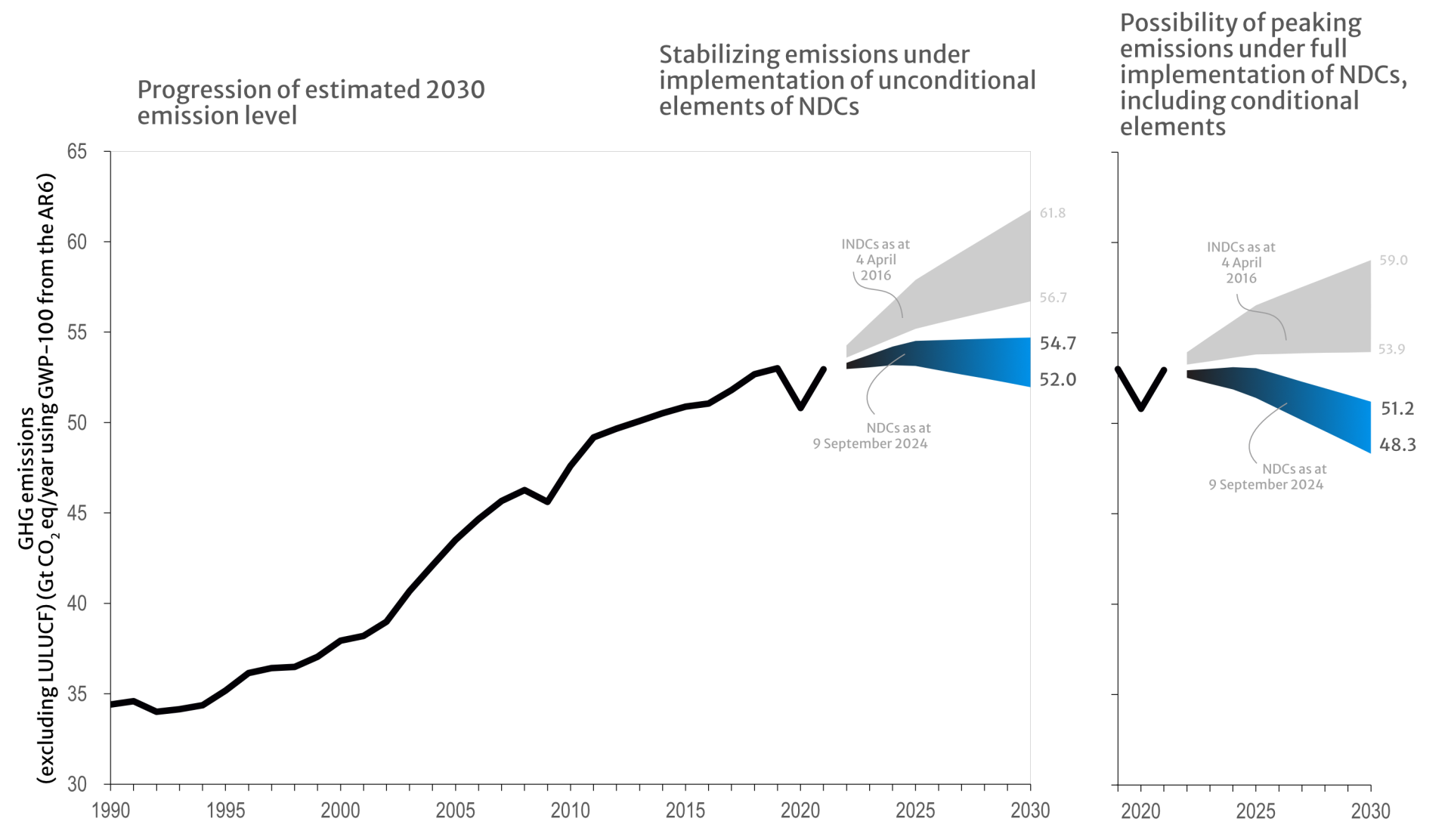
The clearest evidence against the claim is that current international commitments remain far too weak. The United Nations estimates that existing national plans would put 2030 emissions only about 2.6% below 2019 levels. The United Nations Environment Programme projects roughly 2.3°C to 2.5°C of warming this century even if those plans are fully carried out, compared with about 2.8°C under current policies. (see Figure 1) (see Figure 2) These pledges improve the outlook, but not nearly enough to meet the most ambitious climate goals. 4
The Paris Agreement also has limited enforcement power. Compliance is largely designed to be supportive rather than punitive, relying on transparency, review and reputational pressure instead of sanctions. That approach may help countries participate and learn from one another, but it cannot guarantee action when governments change course or prioritize energy prices, economic growth and political survival. 5
Global emissions trends show the same problem. Greenhouse-gas emissions rose an estimated 1.2% in 2023, reaching about 51.8 billion tons of carbon-dioxide equivalent. Energy demand, economic growth and continued fossil-fuel use remain major drivers. This increase does not prove that agreements have had no effect, but it weighs against the idea that international agreements alone have already produced a significant worldwide cut. 6
The bottom line
The evidence slightly favors a conditional version of the claim, not the stronger idea that tougher agreements by themselves would significantly cut global emissions. Kyoto offers a credible example of an agreement associated with additional reductions, and stronger cooperation could address free-riding and provide poorer countries with needed finance and technology.
But the evidence that current commitments remain inadequate and weakly enforced is stronger than the evidence that a hypothetical stronger agreement would deliver a large global cut. The most plausible path combines enforceable incentives, finance, technology transfer, monitoring and durable domestic policies. International agreements can influence national decisions, but they do not determine them.
Overall, stronger agreements are more likely to reduce emissions than no cooperation, but confidence is limited that they would do so on a significant global scale without strong implementation inside countries.
Figures & data
All contributions are reviewed for clarity, balance, and evidence. The strongest insights are elevated into the argument graph — with credit to you.
Help improve this analysis →